
[Paper Review] Returning CP-Observables to The Frames They Belong
This paper proposes a machine learning-based unfolding method to reconstruct CP-observables in their optimal kinematic frames, using conditional normalizing flows (cINNs) to probabilistically map reconstructed detector-level events back to partonic reference frames. The approach enhances sensitivity to CP-violation in the top Yukawa coupling by preserving full kinematic correlations, outperforming classical reconstruction in detecting new physics signals.
Optimal kinematic observables are often defined in specific frames and then approximated at the reconstruction level. We show how multi-dimensional unfolding methods allow us to reconstruct these observables in their proper rest frame and in a probabilistically faithful way. We illustrate our approach with a measurement of a CP-phase in the top Yukawa coupling. Our method makes use of key advantages of generative unfolding, but as a constructed observable it fits into standard LHC analysis frameworks.
Motivation & Objective
- To address the challenge of reconstructing optimal CP-observables—defined in partonic reference frames—when detector-level reconstruction distorts kinematic correlations.
- To improve sensitivity to CP-violation in the top Yukawa coupling by preserving full phase space correlations through a statistically consistent unfolding method.
- To enable integration of such observables into standard LHC analysis frameworks (e.g., ATLAS/CMS) without requiring full reimplementation of analysis chains.
- To demonstrate that generative unfolding via cINNs can outperform classical reconstruction in detecting new physics signals, especially in high-dimensional, correlated observables.
Proposed method
- The method uses conditional normalizing flows (cINNs) to perform generative unfolding, mapping detector-level events back to partonic-level kinematics in the rest frame of the top-Higgs system.
- The network is trained on Standard Model (SM) events to learn the inverse mapping from reconstructed to true kinematics, preserving complex correlations.
- A Bayesian formulation of the cINN enables well-calibrated uncertainty estimates, crucial for statistical validation and model robustness.
- Phase space is parametrized using periodic splines to ensure smooth and physically consistent reconstruction of angular observables like the Collins-Soper angle.
- The approach allows the reconstructed observable to be used directly in standard analysis pipelines, treating the unfolding network as a kinematic reconstruction algorithm.
- Sensitivity is evaluated via chi-squared tests comparing unfolded distributions to parton-level truth, with model dependence tested through cross-training on CP-violating samples.

Experimental results
Research questions
- RQ1Can generative unfolding via cINNs reconstruct CP-observables in their optimal rest frames with higher fidelity than classical reconstruction?
- RQ2How does the sensitivity of the unfolded observable to CP-violation compare to that of classically reconstructed observables in the context of top-Yukawa CP-phases?
- RQ3To what extent does the unfolding method preserve the full kinematic correlation structure necessary for optimal sensitivity?
- RQ4How robust is the unfolding network to model misspecification, such as training on SM-only data while analyzing CP-violating samples?
- RQ5Can the uncertainty estimates from the Bayesian cINN reliably capture systematic biases in the unfolding process?
Key findings
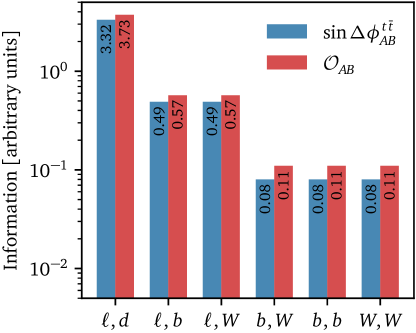
- The generative unfolding approach enhances sensitivity to CP-violation in the top Yukawa coupling, as evidenced by higher chi-squared values compared to classical reconstruction.
- The cINN-unfolded distributions of SM events show excellent agreement with parton-level truth, with deviations well within the Bayesian uncertainty estimates.
- Classical reconstruction performs poorly on certain observables—particularly the Collins-Soper angle—despite being far from the true angle, indicating reconstruction bias.
- The method exhibits only a small, significant model dependence when trained on SM data and applied to CP-violating samples, which can be mitigated via Bayesian iterative refinement.
- The unfolded observable outperforms classical reconstruction in capturing the true sensitivity relations of the underlying CP-phase, especially in high-dimensional phase space.
- The study demonstrates that cINN-based unfolding can be seamlessly integrated into standard LHC analysis frameworks while improving physics reach.
Better researchstarts right now
From reading papers to final review, dramatically reduce your research time.
No credit card · Free plan available
This review was created by AI and reviewed by human editors.