
[Paper Review] Revisiting Emission-Line Measurement Methods for Narrow-Line Active Galactic Nuclei
This study revisits emission-line measurement techniques in narrow-line active galactic nuclei (AGN), focusing on how instrumental spectral resolution affects broad-line width measurements. By comparing high-resolution (Gemini) and low-resolution (Lijiang Telescope) spectra of Mrk 142, it demonstrates that fixing narrow-line flux ratios during spectral fitting reduces artificial broadening in low-resolution data, improving consistency with high-resolution measurements by ~54% in Hβ FWHM.
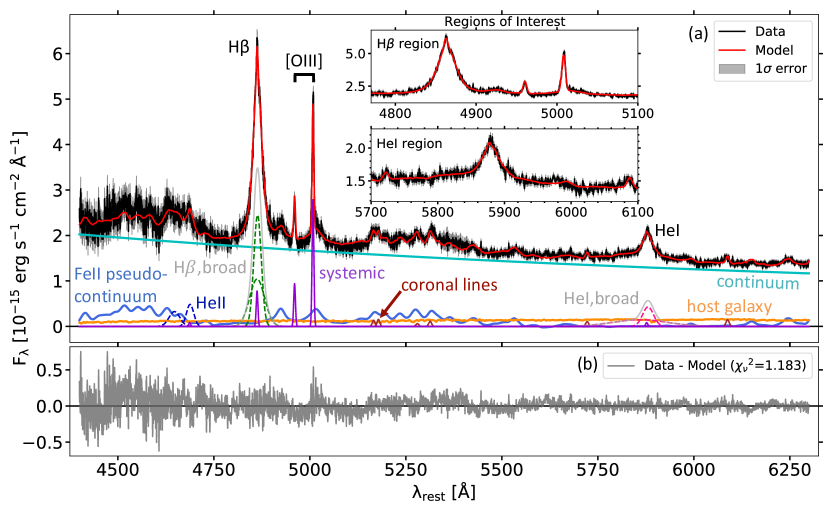
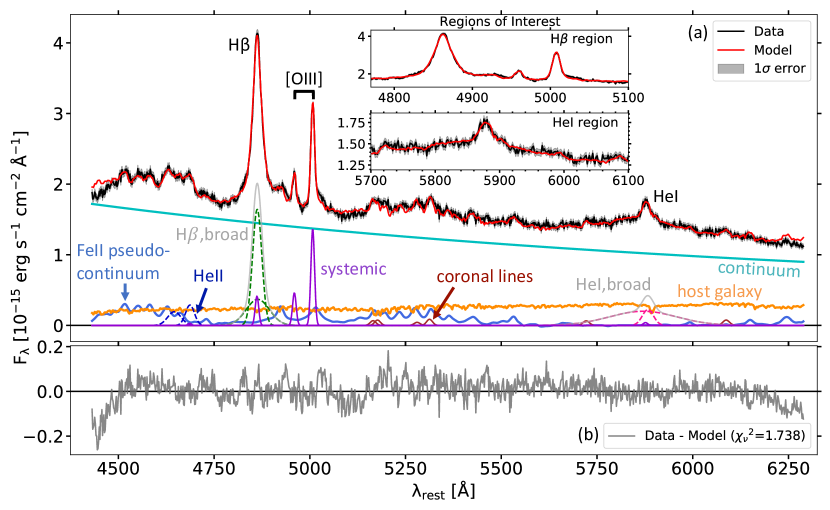
Measuring broad emission-line widths in active galactic nuclei (AGN) is not straightforward owing to the complex nature of flux variability in these systems. Line-width measurements become especially challenging when signal-to-noise is low, profiles are narrower, or spectral resolution is low. We conducted an extensive correlation analysis between emission-line measurements from the optical spectra of Markarian 142 (Mrk 142; a narrow-line Seyfert galaxy) taken with the Gemini North Telescope (Gemini) at a spectral resolution of 185.6+\-10.2 km/s and the Lijiang Telescope (LJT) at 695.2+\-3.9 km/s to investigate the disparities in the measured broad-line widths from both telescope data. Mrk~142 posed a challenge due to its narrow broad-line profiles, which were severely affected by instrumental broadening in the lower-resolution LJT spectra. We discovered that allowing the narrow-line flux of permitted lines having broad and narrow components to vary during spectral fitting caused a leak in the narrow-line flux to the broad component, resulting in broader broad-line widths in the LJT spectra. Fixing the narrow-line flux ratios constrained the flux leak and yielded the Hydrogen-beta broad-line widths from LJT spectra $\sim$54\% closer to the Gemini Hydrogen-beta widths than with flexible narrow-line ratios. The availability of spectra at different resolutions presented this unique opportunity to inspect how spectral resolution affected emission-line profiles in our data and adopt a unique method to accurately measure broad-line widths. Reconsidering line-measurement methods while studying diverse AGN populations is critical for the success of future reverberation-mapping studies. Based on the technique used in this work, we offer recommendations for measuring line widths in narrow-line AGN.
Motivation & Objective
- To investigate how differences in spectral resolution affect emission-line width measurements in narrow-line AGN.
- To identify systematic biases in broad-line width measurements caused by instrumental broadening and flux leakage in low-resolution spectra.
- To develop and validate a correction method that improves consistency between high- and low-resolution emission-line measurements.
- To provide actionable recommendations for accurate line-width measurement in reverberation-mapping studies of narrow-line AGN.
Proposed method
- Conducted a correlation analysis between emission-line measurements from high-resolution (Gemini, 185.6 km s⁻¹) and low-resolution (Lijiang Telescope, 695.2 km s⁻¹) spectra of Mrk 142.
- Used spectral fitting with variable narrow-line flux ratios to identify flux leakage from narrow to broad components in low-resolution data.
- Applied a correction by fixing the Hβ to [O iii] λ5008 narrow-line flux ratio based on high-resolution fits to suppress artificial broadening in low-resolution data.
- Compared FWHM measurements of Hβ before and after correction to quantify improvement in consistency with high-resolution results.
- Employed Sherpa and custom Python/astropy pipelines for spectral reduction, fitting, and error analysis.
- Assessed scatter and bias in FWHM measurements before and after correction to evaluate method robustness.
Experimental results
Research questions
- RQ1How does instrumental spectral resolution affect the measured full width at half maximum (FWHM) of broad Hβ in narrow-line AGN?
- RQ2To what extent does flux leakage from narrow to broad components in spectral fitting distort broad-line width measurements in low-resolution data?
- RQ3Can fixing the narrow-line flux ratio between Hβ and [O iii] λ5008 improve the consistency of Hβ FWHM measurements between high- and low-resolution spectra?
- RQ4What is the impact of unresolved [O iii] λ5008 on Hβ FWHM measurements in low-resolution spectra of narrow-line AGN?
- RQ5How can spectral fitting methods be improved to reduce systematic biases in reverberation-mapping studies of narrow-line AGN?
Key findings
- The Hβ broad-line FWHM measured in low-resolution LJT spectra was ~2220 km s⁻¹, significantly broader than the ~1930 km s⁻¹ measured in high-resolution Gemini spectra.
- Fixing the narrow-line flux ratio of Hβ to [O iii] λ5008 reduced the mean Hβ FWHM in LJT spectra by ~54%, aligning it much more closely with the Gemini measurement.
- The scatter in Hβ FWHM measurements from LJT spectra decreased by a factor of 2.6 after fixing the narrow-line flux ratio, matching the scatter in the high-resolution Gemini data.
- Flux leakage from the narrow to broad component in spectral fitting—caused by an unresolved [O iii] λ5008 line in low-resolution data—was the primary driver of artificial broadening in Hβ FWHM.
- The remaining discrepancy in Hβ FWHM after correction is likely due to unresolved Fe ii emission, indicating a need for better Fe ii template modeling.
- The study demonstrates that combining high- and low-resolution spectra with proper flux ratio constraints enables more accurate and consistent line-width measurements in narrow-line AGN.
Better researchstarts right now
From reading papers to final review, dramatically reduce your research time.
No credit card · Free plan available
This review was created by AI and reviewed by human editors.