
[Paper Review] Revisiting Feature Prediction for Learning Visual Representations from Video
This paper introduces V-JEPA, a family of vision models pretrained only with a feature-prediction objective on 2M videos, achieving strong motion and appearance representations with a frozen backbone and shorter pretraining.
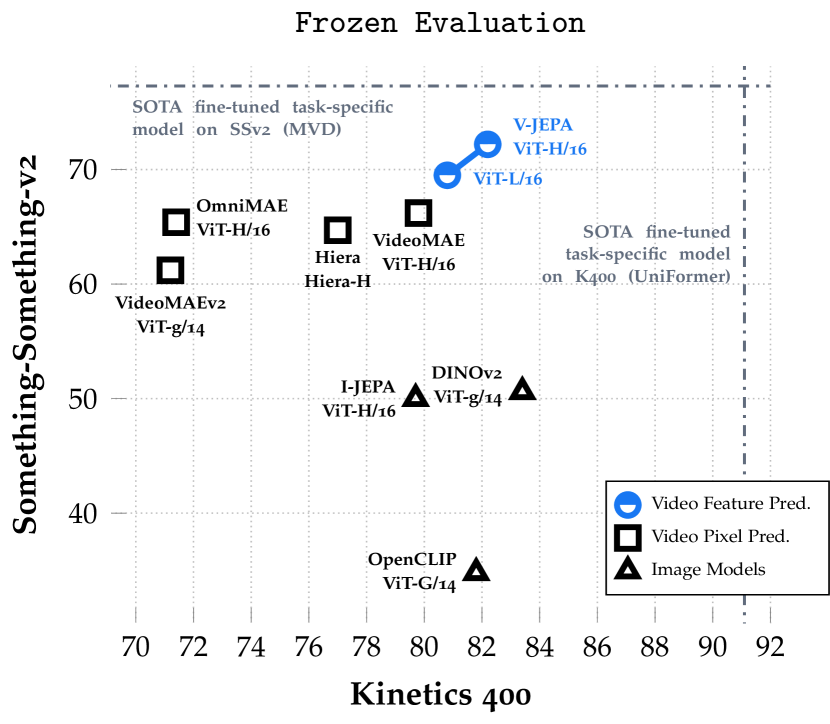
This paper explores feature prediction as a stand-alone objective for unsupervised learning from video and introduces V-JEPA, a collection of vision models trained solely using a feature prediction objective, without the use of pretrained image encoders, text, negative examples, reconstruction, or other sources of supervision. The models are trained on 2 million videos collected from public datasets and are evaluated on downstream image and video tasks. Our results show that learning by predicting video features leads to versatile visual representations that perform well on both motion and appearance-based tasks, without adaption of the model's parameters; e.g., using a frozen backbone. Our largest model, a ViT-H/16 trained only on videos, obtains 81.9% on Kinetics-400, 72.2% on Something-Something-v2, and 77.9% on ImageNet1K.
Motivation & Objective
- Motivate unsupervised visual representation learning from video using a stand-alone feature prediction objective.
- Develop a JEPA-based framework that predicts target representations from source representations without pretrained encoders or pixel reconstruction.
- Evaluate how feature-prediction pretraining transfers to downstream image and video tasks under frozen and fine-tuning settings.
- Analyze design choices (masking, data distribution, pooling) that influence performance in video-based representation learning.
Proposed method
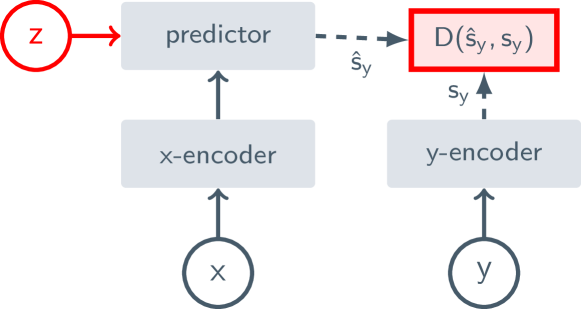
- Adopt a joint-embedding predictive architecture (JEPA) to learn by predicting y from x within video inputs.
- Use a masked feature-prediction task where x is a masked subset of a video and y is the complement target, trained with an L1 loss and stop-gradient/EMA collapse-prevention.
- Represent x and y as ViT-based encoders and a lightweight predictor that operates on masked token sequences with learnable mask tokens.
- Employ a multi-block masking strategy to mask large contiguous spatio-temporal regions, creating a challenging prediction task.
- Evaluate with attentive probing, adaptive pooling, and end-to-end fine-tuning to assess both frozen and finetuned performance.
Experimental results
Research questions
- RQ1How effective is feature prediction, as a stand-alone objective, for unsupervised learning of visual representations from video?
- RQ2Can video-based feature prediction produce representations that transfer well to both motion-based and appearance-based downstream tasks without changing model weights?
- RQ3What design choices (masking strategy, data mixture, pooling) most influence the quality of learned representations from video?
Key findings
- Feature prediction with V-JEPA yields versatile representations that perform well on motion-based tasks (Something-Something-v2) and appearance-based tasks (Kinetics-400) using a frozen backbone.
- Feature-prediction pretraining outperforms pixel-prediction baselines under frozen evaluation and is competitive under fine-tuning, with shorter pretraining schedules.
- Adaptive pooling via cross-attention significantly improves downstream performance over simple average pooling (notably on K400 and SSv2).
- Increasing pretraining data size improves average downstream performance, with task-specific best results achieved by task-tailored data mixes (VideoMix2M generally offers best average).
- V-JEPA demonstrates label efficiency, with larger gaps vs pixel-prediction baselines at lower labeled data regimes.
- Compared to pixel-prediction video models, V-JEPA achieves competitive or superior performance while requiring fewer pretraining samples and less compute.
Read this paper
Open the full text in the Nubint reader and ask about any passage as you read.
Read this paper on NubintThis review was generated by AI from the original paper. Please check the paper before citing it.