
[Paper Review] ReWOO: Decoupling Reasoning from Observations for Efficient Augmented Language Models
ReWOO decouples reasoning from tool observations in augmented language models, dramatically reducing token usage while maintaining or improving accuracy across multi-step NLP tasks, and enabling specialization of reasoning in smaller models.
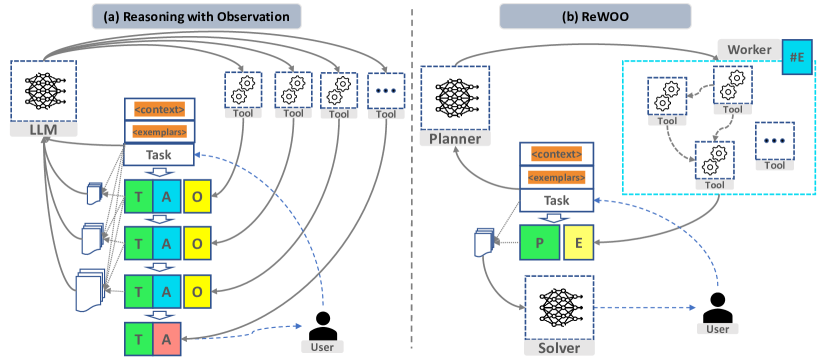
Augmented Language Models (ALMs) blend the reasoning capabilities of Large Language Models (LLMs) with tools that allow for knowledge retrieval and action execution. Existing ALM systems trigger LLM thought processes while pulling observations from these tools in an interleaved fashion. Specifically, an LLM reasons to call an external tool, gets halted to fetch the tool's response, and then decides the next action based on all preceding response tokens. Such a paradigm, though straightforward and easy to implement, often leads to huge computation complexity from redundant prompts and repeated execution. This study addresses such challenges for the first time, proposing a modular paradigm ReWOO (Reasoning WithOut Observation) that detaches the reasoning process from external observations, thus significantly reducing token consumption. Comprehensive evaluations across six public NLP benchmarks and a curated dataset reveal consistent performance enhancements with our proposed methodology. Notably, ReWOO achieves 5x token efficiency and 4% accuracy improvement on HotpotQA, a multi-step reasoning benchmark. Furthermore, ReWOO demonstrates robustness under tool-failure scenarios. Beyond prompt efficiency, decoupling parametric modules from non-parametric tool calls enables instruction fine-tuning to offload LLMs into smaller language models, thus substantially reducing model parameters. Our illustrative work offloads reasoning ability from 175B GPT3.5 into 7B LLaMA, demonstrating the significant potential for truly efficient and scalable ALM systems.
Motivation & Objective
- Motivate reducing token redundancy in tool-augmented LLM workflows by separating reasoning from observations.
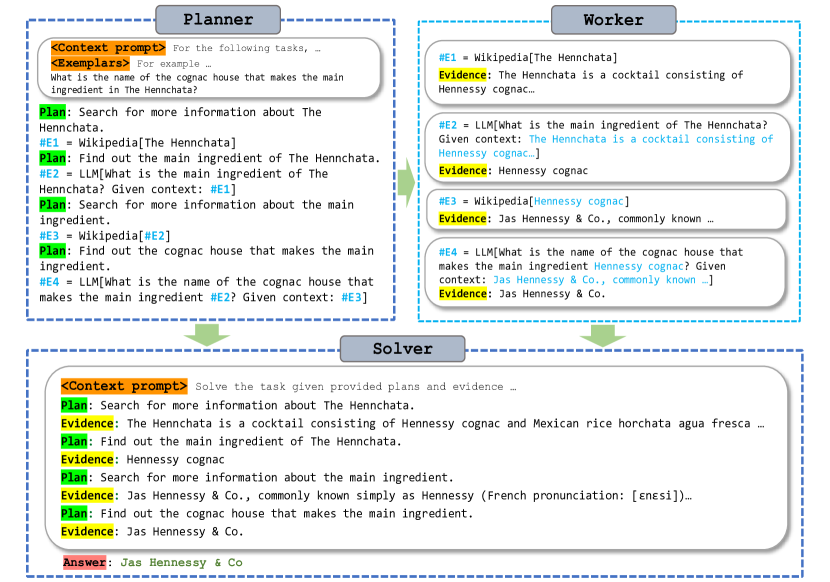
- Propose a modular Planner-Worker-Solver framework (ReWOO) to decouple reasoning from tool feedback.
- Quantify token efficiency gains and accuracy improvements across diverse benchmarks.
- Demonstrate robustness to tool failures and show potential for offloading reasoning to smaller models via specialization.
Proposed method
- Introduce Planner-Worker-Solver architecture to separate reasoning, tool calls, and evidence synthesis.
- Provide formal prompt-token analysis showing reduced token usage compared to observation-dependent prompting.
- Use exemplars and a diverse toolset to enable planning before tool responses.
- Leverage specialization by offloading foreseeable reasoning to smaller LLMs (Planner 7B) via instruction tuning.
- Evaluate with multiple benchmarks (HotpotQA, TriviaQA, GSM8K, StrategyQA, PhysicsQA, SportsUnderstanding, SOTUQA) and GPT-3.5-turbo as a baseline.
Experimental results
Research questions
- RQ1Can decoupling reasoning from observations reduce token cost without sacrificing accuracy in ALMs?
- RQ2How does ReWOO perform relative to ReAct and direct prompting across multi-step NLP tasks?
- RQ3To what extent can foreseeable reasoning be offloaded to smaller models via specialization?
- RQ4How robust is ReWOO to tool failures and extraneous tools?
- RQ5What is the impact of conversation RLHF on performance in this paradigm?
Key findings
- ReWOO reduces token usage by 64% on average across six NLP benchmarks.
- ReWOO achieves an absolute accuracy gain of 4.4 percentage points on average over ReAct.
- On SOTUQA, ReWOO outperforms ReAct by 8% absolute accuracy while using 43% fewer tokens.
- ReWOO maintains robustness under tool-failure scenarios and degrades less than ReAct when tools fail.
- Specialization can enable a 7B LLaMA-based Planner to match 25× larger GPT-3.5 performance on several benchmarks.
- Across benchmarks, ReWOO demonstrates consistent performance with substantially lower prompting cost.
Read this paper
Open the full text in the Nubint reader and ask about any passage as you read.
Read this paper on NubintThis review was generated by AI from the original paper. Please check the paper before citing it.