
[Paper Review] Rewrite Caption Semantics: Bridging Semantic Gaps for Language-Supervised Semantic Segmentation
This paper proposes Concept Curation (CoCu), a three-stage pipeline that bridges the semantic gap in language-supervised semantic segmentation by expanding image captions with missing visual concepts via CLIP-based vision-driven retrieval, text-to-vision-guided ranking, and cluster-guided sampling. CoCu significantly improves zero-shot transfer performance across 8 segmentation benchmarks, achieving a 13.1% average mIoU and outperforming state-of-the-art methods by large margins.
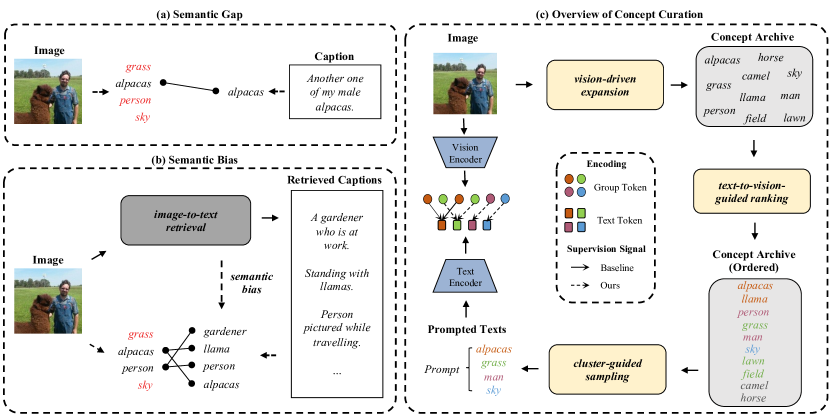
Vision-Language Pre-training has demonstrated its remarkable zero-shot recognition ability and potential to learn generalizable visual representations from language supervision. Taking a step ahead, language-supervised semantic segmentation enables spatial localization of textual inputs by learning pixel grouping solely from image-text pairs. Nevertheless, the state-of-the-art suffers from clear semantic gaps between visual and textual modality: plenty of visual concepts appeared in images are missing in their paired captions. Such semantic misalignment circulates in pre-training, leading to inferior zero-shot performance in dense predictions due to insufficient visual concepts captured in textual representations. To close such semantic gap, we propose Concept Curation (CoCu), a pipeline that leverages CLIP to compensate for the missing semantics. For each image-text pair, we establish a concept archive that maintains potential visually-matched concepts with our proposed vision-driven expansion and text-to-vision-guided ranking. Relevant concepts can thus be identified via cluster-guided sampling and fed into pre-training, thereby bridging the gap between visual and textual semantics. Extensive experiments over a broad suite of 8 segmentation benchmarks show that CoCu achieves superb zero-shot transfer performance and greatly boosts language-supervised segmentation baseline by a large margin, suggesting the value of bridging semantic gap in pre-training data.
Motivation & Objective
- To address the prevalent semantic gap in web-crawled image-text pairs, where key visual concepts are missing from captions, which hinders effective pre-training for semantic segmentation.
- To improve zero-shot generalization in language-supervised semantic segmentation by enriching textual representations with missing visual concepts from pre-training data.
- To develop a robust pipeline that avoids semantic bias in retrieved concepts while ensuring comprehensive and diverse visual concept coverage.
- To demonstrate the effectiveness of concept curation in improving both zero-shot segmentation and zero-shot classification performance.
Proposed method
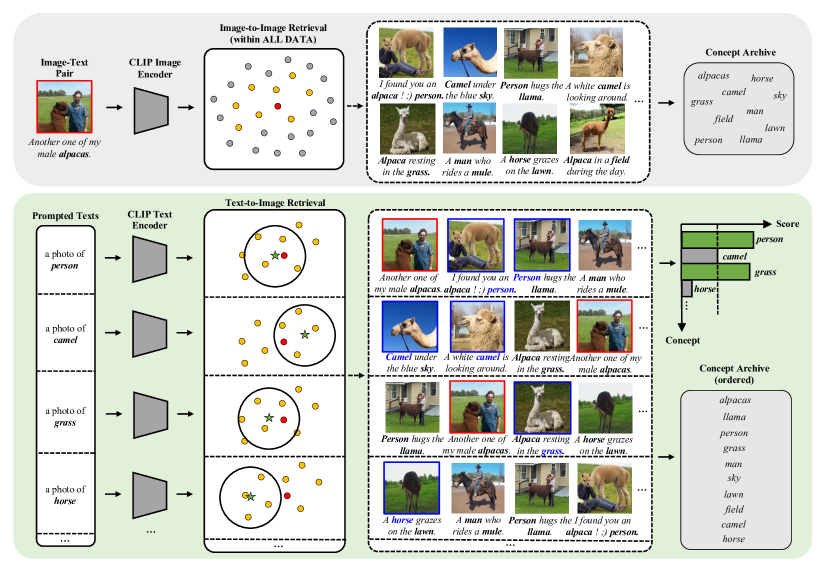
- Vision-driven expansion constructs a concept archive by retrieving relevant concepts from other images using CLIP embeddings, ensuring unbiased coverage of visual concepts.
- Text-to-vision-guided ranking scores retrieved concepts based on their semantic relevancy to the input image using CLIP's vision-language alignment.
- Cluster-guided sampling selects diverse, high-relevancy concepts by leveraging semantic clustering to avoid redundancy and improve representation diversity.
- The curated concepts are integrated into pre-training data, enhancing the model's ability to associate textual queries with accurate pixel-level regions.
- The pipeline is applied to pre-train GroupViT from scratch on image-text pairs, with zero-shot evaluation on multiple segmentation benchmarks.
- The method leverages off-the-shelf CLIP models to avoid retraining vision-language encoders, enabling efficient and scalable concept curation.
Experimental results
Research questions
- RQ1Can enriching image captions with missing visual concepts from other images improve zero-shot semantic segmentation performance?
- RQ2How can we effectively retrieve and rank visual concepts to minimize semantic bias while maximizing relevancy to the input image?
- RQ3Does incorporating semantic diversity through clustering during concept sampling lead to better generalization in zero-shot segmentation?
- RQ4To what extent does concept curation improve zero-shot transfer beyond segmentation, such as in image classification?
Key findings
- CoCu achieves a 13.1% average mIoU on 8 segmentation benchmarks, representing a 4.9% improvement over the baseline GroupViT.
- The ablation study confirms that each component of CoCu—vision-driven expansion, text-to-vision ranking, and cluster-guided sampling—contributes incrementally to performance gains.
- CoCu improves zero-shot ImageNet-1K classification accuracy by 6.2% (top-1) and 6.9% (top-5) when pre-trained on C3, C12, Y14 data, outperforming GroupViT.
- The vision-driven expansion stage alone boosts performance by 2.1% mIoU over the baseline, highlighting its role in reducing semantic bias.
- Cluster-guided sampling provides the largest marginal gain among sampling strategies, indicating that semantic diversity is crucial for robust pre-training.
- The method consistently improves performance across all 8 evaluated segmentation benchmarks, demonstrating broad applicability and generalization.
Read this paper
Open the full text in the Nubint reader and ask about any passage as you read.
Read this paper on NubintThis review was generated by AI from the original paper. Please check the paper before citing it.