
[Paper Review] RGFN: Synthesizable Molecular Generation Using GFlowNets
RGFN extends GFlowNets to operate over chemical reaction space, ensuring synthesizability while achieving comparable optimization quality and enabling a vastly larger, low-cost search space. It demonstrates effective ligand generation across docking and activity tasks with scalable fragment libraries.
Generative models hold great promise for small molecule discovery, significantly increasing the size of search space compared to traditional in silico screening libraries. However, most existing machine learning methods for small molecule generation suffer from poor synthesizability of candidate compounds, making experimental validation difficult. In this paper we propose Reaction-GFlowNet (RGFN), an extension of the GFlowNet framework that operates directly in the space of chemical reactions, thereby allowing out-of-the-box synthesizability while maintaining comparable quality of generated candidates. We demonstrate that with the proposed set of reactions and building blocks, it is possible to obtain a search space of molecules orders of magnitude larger than existing screening libraries coupled with low cost of synthesis. We also show that the approach scales to very large fragment libraries, further increasing the number of potential molecules. We demonstrate the effectiveness of the proposed approach across a range of oracle models, including pretrained proxy models and GPU-accelerated docking.
Motivation & Objective
- Motivate and address the challenge of generating synthesizable molecules at scale for drug discovery.
- Propose Reaction-GFlowNet (RGFN), an extension of GFlowNets that samples via a predefined set of reactions and fragments to guarantee synthesizability.
- Design domain-specific action representations and training components to scale to large fragment libraries.
- Demonstrate RGFN's effectiveness on docking, proxy-based activity, and senolytic classification tasks while comparing to baselines.
Proposed method
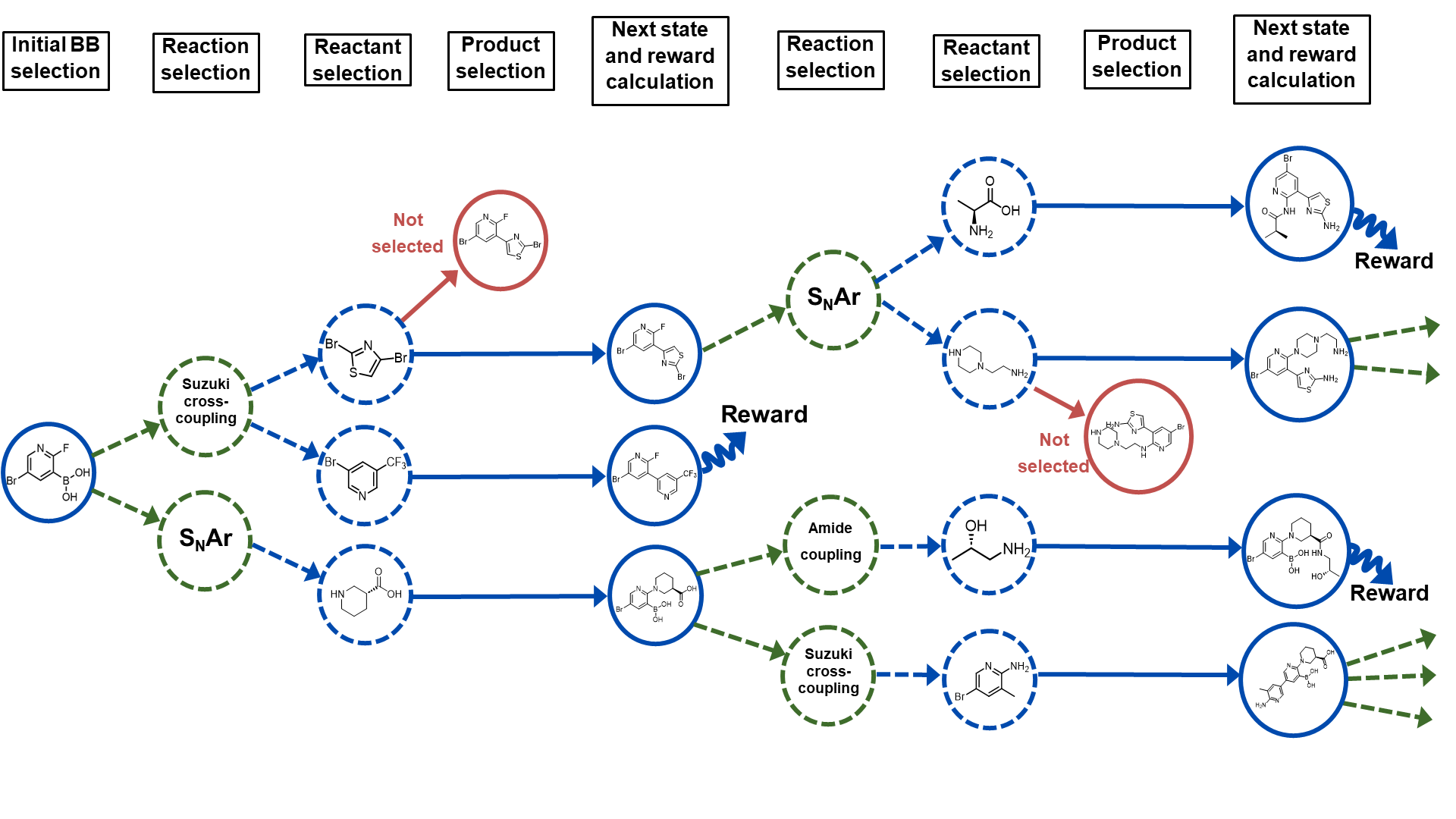
- RGFN generates molecules by sequentially selecting an initial fragment, a reaction template, and a second fragment, then performing an in silico reaction to produce candidate molecules.
- Forward policy uses a graph transformer f to embed molecules and reactions, producing action probabilities for selecting fragments, reactions, and reaction products.
- Action embedding includes a mechanism g(m_i) that captures structural similarity among fragments via fingerprints, improving scalability to larger fragment libraries.
- A curated set of 17 high-yield reactions and 350 affordable building blocks guides synthesis feasibility and cost-efficiency.
- Backward policy is incorporated to align intermediate steps with feasible retrosynthetic routes, ensuring coherent generation paths.
- The framework leverages RDKit RunReactants for reaction simulation and a mixture of synthesis- and cost-aware metrics within the reward.
Experimental results
Research questions
- RQ1Can reaction-space generative models produce synthesizable molecules at a scale surpassing traditional fragment-based libraries?
- RQ2Do reaction-based GFlowNets achieve competitive optimization quality and diversity compared to non-synthesizability-enforcing baselines?
- RQ3How does scaling the fragment library affect learning efficiency and generated space quality?
- RQ4Are generated ligands realistic in docking poses and diverse across multiple targets?
- RQ5What is the impact of fingerprint-based action embeddings on scalability and convergence?
Key findings
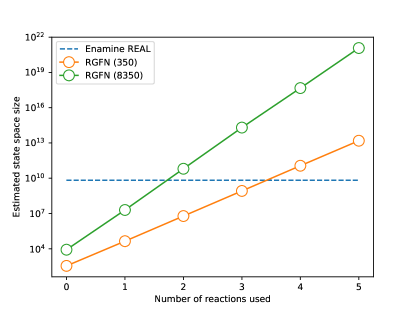
- RGFN yields a search space orders of magnitude larger than typical screening libraries while maintaining low synthesis cost.
- RGFN achieves similar average rewards to baseline methods and outperforms non-synthesizability-enforcing approaches in several tasks, including senolytic discovery.
- RGFN produces high-synthesizability scores (comparable to SyntheMol) and practical retrosynthesis routes (AiZynthFinder) for Top-k modes across tasks.
- Scaling fragment libraries with fingerprint-based action embeddings dramatically improves convergence and performance for large action spaces.
- Generated ligands form realistic docking poses and cluster by target in chemical space, indicating meaningful diversity and target-specific chemistry.
- RGFN demonstrates robust performance across multiple targets (sEH, ClpP, Mpro) with docking-based rewards, and viable synthetic routes for generated compounds.
Read this paper
Open the full text in the Nubint reader and ask about any passage as you read.
Read this paper on NubintThis review was generated by AI from the original paper. Please check the paper before citing it.