
[Paper Review] RIDCP: Revitalizing Real Image Dehazing via High-Quality Codebook Priors
RIDCP introduces high-quality codebook priors from a pre-trained VQGAN and a controllable HQPs matching mechanism to improve real-image dehazing, along with a phenomenological degradation pipeline to synthesize realistic hazy data.
Existing dehazing approaches struggle to process real-world hazy images owing to the lack of paired real data and robust priors. In this work, we present a new paradigm for real image dehazing from the perspectives of synthesizing more realistic hazy data and introducing more robust priors into the network. Specifically, (1) instead of adopting the de facto physical scattering model, we rethink the degradation of real hazy images and propose a phenomenological pipeline considering diverse degradation types. (2) We propose a Real Image Dehazing network via high-quality Codebook Priors (RIDCP). Firstly, a VQGAN is pre-trained on a large-scale high-quality dataset to obtain the discrete codebook, encapsulating high-quality priors (HQPs). After replacing the negative effects brought by haze with HQPs, the decoder equipped with a novel normalized feature alignment module can effectively utilize high-quality features and produce clean results. However, although our degradation pipeline drastically mitigates the domain gap between synthetic and real data, it is still intractable to avoid it, which challenges HQPs matching in the wild. Thus, we re-calculate the distance when matching the features to the HQPs by a controllable matching operation, which facilitates finding better counterparts. We provide a recommendation to control the matching based on an explainable solution. Users can also flexibly adjust the enhancement degree as per their preference. Extensive experiments verify the effectiveness of our data synthesis pipeline and the superior performance of RIDCP in real image dehazing.
Motivation & Objective
- Motivate real-world dehazing by addressing the lack of paired real data and robust priors.
- Propose a phenomenological degradation pipeline to synthesize realistic hazy images across diverse degradation types.
- Leverage a pre-trained VQGAN codebook to inject high-quality priors into a dehazing network.
- Develop a controllable HQPs matching mechanism to bridge synthetic-real domain gap.
- Introduce a normalized feature alignment module to fuse HQP-derived features with real-domain features.
Proposed method
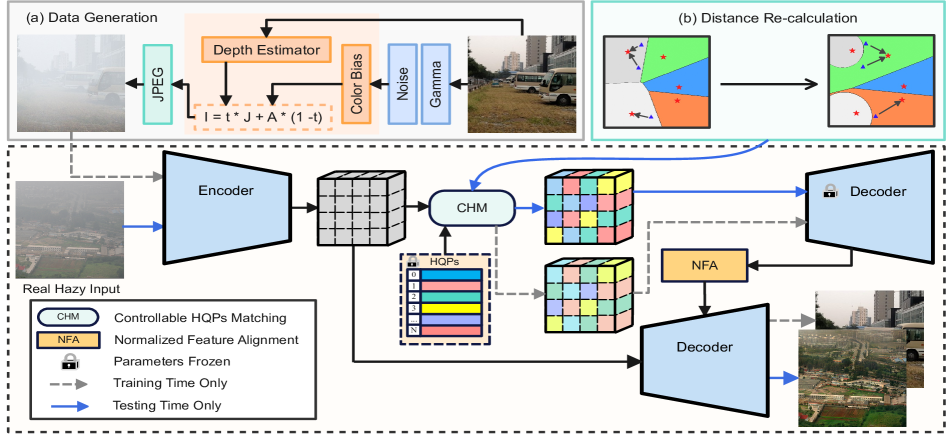
- Pre-train a VQGAN on high-quality data to obtain a discrete HQP codebook and a corresponding decoder.
- Train RIDCP with an encoder that matches HQPs and a decoder that utilizes HQP-aware features.
- Use a Normalized Feature Alignment (NFA) to align and balance VQGAN-derived features with real-dehazed features via deformable convolution and adaptive scaling.
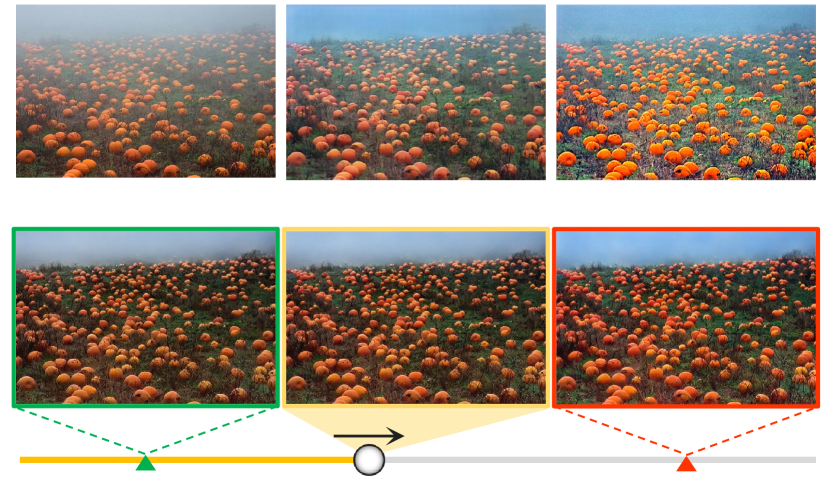
- Implement Controllable HQPs Matching (CHM) to re-weight HQP-cell distances during matching by a parameter alpha.
- Define CHM weights as F(f̃k, α)=exp(a·f̃k) to control HQP activation influence, where f̃k is the frequency gap between hazy and clean activations.
- Adopt a two-stage training: (1) train VQGAN on HQP data; (2) train RIDCP on synthetically hazy data generated by a phenomenological pipeline.
Experimental results
Research questions
- RQ1Can high-quality codebook priors from a pre-trained VQGAN improve real image dehazing performance?
- RQ2Does a controllable HQPs matching mechanism mitigate the synthetic-real domain gap and enable adjustable dehazing strength?
- RQ3How does a phenomenological degradation pipeline affect the realism of synthetic hazy data and subsequent dehazing performance?
- RQ4What is the impact of Normalized Feature Alignment on the quality and stability of HQP-based dehazing?
- RQ5Can the optimal enhancement degree (α) be estimated to approach a natural, artifact-free dehazed result?
Key findings
- RIDCP achieves the best BRISQUE and NIMA scores among evaluated methods on RTTS, indicating superior perceptual quality.
- RIDCP attains near-best FADE and a notably high user-study preference, suggesting strong real-world performance.
- Qualitative results show RIDCP producing brighter, more colorful, and less hazy outputs compared with state-of-the-art real-image dehazing methods.
- CHM enables adjustable enhancement by varying α, with a recommended α (≈21.25) yielding natural results in reported examples.
- A well-designed Normalized Feature Alignment (NFA) is essential to reduce texture distortion and balance HQP-derived features with the main network features.
- A phenomenological degradation pipeline significantly improves performance when training on synthetic data, generalizing better to real hazy images.
Read this paper
Open the full text in the Nubint reader and ask about any passage as you read.
Read this paper on NubintThis review was generated by AI from the original paper. Please check the paper before citing it.