
[Paper Review] RIFT2: Speeding-up RIFT with A New Rotation-Invariance Technique
RIFT2 introduces a dominant-index-based rotation invariance to replace the convolution sequence ring in RIFT, achieving similar multimodal matching performance with roughly one-third lower computation and memory usage.
Multimodal image matching is an important prerequisite for multisource image information fusion. Compared with the traditional matching problem, multimodal feature matching is more challenging due to the severe nonlinear radiation distortion (NRD). Radiation-variation insensitive feature transform (RIFT)~\cite{li2019rift} has shown very good robustness to NRD and become a baseline method in multimodal feature matching. However, the high computational cost for rotation invariance largely limits its usage in practice. In this paper, we propose an improved RIFT method, called RIFT2. We develop a new rotation invariance technique based on dominant index value, which avoids the construction process of convolution sequence ring. Hence, it can speed up the running time and reduce the memory consumption of the original RIFT by almost 3 times in theory. Extensive experiments show that RIFT2 achieves similar matching performance to RIFT while being much faster and having less memory consumption. The source code will be made publicly available in \url{https://github.com/LJY-RS/RIFT2-multimodal-matching-rotation}
Motivation & Objective
- Motivate faster multimodal feature matching under nonlinear radiation distortion (NRD).
- Improve the rotation-invariance mechanism of RIFT to cut computational cost and memory usage.
- Maintain or closely match the matching performance of RIFT while reducing descriptor complexity.
Proposed method
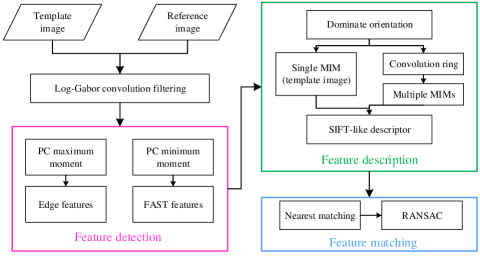
- Reuse a single MIM per keypoint instead of multiple MIMs generated by a Log-Gabor convolution ring.
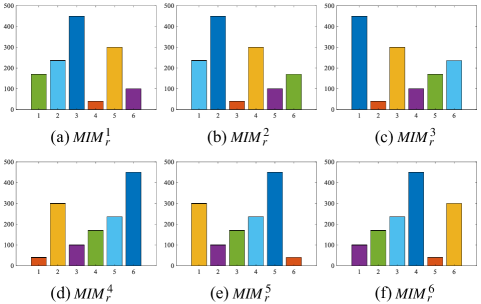
- Compute the MIM histogram patch and identify the dominant index in the histogram.
- Recoding MIMs based on the dominant index to achieve rotation invariance without the convolution sequence ring.
- If the dominant index is not distinctive, also create a second MIM using the second-highest bin (enhanced stability).
- Compare RIFT2 against SIFT, PSO-SIFT, OS-SIFT, and RIFT on SAR-optical and infrared-optical datasets using fixed keypoint counts and patch sizes.
Experimental results
Research questions
- RQ1Can a dominance-based histogram recoding provide rotation invariance without constructing multiple MIMs?
- RQ2Does the dominant-index technique maintain RIFT-level matching accuracy while reducing computation and memory?
- RQ3How does RIFT2 perform relative to traditional feature matchers on multimodal SAR-optical and infrared-optical image pairs?
Key findings
- RIFT2 significantly reduces running time and memory usage by avoiding the Log-Gabor ring and multiple MIMs, with near-identical matching performance to RIFT.
- On SAR-optical data, RIFT2 achieves RMSE of 2.79 vs 3.12 for RIFT and a 96% success rate vs 94% for RIFT.
- On infrared-optical data, RIFT2 achieves RMSE of 2.62 vs 2.45 for RIFT and a 97% success rate vs 98% for RIFT.
- Across both datasets, RIFT2 shows substantially higher correct match counts (around 110) than PSO-SIFT and OS-SIFT (around 7–10).
- RIFT2 reduces descriptor total quantity for the reference image by about 6×, speeding up matching while keeping accuracy.
Read this paper
Open the full text in the Nubint reader and ask about any passage as you read.
Read this paper on NubintThis review was generated by AI from the original paper. Please check the paper before citing it.