
[Paper Review] RIGA: Rotation-Invariant and Globally-Aware Descriptors for Point Cloud Registration
RIGA proposes a novel neural descriptor for point cloud registration that is inherently rotation-invariant and globally-aware, leveraging rotation-invariant local geometry from Point Pair Features (PPFs) and integrating global structural and contextual information via a Vision Transformer. It achieves state-of-the-art performance, reducing Relative Rotation Error by 8° on ModelNet40 under large rotations and improving Feature Matching Recall by at least 5 percentage points on 3DLoMatch.
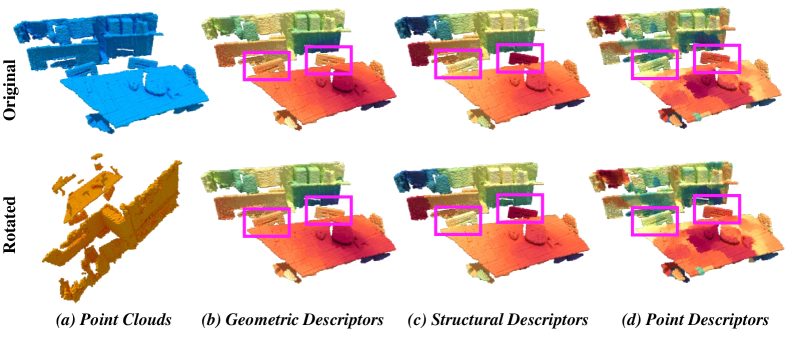
Successful point cloud registration relies on accurate correspondences established upon powerful descriptors. However, existing neural descriptors either leverage a rotation-variant backbone whose performance declines under large rotations, or encode local geometry that is less distinctive. To address this issue, we introduce RIGA to learn descriptors that are Rotation-Invariant by design and Globally-Aware. From the Point Pair Features (PPFs) of sparse local regions, rotation-invariant local geometry is encoded into geometric descriptors. Global awareness of 3D structures and geometric context is subsequently incorporated, both in a rotation-invariant fashion. More specifically, 3D structures of the whole frame are first represented by our global PPF signatures, from which structural descriptors are learned to help geometric descriptors sense the 3D world beyond local regions. Geometric context from the whole scene is then globally aggregated into descriptors. Finally, the description of sparse regions is interpolated to dense point descriptors, from which correspondences are extracted for registration. To validate our approach, we conduct extensive experiments on both object- and scene-level data. With large rotations, RIGA surpasses the state-of-the-art methods by a margin of 8\degree in terms of the Relative Rotation Error on ModelNet40 and improves the Feature Matching Recall by at least 5 percentage points on 3DLoMatch.
Motivation & Objective
- Address the limitation of existing neural descriptors that degrade under large rotations due to rotation-variant backbones.
- Improve descriptor distinctiveness by incorporating global 3D structural context beyond local geometry.
- Mitigate the repeatability problem in sparse sampling by enabling coarse-to-fine correspondence matching with robust descriptors.
- Design a descriptor that maintains invariance to arbitrary rotations while preserving high discriminative power.
- Achieve superior registration performance on both object-level and scene-level benchmarks under challenging rotational conditions.
Proposed method
- Extract sparse local regions from point clouds and compute Point Pair Features (PPFs) to represent local geometry.
- Apply a rotation-invariant encoding module to transform PPFs into rotation-invariant local geometric descriptors.
- Construct global PPF signatures to represent the entire 3D structure of the point cloud, enabling global structural awareness.
- Learn structural descriptors from global PPF signatures using a Vision Transformer (ViT) to inject global context into local descriptors.
- Globally aggregate scene-level geometric context into local descriptors via a self-attention mechanism in the ViT encoder.
- Interpolate sparse descriptors to dense point descriptors for efficient and reliable correspondence matching in a coarse-to-fine registration pipeline.
Experimental results
Research questions
- RQ1Can a neural descriptor be designed to be inherently rotation-invariant while maintaining high discriminative power?
- RQ2How does incorporating global structural and contextual information improve descriptor robustness under large rotations?
- RQ3To what extent does global awareness reduce performance degradation on rotated benchmarks compared to purely local methods?
- RQ4Can a rotation-invariant, globally-aware descriptor outperform state-of-the-art methods in both object-level and scene-level registration tasks?
- RQ5How robust is the proposed descriptor under poor normal estimation, common in real-world LiDAR data?
Key findings
- On ModelNet40 with large rotations, RIGA reduces Relative Rotation Error by 8° compared to state-of-the-art methods.
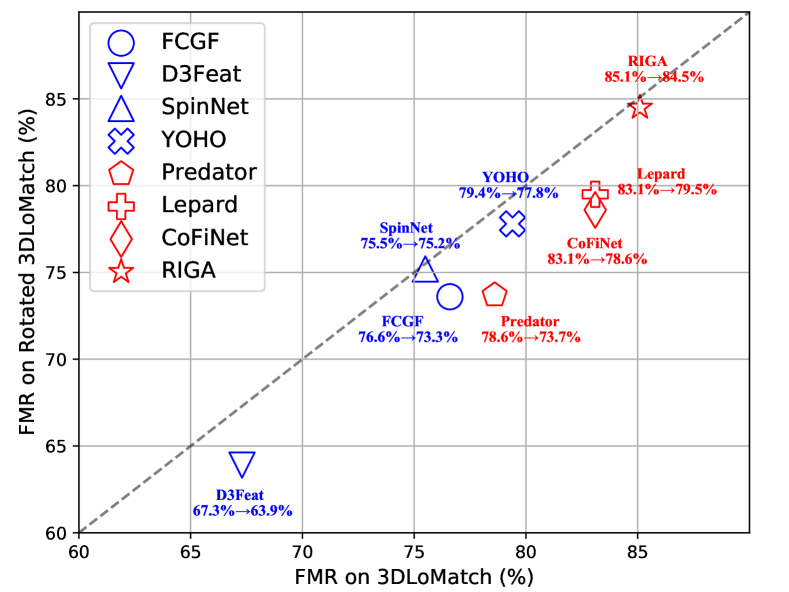
- On 3DLoMatch, RIGA improves Feature Matching Recall by at least 5 percentage points, even under rotated test conditions.
- RIGA achieves a registration recall of 99.1% on KITTI, outperforming most baselines despite using a ViT-based architecture with higher computational cost.
- The method exhibits only a 0.6% drop in performance on rotated 3DLoMatch, the smallest among all compared methods, demonstrating superior rotational robustness.
- Even under poor normal estimation on outdoor KITTI scans, RIGA maintains performance comparable to state-of-the-art methods across all metrics.
- Ablation studies confirm that both global structural encoding and global context aggregation significantly contribute to performance gains, with the ViT-based attention mechanism playing a key role in context integration.
Read this paper
Open the full text in the Nubint reader and ask about any passage as you read.
Read this paper on NubintThis review was generated by AI from the original paper. Please check the paper before citing it.