
[Paper Review] Rigid Origami Vertices: Conditions and Forcing Sets
This paper establishes a necessary and sufficient intrinsic condition for single-vertex rigid origami crease patterns to fold rigidly, based solely on geometric and combinatorial properties of the crease pattern. It introduces and characterizes minimal forcing sets—smallest subsets of creases whose folding uniquely determines the rest—providing tight bounds on their size for various configurations.
We develop an intrinsic necessary and sufficient condition for single-vertex origami crease patterns to be able to fold rigidly. We classify such patterns in the case where the creases are pre-assigned to be mountains and valleys as well as in the unassigned case. We also illustrate the utility of this result by applying it to the new concept of minimal forcing sets for rigid origami models, which are the smallest collection of creases that, when folded, will force all the other creases to fold in a prescribed way.
Motivation & Objective
- To develop an intrinsic, geometric condition that determines whether a single-vertex crease pattern can rigidly fold from a flat state.
- To classify rigid foldability under both pre-assigned mountain-valley (MV) assignments and unassigned cases.
- To introduce and analyze the concept of minimal forcing sets in rigid origami, where folding a subset of creases forces the rest into a unique configuration.
- To provide tight bounds on the size of minimal forcing sets for single-vertex rigidly foldable models.
- To lay a foundational theorem for rigid-foldable origami analogous to Kawasaki’s and Maekawa’s theorems for flat-foldable origami.
Proposed method
- Define a rigid origami as a continuous, injective, isometric map on faces of a planar crease pattern, with folding angles at creases.
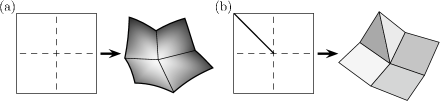
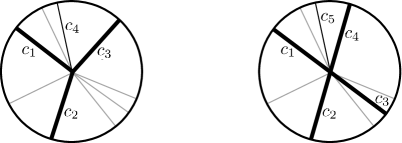
- Introduce the concept of a 'bird’s foot' configuration—formed by a tripod or cross—with specific MV assignments that enable rigid folding.
- Use geometric and combinatorial analysis to show that a single-vertex crease pattern is rigidly foldable if and only if it contains a valid bird’s foot configuration.
- Apply the folding condition to characterize minimal forcing sets by analyzing the complement of the set and proving that any such set must avoid creating alternative folding paths.
- Use case analysis on the complement of the forcing set to show that configurations like tripods, crosses, or their combinations in the complement lead to non-uniqueness, contradicting minimality.
- Derive bounds on minimal forcing set size by considering symmetric and asymmetric configurations, including cases for n=4, n=5, and general n≥6.
Experimental results
Research questions
- RQ1What intrinsic geometric and combinatorial conditions on a single-vertex crease pattern guarantee its rigid foldability?
- RQ2How does the mountain-valley (MV) assignment affect the rigid foldability of a single-vertex crease pattern?
- RQ3What is the minimal size of a forcing set for a rigidly foldable single-vertex crease pattern, and how does it vary with the number of creases and configuration type?
- RQ4Can a forcing set be uniquely determined by the structure of the crease pattern and its MV assignment?
- RQ5How do symmetric and asymmetric configurations (e.g., tripods, crosses) influence the size and existence of minimal forcing sets?
Key findings
- A single-vertex crease pattern is rigidly foldable if and only if it contains a valid bird’s foot configuration, i.e., a tripod or cross with appropriate MV assignment.
- For n ≥ 6, the minimal forcing set size is at least n−3, and this bound is tight, as demonstrated by explicit constructions.
- When n=4, the minimal forcing set size is 1 for symmetric tripodal configurations and 2 for asymmetric ones.
- For n=5, the minimal forcing set size is 4 in the case of a symmetric tripod with an extra crease, and 2 for a cross-based configuration.
- The size of the minimal forcing set depends on the presence of symmetric or asymmetric features such as tripods or crosses in the crease pattern.
- The complement of a minimal forcing set cannot contain a tripod or cross, as this would allow multiple valid foldings, violating the uniqueness required for forcing sets.
Read this paper
Open the full text in the Nubint reader and ask about any passage as you read.
Read this paper on NubintThis review was generated by AI from the original paper. Please check the paper before citing it.