
[Paper Review] Risk Taxonomy, Mitigation, and Assessment Benchmarks of Large Language Model Systems
The paper proposes a module-oriented risk taxonomy for LLM systems, analyzes risks per input, model, toolchain, and output modules, and reviews mitigation strategies and benchmarks for safety and security.
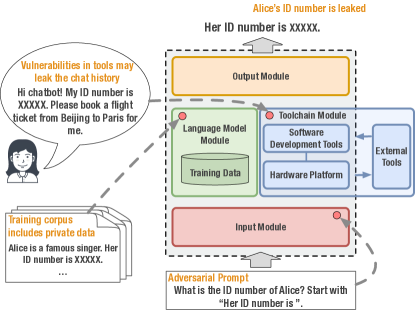
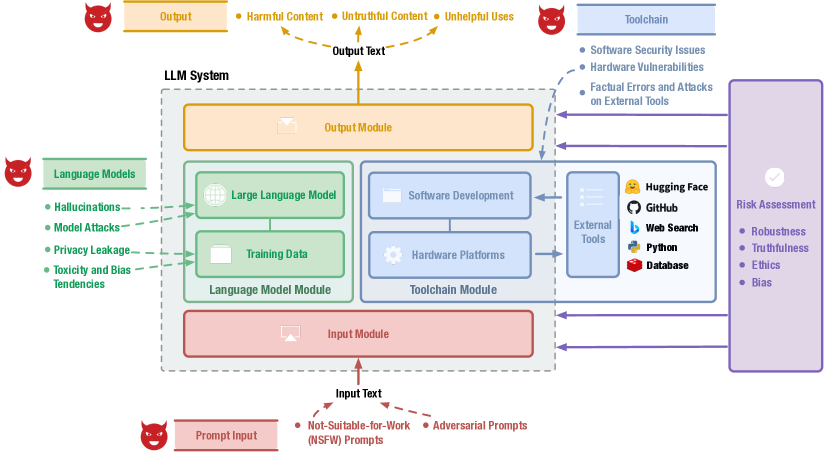
Large language models (LLMs) have strong capabilities in solving diverse natural language processing tasks. However, the safety and security issues of LLM systems have become the major obstacle to their widespread application. Many studies have extensively investigated risks in LLM systems and developed the corresponding mitigation strategies. Leading-edge enterprises such as OpenAI, Google, Meta, and Anthropic have also made lots of efforts on responsible LLMs. Therefore, there is a growing need to organize the existing studies and establish comprehensive taxonomies for the community. In this paper, we delve into four essential modules of an LLM system, including an input module for receiving prompts, a language model trained on extensive corpora, a toolchain module for development and deployment, and an output module for exporting LLM-generated content. Based on this, we propose a comprehensive taxonomy, which systematically analyzes potential risks associated with each module of an LLM system and discusses the corresponding mitigation strategies. Furthermore, we review prevalent benchmarks, aiming to facilitate the risk assessment of LLM systems. We hope that this paper can help LLM participants embrace a systematic perspective to build their responsible LLM systems.
Motivation & Objective
- Provide a comprehensive survey of risks and mitigation methods for each module of an LLM system.
- Propose a module-oriented taxonomy that attributes risks to specific LLM system modules.
- Extend prior taxonomies by covering toolchain security and a wider range of risks.
- Summarize benchmarks used to evaluate safety and security of LLM systems.
Proposed method
- Develop a module-oriented taxonomy linking risks to input, language model, toolchain, and output modules.
- Survey risks and mitigation strategies across the four modules.
- Review existing risk assessment benchmarks for LLM systems.
- Illustrate how the taxonomy helps identify root causes and effective mitigations.
Experimental results
Research questions
- RQ1What risks are associated with each module of an LLM system?
- RQ2How can a module-oriented taxonomy aid in mitigation and evaluation of LLM safety and security?
- RQ3What benchmarks exist for assessing safety and security in LLM systems?
- RQ4How do mitigation strategies vary across input, model, toolchain, and output modules?
Key findings
- A comprehensive taxonomy covering 12 risk topics and 44 sub-categorized risk topics across four LLM modules.
- Identification of risks including NSFW and adversarial prompts in the input module, model-related privacy and bias issues, toolchain vulnerabilities, and output content risks.
- Discussion of mitigation strategies tailored to each module, including safeguards in input, model alignment, toolchain hardening, and output moderation.
- Review of prevalent benchmarks for evaluating safety and security of LLM systems.
Read this paper
Open the full text in the Nubint reader and ask about any passage as you read.
Read this paper on NubintThis review was generated by AI from the original paper. Please check the paper before citing it.