
[Paper Review] rKAN: Rational Kolmogorov-Arnold Networks
The paper introduces two rational-basis implementations of Kolmogorov-Arnold Networks (rKAN): Padé approximants and rational Jacobi mappings, and evaluates them on regression, MNIST classification, and physics-informed differential equations.
The development of Kolmogorov-Arnold networks (KANs) marks a significant shift from traditional multi-layer perceptrons in deep learning. Initially, KANs employed B-spline curves as their primary basis function, but their inherent complexity posed implementation challenges. Consequently, researchers have explored alternative basis functions such as Wavelets, Polynomials, and Fractional functions. In this research, we explore the use of rational functions as a novel basis function for KANs. We propose two different approaches based on Pade approximation and rational Jacobi functions as trainable basis functions, establishing the rational KAN (rKAN). We then evaluate rKAN's performance in various deep learning and physics-informed tasks to demonstrate its practicality and effectiveness in function approximation.
Motivation & Objective
- Motivate and overcome limitations of traditional KANs by employing rational basis functions for better function approximation and handling asymptotic behavior.
- Develop two concrete rKAN architectures: Padé-based rational functions and mapped rational Jacobi functions.
- Assess rKAN performance on synthetic regression tasks, MNIST classification, and physics-informed differential equation problems.
- Compare against existing KAN variants and baseline activation functions to establish practical viability.
Proposed method
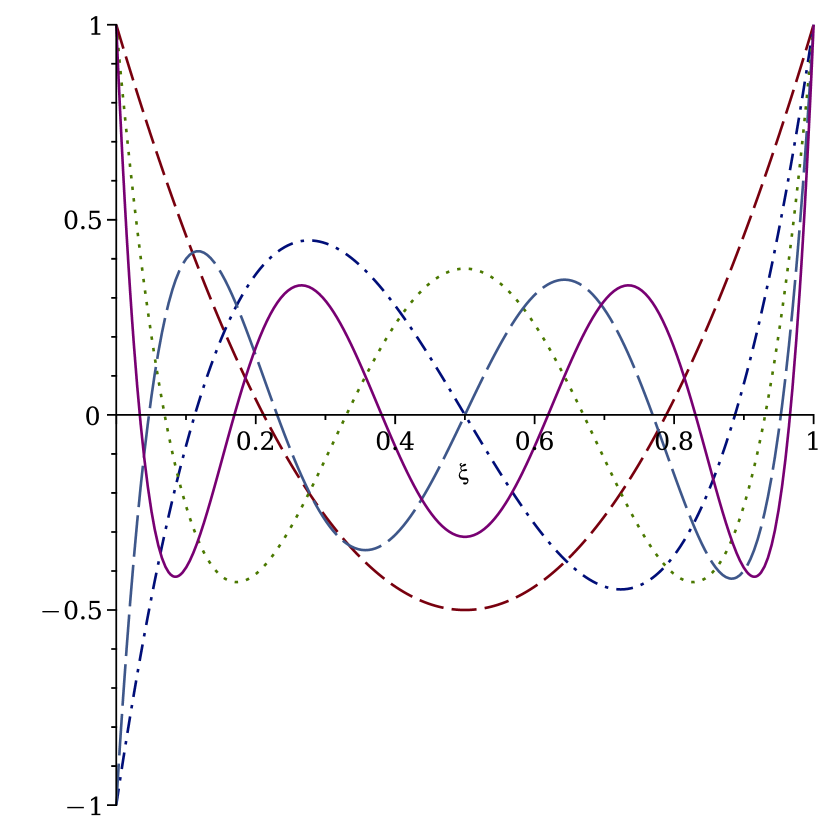
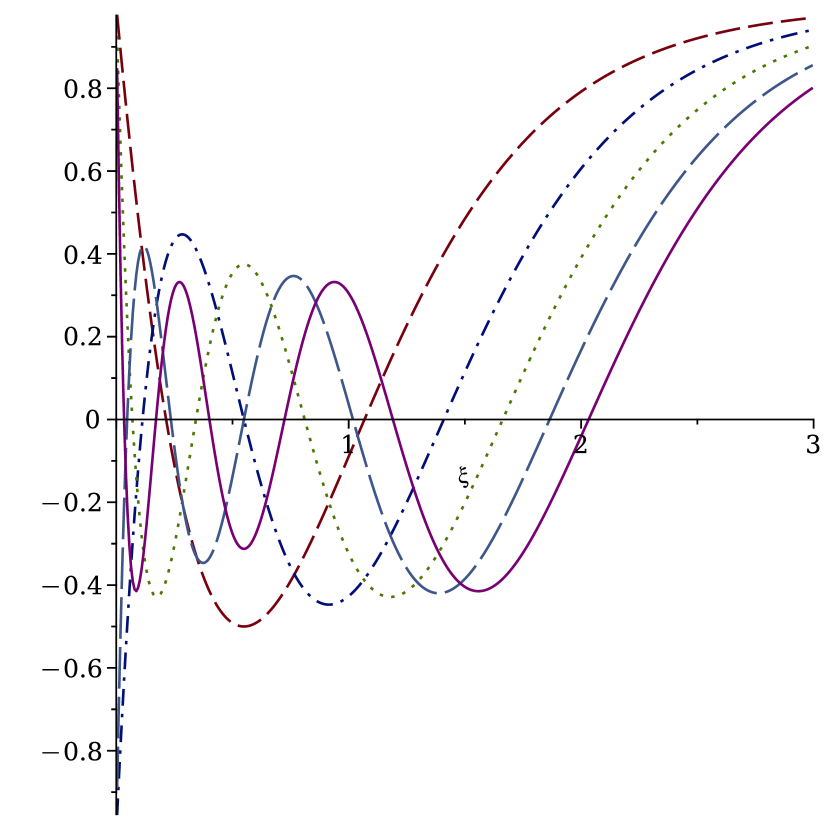
- Define rational basis functions for KANs via two approaches: Padé approximation using ratios of Jacobi-derived polynomials, with trainable coefficients; and rational Jacobi functions obtained by mapping Jacobi polynomials to finite or infinite domains.
- In Padé-rKAN, φ_{q,k}(ξ) = (sum_{i=0}^{k} θ^e_i R^{(α,β)}_i(ξ_q)) / (sum_{i=0}^{p} θ^d_i R^{(α,β)}_i(ξ_q)), with ξ input bounded by activate σ(·) and optimizable α,β,ι hyperparameters.
- In Jacobi-rKAN, φ_{q,k}(ξ) = J^{(α,β)}_k(φ(ξ_q)) where φ is a nonlinear rational mapping (finite/semi-infinite/infinite domains) and SoftPlus controls trainable ι to ensure positivity.
- Combine φ functions within the Kolmogorov-Arnold network framework as F(ξ) = sum_{k=1}^K ψ_k(sum_{q=1}^ν φ_{q,k}(σ(ξ_q))), where ψ_k are linear.
- Investigate fractional rational KAN variants by constraining mappings to map inputs to positive domains with a fractional order γ when using φ(·) as a mapped Jacobi function.
- Evaluate on regression, MNIST classification with a CNN backbone, and physics-informed deep learning tasks involving Lane-Emden ODEs and a Poisson-type PDE.
Experimental results
Research questions
- RQ1Can rational basis functions within KANs improve approximation of functions with asymptotic behavior or singularities compared to traditional KAN variants?
- RQ2How do Padé-based and mapped Jacobi-based rKANs compare in terms of accuracy and training complexity across regression, classification, and physics-informed problems?
- RQ3What is the impact of hyperparameters α, β, and mapping/ι on model performance and stability during optimization?
- RQ4Do rKANs offer practical advantages in physics-informed neural networks for solving differential equations like Lane-Emden and elliptic PDEs?
Key findings
- rKAN variants achieve competitive to superior MSE on synthetic regression tasks across F1, F2, F3 compared to fKAN, Jacobi-rKAN, and standard KAN under various K values.
- On MNIST, Jacobi-rKAN and rKAN (with multiple K) attain high accuracies (e.g., up to 99.293% for rKAN(5)) and favorable losses versus baselines and some fKAN configurations.
- In physics-informed tests, Jacobi-rKAN and Padé-rKAN yield small first-root errors in Lane-Emden problems and comparable or better residuals than some GEPINN configurations, with specific values reported in Table 5.
- Elliptic PDE approximation using a 4-layer Jacobi-rKAN achieves a reasonable prediction with interpretable residuals, demonstrating applicability to PDEs.
- Padé-rKAN can improve accuracy but increases training time due to polynomial computations, highlighting a trade-off between accuracy and efficiency.
- The approach supports integration with fractional KANs in appropriate contexts, suggesting flexibility across problem domains.
Read this paper
Open the full text in the Nubint reader and ask about any passage as you read.
Read this paper on NubintThis review was generated by AI from the original paper. Please check the paper before citing it.