
[Paper Review] RoBERTa-BiLSTM: A Context-Aware Hybrid Model for Sentiment Analysis
This paper proposes RoBERTa-BiLSTM, a hybrid model that uses RoBERTa to generate word embeddings and BiLSTM to capture long-range dependencies, achieving state-of-the-art sentiment analysis results across three datasets.
Effectively analyzing the comments to uncover latent intentions holds immense value in making strategic decisions across various domains. However, several challenges hinder the process of sentiment analysis including the lexical diversity exhibited in comments, the presence of long dependencies within the text, encountering unknown symbols and words, and dealing with imbalanced datasets. Moreover, existing sentiment analysis tasks mostly leveraged sequential models to encode the long dependent texts and it requires longer execution time as it processes the text sequentially. In contrast, the Transformer requires less execution time due to its parallel processing nature. In this work, we introduce a novel hybrid deep learning model, RoBERTa-BiLSTM, which combines the Robustly Optimized BERT Pretraining Approach (RoBERTa) with Bidirectional Long Short-Term Memory (BiLSTM) networks. RoBERTa is utilized to generate meaningful word embedding vectors, while BiLSTM effectively captures the contextual semantics of long-dependent texts. The RoBERTa-BiLSTM hybrid model leverages the strengths of both sequential and Transformer models to enhance performance in sentiment analysis. We conducted experiments using datasets from IMDb, Twitter US Airline, and Sentiment140 to evaluate the proposed model against existing state-of-the-art methods. Our experimental findings demonstrate that the RoBERTa-BiLSTM model surpasses baseline models (e.g., BERT, RoBERTa-base, RoBERTa-GRU, and RoBERTa-LSTM), achieving accuracies of 80.74%, 92.36%, and 82.25% on the Twitter US Airline, IMDb, and Sentiment140 datasets, respectively. Additionally, the model achieves F1-scores of 80.73%, 92.35%, and 82.25% on the same datasets, respectively.
Motivation & Objective
- Motivate sentiment analysis on diverse online comments amid lexical diversity, long dependencies, and imbalanced data.
- Propose a context-aware hybrid model combining RoBERTa embeddings with BiLSTM for improved performance.
- Evaluate RoBERTa-BiLSTM against state-of-the-art baselines on multiple datasets.
- Analyze the impact of data preprocessing and hyperparameter tuning on model performance.
Proposed method
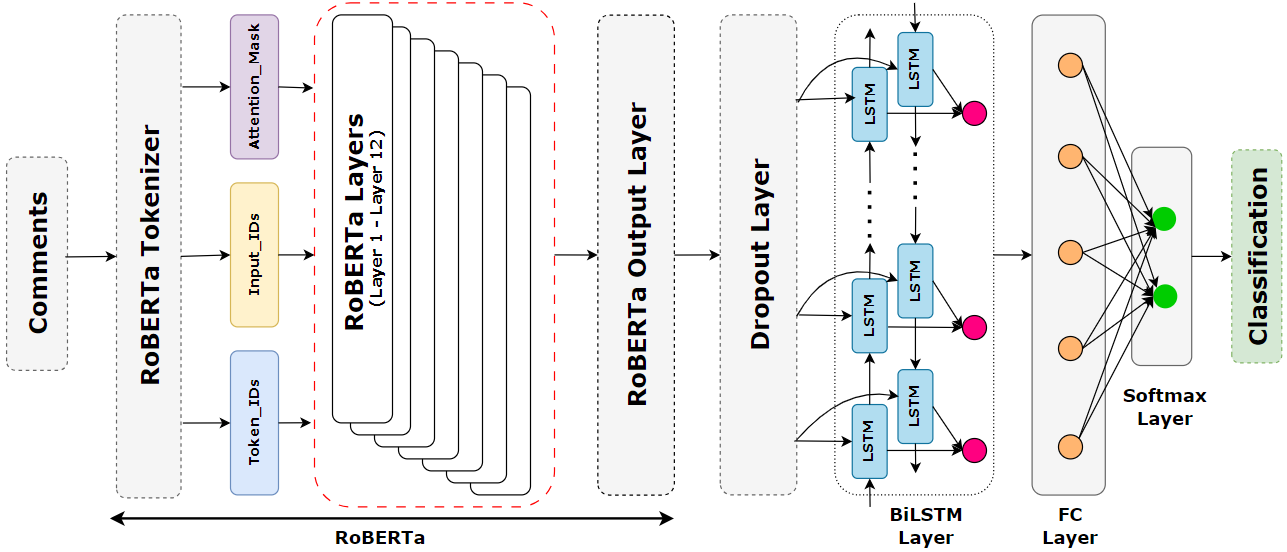
- Utilize RoBERTa as the encoder to generate contextual word embeddings.
- Feed RoBERTa embeddings into a BiLSTM with a dropout layer to capture long-range dependencies.
- Add a dense layer and Softmax classifier to map BiLSTM outputs to sentiment classes.
- Apply data preprocessing including lowercasing, removal of noise, and lemmatization before RoBERTa tokenization.
- Tune hyperparameters (learning rate, hidden units) and compare against LSTM/GRU variants.
- Use cross-entropy loss for multi-class sentiment classification.
Experimental results
Research questions
- RQ1Can the RoBERTa-BiLSTM hybrid model outperform standard RoBERTa variants (base, GRU, LSTM) on sentiment analysis tasks?
- RQ2What are the effects of data preprocessing choices and hyperparameter tuning on the model’s performance?
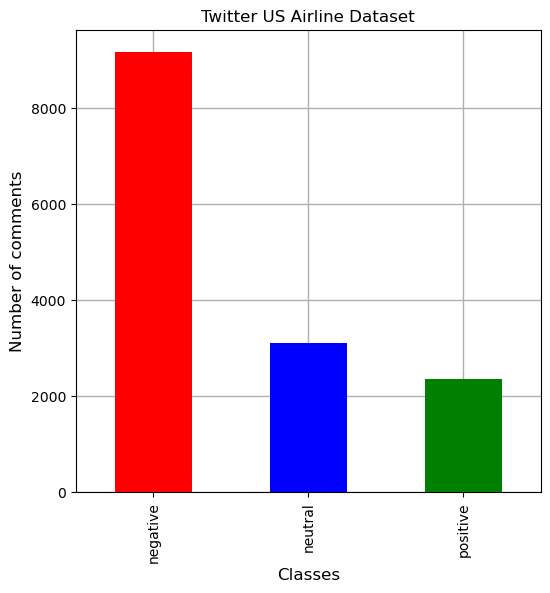
- RQ3How does the model perform across diverse datasets with varying class distributions (IMDb, Twitter US Airline, Sentiment140)?
Key findings
- RoBERTa-BiLSTM achieves 80.74% accuracy on Twitter US Airline.
- RoBERTa-BiLSTM achieves 92.36% accuracy on IMDb.
- RoBERTa-BiLSTM achieves 82.25% accuracy on Sentiment140.
- RoBERTa-BiLSTM attains F1-scores of 80.73% (Twitter US Airline), 92.35% (IMDb), and 82.25% (Sentiment140).
- The model outperforms RoBERTa-base, RoBERTa-GRU, and RoBERTa-LSTM baselines on the evaluated datasets.
Read this paper
Open the full text in the Nubint reader and ask about any passage as you read.
Read this paper on NubintThis review was generated by AI from the original paper. Please check the paper before citing it.