
[Paper Review] Robo3D: Towards Robust and Reliable 3D Perception against Corruptions
Robo3D introduces the first comprehensive benchmark for evaluating 3D perception robustness under real-world corruptions, including severe weather, motion blur, beam loss, and sensor failures. The paper proposes a density-insensitive training framework with flexible voxelization, significantly improving model resilience across 8 corruption types on KITTI, SemanticKITTI, nuScenes, and Waymo Open datasets, with mCE reductions up to 17.5% on semantic segmentation and 1.5% on detection.
The robustness of 3D perception systems under natural corruptions from environments and sensors is pivotal for safety-critical applications. Existing large-scale 3D perception datasets often contain data that are meticulously cleaned. Such configurations, however, cannot reflect the reliability of perception models during the deployment stage. In this work, we present Robo3D, the first comprehensive benchmark heading toward probing the robustness of 3D detectors and segmentors under out-of-distribution scenarios against natural corruptions that occur in real-world environments. Specifically, we consider eight corruption types stemming from severe weather conditions, external disturbances, and internal sensor failure. We uncover that, although promising results have been progressively achieved on standard benchmarks, state-of-the-art 3D perception models are at risk of being vulnerable to corruptions. We draw key observations on the use of data representations, augmentation schemes, and training strategies, that could severely affect the model's performance. To pursue better robustness, we propose a density-insensitive training framework along with a simple flexible voxelization strategy to enhance the model resiliency. We hope our benchmark and approach could inspire future research in designing more robust and reliable 3D perception models. Our robustness benchmark suite is publicly available.
Motivation & Objective
- To address the lack of systematic evaluation for 3D perception models under real-world corruptions and sensor failures.
- To identify key failure modes in state-of-the-art 3D detectors and segmentors when exposed to out-of-distribution (OoD) scenarios.
- To analyze the impact of data representation, augmentation, and training strategies on model robustness.
- To propose a training framework that enhances resilience to sensor and environmental corruptions without requiring architectural overhaul.
- To establish a publicly available benchmark suite for future research in robust 3D perception.
Proposed method
- Simulates eight corruption types across three categories: severe weather (fog, rain, snow), external disturbances (motion blur, beam missing), and internal sensor failures (crosstalk, incomplete echo, cross-sensor).
- Applies each corruption at three severity levels (light, moderate, heavy) to validation sets of KITTI, SemanticKITTI, nuScenes, and Waymo Open.
- Introduces a density-insensitive training framework that reduces sensitivity to point cloud density variations caused by corruptions.
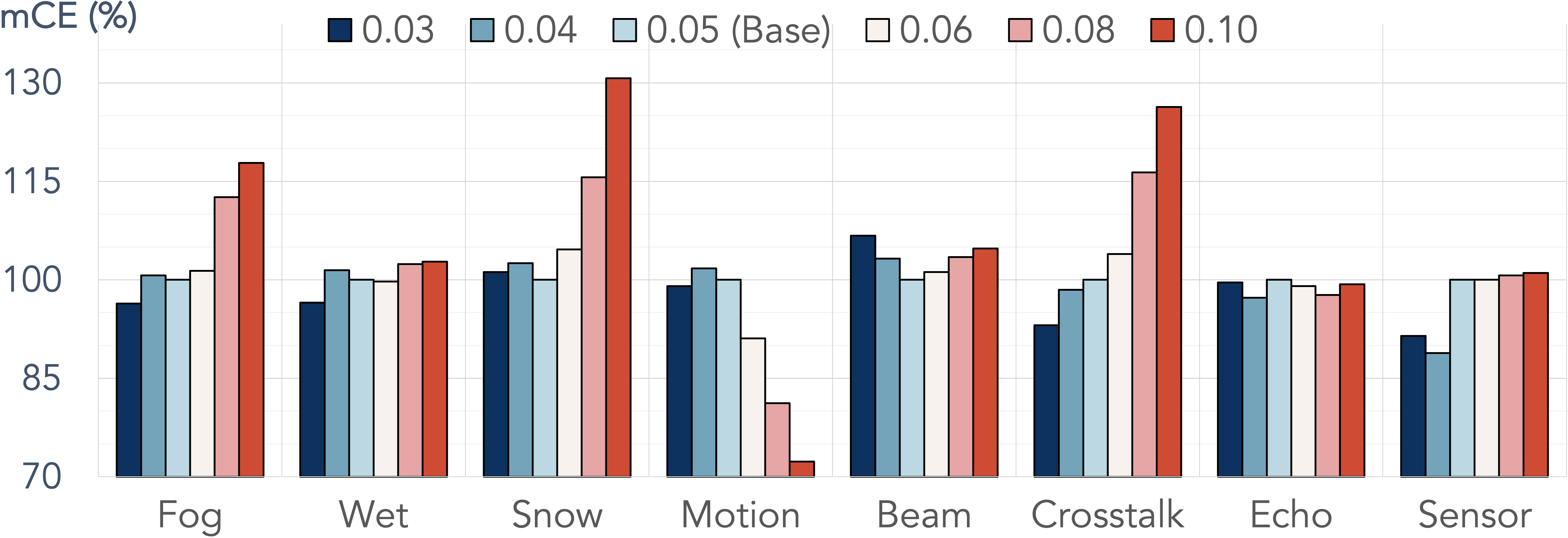
- Proposes a flexible voxelization strategy that adapts to varying point cloud densities and maintains spatial consistency under corruptions.
- Employs out-of-context augmentation (OCA) to improve generalization under corrupted inputs.
- Uses Corruption Error (CE) as the primary metric, defined as the average drop in mIoU or mAP across all corruption levels and types.
Experimental results
Research questions
- RQ1How do state-of-the-art 3D perception models perform under realistic corruptions not seen during training?
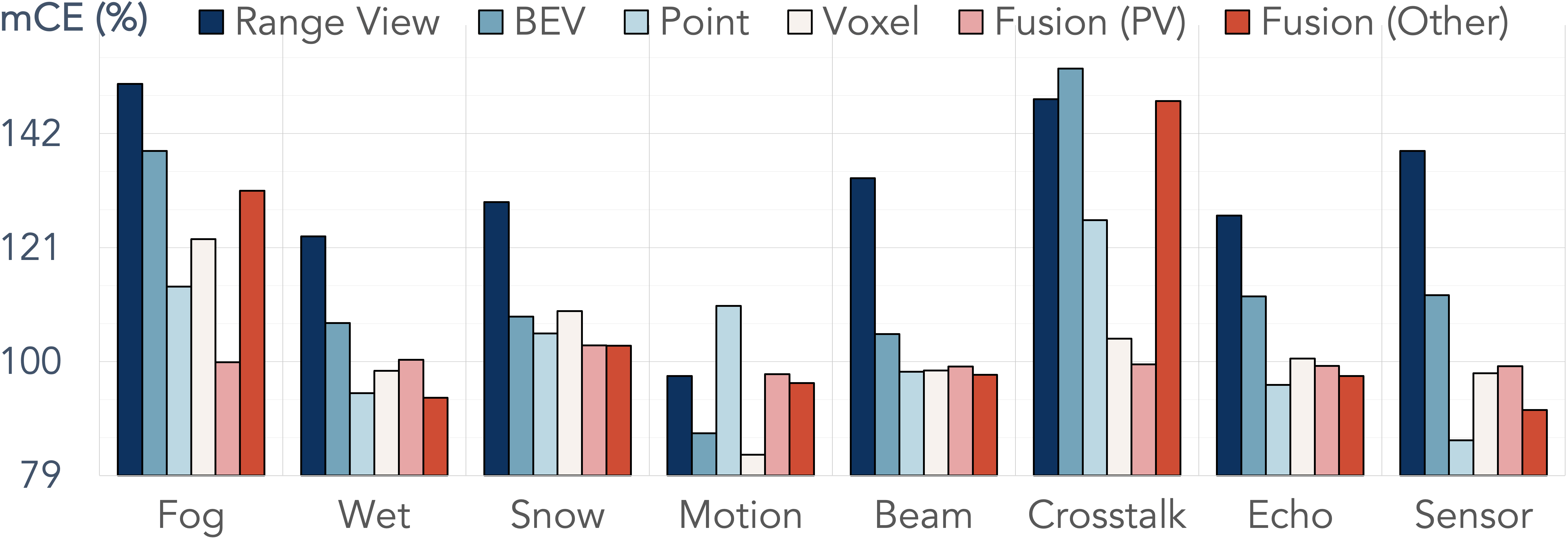
- RQ2What role do data representations (e.g., voxel, point, range view) play in determining model robustness under corruptions?
- RQ3How do sensor configuration differences and augmentation schemes affect model resilience?
- RQ4Can a simple, plug-and-play training framework improve robustness across diverse corruption types?
- RQ5Which corruption types most severely degrade 3D detection and segmentation performance?
Key findings
- State-of-the-art 3D models show significant performance drops under real-world corruptions, with mCE increases up to 106.31 on SemanticKITTI-C, indicating high vulnerability.
- Voxel-based and point-voxel fusion methods (e.g., PV-RCNN++) outperform projection-based methods (e.g., range view) under all corruption types, especially fog and beam missing.
- The proposed density-insensitive training framework reduces mCE by 17.5% on SemanticKITTI-C (Seg3D) and 1.5% on WOD-C (Det3D) compared to baseline models.
- Out-of-context augmentation (OCA) combined with flexible voxelization reduces mCE by 12.5% on average across all corruption types, demonstrating strong generalization gains.
- Models trained on single-sensor data show higher sensitivity to cross-sensor corruptions, highlighting the need for multi-sensor robustness in real deployments.
- Motion blur and beam missing corruptions cause the most significant performance degradation, especially for models relying on dense point clouds.
Read this paper
Open the full text in the Nubint reader and ask about any passage as you read.
Read this paper on NubintThis review was generated by AI from the original paper. Please check the paper before citing it.