
[Paper Review] RoboCodeX: Multimodal Code Generation for Robotic Behavior Synthesis
RoboCodeX proposes a tree-structured multimodal code generation framework that translates high-level human instructions into executable robotic control code by decomposing tasks into object-centric manipulation units with physical constraints and preferences. It achieves state-of-the-art performance across simulators and real robots on diverse manipulation and navigation tasks through multimodal reasoning and code-based generalization across platforms.
Robotic behavior synthesis, the problem of understanding multimodal inputs and generating precise physical control for robots, is an important part of Embodied AI. Despite successes in applying multimodal large language models for high-level understanding, it remains challenging to translate these conceptual understandings into detailed robotic actions while achieving generalization across various scenarios. In this paper, we propose a tree-structured multimodal code generation framework for generalized robotic behavior synthesis, termed RoboCodeX. RoboCodeX decomposes high-level human instructions into multiple object-centric manipulation units consisting of physical preferences such as affordance and safety constraints, and applies code generation to introduce generalization ability across various robotics platforms. To further enhance the capability to map conceptual and perceptual understanding into control commands, a specialized multimodal reasoning dataset is collected for pre-training and an iterative self-updating methodology is introduced for supervised fine-tuning. Extensive experiments demonstrate that RoboCodeX achieves state-of-the-art performance in both simulators and real robots on four different kinds of manipulation tasks and one navigation task.
Motivation & Objective
- To bridge the gap between high-level semantic understanding and low-level robotic control in embodied AI.
- To address the challenge of generalizing robotic policies across diverse objects, morphologies, and robotic platforms.
- To enable precise, transferable robotic behavior synthesis by encoding physical preferences and constraints in executable code.
- To leverage multimodal large language models for grounded, context-aware robotic planning and action generation.
- To develop a unified framework that maps vision, language, and spatial reasoning into platform-agnostic robotic code.
Proposed method
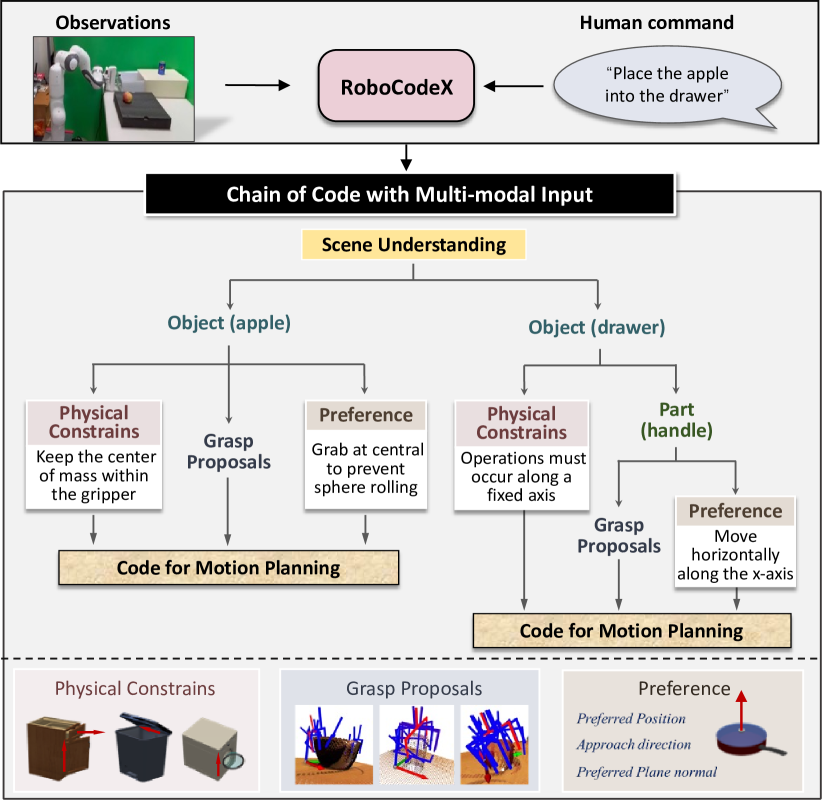
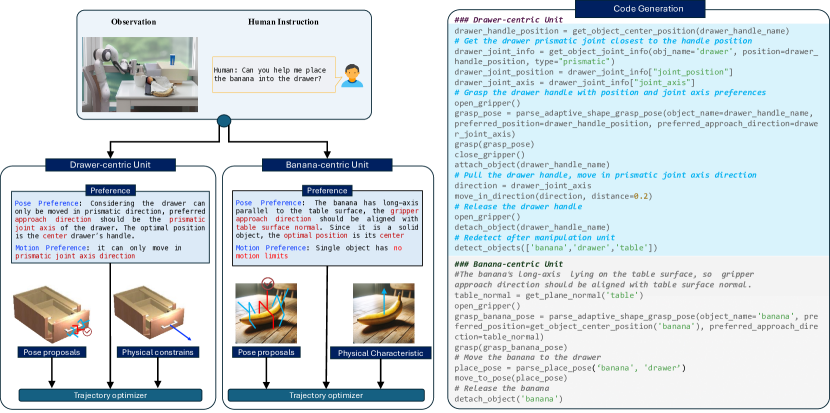
- RoboCodeX uses a tree-of-thought reasoning structure to decompose high-level instructions into object-centric manipulation units.
- It generates target pose proposals, predicts physical constraints (e.g., joint axes, grasp regions), and infers preferred grasping poses using 3D spatial and visual inputs.
- The framework employs a specialized multimodal reasoning dataset for pre-training and an iterative self-updating method for supervised fine-tuning.
- It integrates a Python-based API with motion planning functions (e.g., move_to_pose, follow_path, grasp) to generate executable robotic code.
- Physical preferences such as gripper approach direction, plane normal, and grasp type are encoded as configurable parameters in the code generation process.
- The system maps conceptual understanding into low-level control sequences that are transferable across different robotic platforms via symbolic code representation.
Experimental results
Research questions
- RQ1Can a multimodal reasoning framework generalize robotic behavior synthesis across diverse objects and robotic platforms using code as a symbolic bridge?
- RQ2How effectively can a tree-of-thought structured model decompose high-level instructions into executable, physically plausible manipulation units?
- RQ3To what extent does self-supervised fine-tuning improve code generation quality and zero-shot generalization in real-world robotic tasks?
- RQ4Can multimodal large language models be effectively grounded in 3D spatial and physical constraints to produce reliable robotic control code?
- RQ5How does the integration of physical preference modeling (e.g., grasp regions, joint constraints) enhance the robustness and adaptability of generated robotic behaviors?
Key findings
- RoboCodeX achieves state-of-the-art performance on four manipulation tasks and one navigation task in both simulated and real-world environments.
- The framework demonstrates strong zero-shot generalization to novel objects and robotic platforms due to its code-based, platform-agnostic execution interface.
- The iterative self-updating fine-tuning strategy significantly improves code generation accuracy and task success rates over baseline methods.
- The integration of physical constraints and preference modeling leads to more reliable and safer grasping and manipulation behaviors.
- The use of a specialized multimodal reasoning dataset during pre-training enhances the model’s ability to reason about object affordances and spatial relationships.
- The system successfully generates executable Python code that maps high-level instructions to precise robotic actions, validated through real robot deployment.
Read this paper
Open the full text in the Nubint reader and ask about any passage as you read.
Read this paper on NubintThis review was generated by AI from the original paper. Please check the paper before citing it.