
[Paper Review] RoboDepth: Robust Out-of-Distribution Depth Estimation under Corruptions
The paper presents RoboDepth, a robustness benchmark with 18 corruptions across three categories, benchmarks 42 monocular depth estimation models on indoor/outdoor data, and analyzes factors influencing OoD depth estimation robustness. It also provides insights and recommendations for building more robust MDE systems.
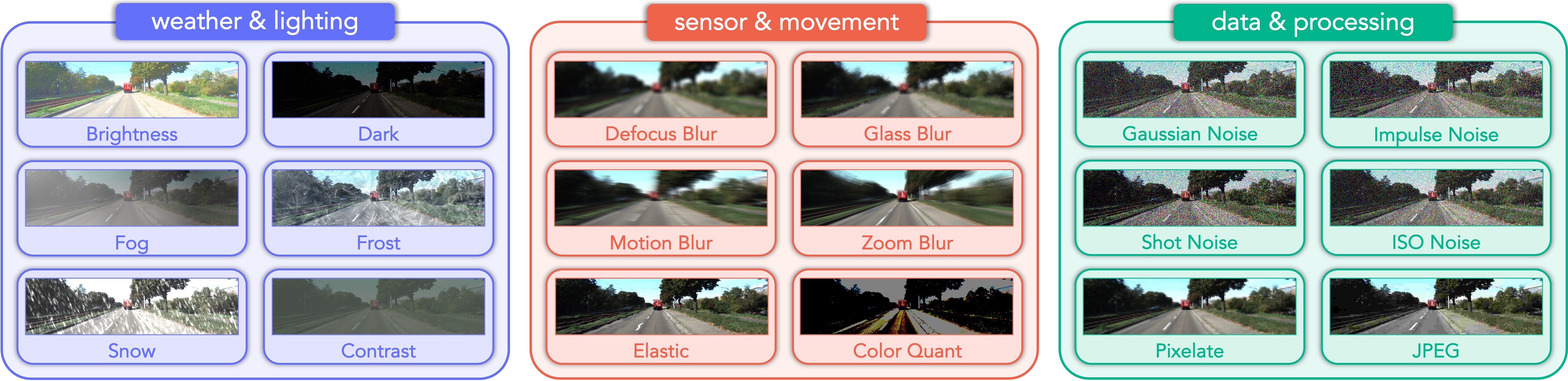
Depth estimation from monocular images is pivotal for real-world visual perception systems. While current learning-based depth estimation models train and test on meticulously curated data, they often overlook out-of-distribution (OoD) situations. Yet, in practical settings -- especially safety-critical ones like autonomous driving -- common corruptions can arise. Addressing this oversight, we introduce a comprehensive robustness test suite, RoboDepth, encompassing 18 corruptions spanning three categories: i) weather and lighting conditions; ii) sensor failures and movement; and iii) data processing anomalies. We subsequently benchmark 42 depth estimation models across indoor and outdoor scenes to assess their resilience to these corruptions. Our findings underscore that, in the absence of a dedicated robustness evaluation framework, many leading depth estimation models may be susceptible to typical corruptions. We delve into design considerations for crafting more robust depth estimation models, touching upon pre-training, augmentation, modality, model capacity, and learning paradigms. We anticipate our benchmark will establish a foundational platform for advancing robust OoD depth estimation.
Motivation & Objective
- Motivate the need for robustness evaluation in monocular depth estimation (MDE) under real-world corruptions.
- Define and release a comprehensive OoD robustness benchmark for MDE, including indoor and outdoor datasets.
- Systematically evaluate a broad set of state-of-the-art MDE models under diverse corruptions.
- Analyze how inputs, training paradigms, and model design choices affect robustness.
- Offer design considerations and guidelines to improve robustness and reliability of MDE systems.
Proposed method
- Introduce RoboDepth, an OoD robustness evaluation suite for MDE with 18 corruptions across weather/lighting, sensor/movement, and data processing categories.
- Create three benchmarks: KITTI-C (outdoor), NYUDepth2-C (indoor), and KITTI-S (style/shifts).
- Define robustness metrics: Corruption Error (mCE) and Resilience Rate (mRR), plus a depth estimation error (DEE) metric.
- Benchmark 42 depth estimation models (outdoor and indoor) trained on KITTI or NYU-Depth2, using unified evaluation protocols.
- Open-source the corruption simulation toolkit to enable replication and extension.
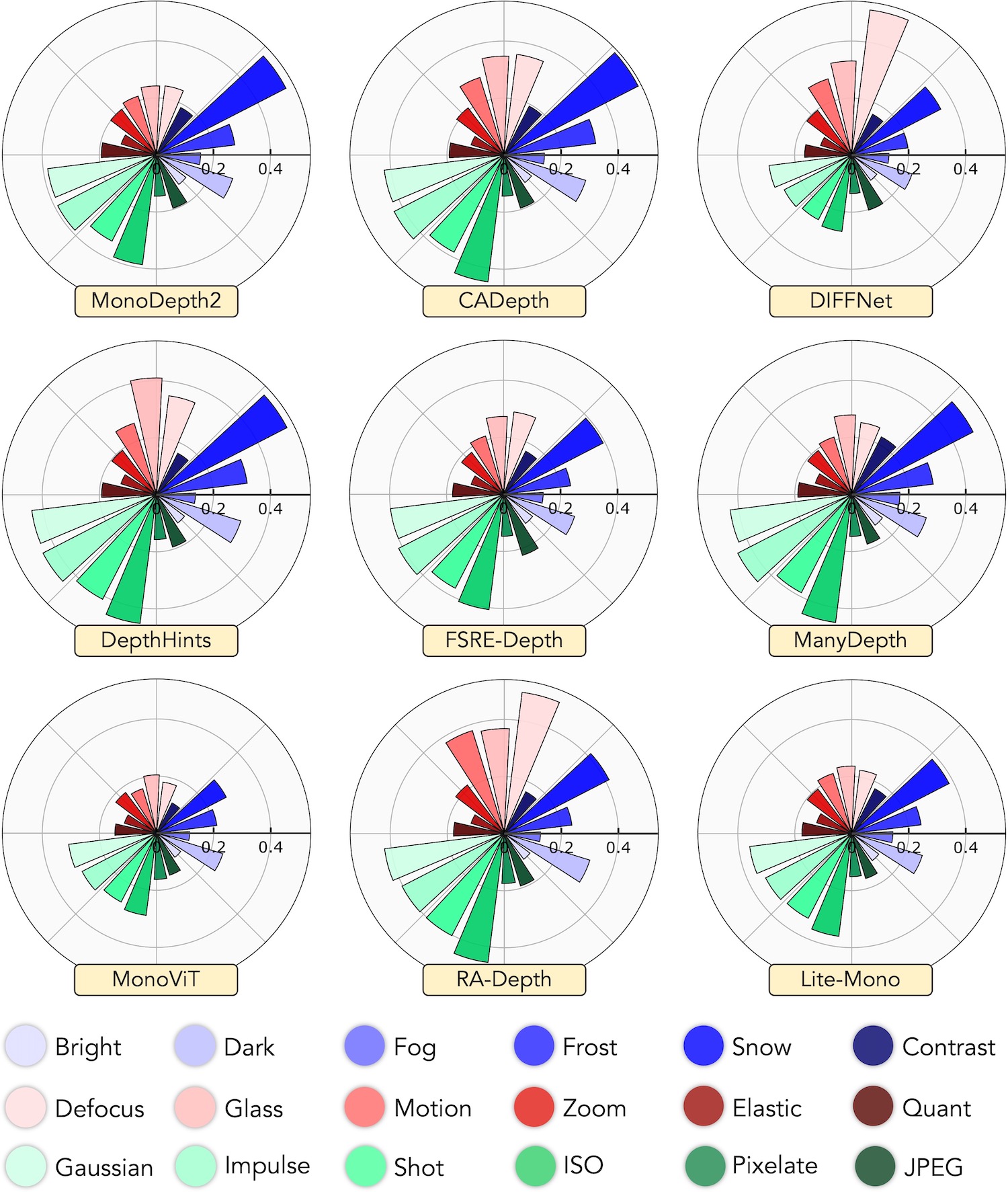
Experimental results
Research questions
- RQ1Are current MDE models robust under real-world corruptions?
- RQ2Which input modalities (monocular, stereo, or both) confer greater robustness?
- RQ3How do learning paradigms (supervised vs. self-supervised) affect robustness to corruptions?
- RQ4What model design choices (pre-training, input resolution, capacity) influence OoD depth estimation robustness?
- RQ5Are simulated corruptions realistic enough to reflect real-world scenarios?
Key findings
- State-of-the-art MDE models show vulnerability to corruptions, with robustness varying by architecture and corruption type.
- Monocular-only MDE models tend to be more robust than stereo-based ones under corruptions.
- Self-supervised MDE models can be less sensitive to lighting changes and motion blur than supervised models, but both suffer from noise.
- Higher input resolution can improve robustness to noise; larger models do not always improve robustness and may hurt it.
- Transformers-based models (e.g., MonoViT, Lite-Mono) often show stronger robustness to texture shifts and edge distortions.
Read this paper
Open the full text in the Nubint reader and ask about any passage as you read.
Read this paper on NubintThis review was generated by AI from the original paper. Please check the paper before citing it.