
[Paper Review] RoboHive: A Unified Framework for Robot Learning
RoboHive is an open-source, unified framework for robot learning that integrates diverse simulated and real-world environments with high physics fidelity and visual diversity. It provides a standardized, gym-like API, hardware abstraction via a unified RobotClass, teleoperation support, expert demonstrations (RoboSet), and comprehensive baselines—enabling seamless simulation-to-reality transfer and accelerating research in imitation, reinforcement, and multi-task learning.
We present RoboHive, a comprehensive software platform and ecosystem for research in the field of Robot Learning and Embodied Artificial Intelligence. Our platform encompasses a diverse range of pre-existing and novel environments, including dexterous manipulation with the Shadow Hand, whole-arm manipulation tasks with Franka and Fetch robots, quadruped locomotion, among others. Included environments are organized within and cover multiple domains such as hand manipulation, locomotion, multi-task, multi-agent, muscles, etc. In comparison to prior works, RoboHive offers a streamlined and unified task interface taking dependency on only a minimal set of well-maintained packages, features tasks with high physics fidelity and rich visual diversity, and supports common hardware drivers for real-world deployment. The unified interface of RoboHive offers a convenient and accessible abstraction for algorithmic research in imitation, reinforcement, multi-task, and hierarchical learning. Furthermore, RoboHive includes expert demonstrations and baseline results for most environments, providing a standard for benchmarking and comparisons. Details: https://sites.google.com/view/robohive
Motivation & Objective
- To address the fragmented landscape of robot learning software by unifying diverse environments, algorithms, and hardware interfaces into a single, maintainable ecosystem.
- To lower the barrier to entry for researchers by providing a consistent, accessible API and out-of-the-box support for simulation and real-world deployment.
- To enable robust benchmarking through standardized metrics, expert demonstrations (RoboSet), and baseline results across multiple task families.
- To support visual generalization and real-world transfer by emphasizing high physics fidelity and rich visual diversity in environments.
- To foster reproducibility and community-driven development through versioned releases, CI testing, and extensive documentation.
Proposed method
- The framework introduces a unified RobotClass abstraction that abstracts both simulated and physical robots, enabling seamless simulation-to-reality transfer via a single configuration flag.
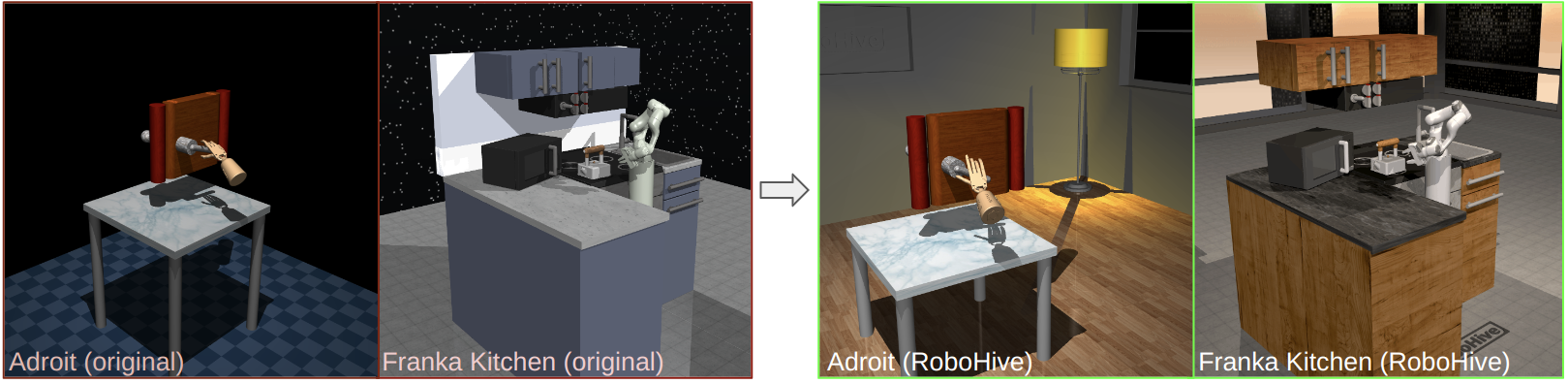
- It leverages MuJoCo for high-fidelity physics simulation and integrates rich visual assets, textures, and scene compositions to enhance visual diversity.
- Teleoperation is natively supported via keyboard, space mouse, and VR controllers, enabling collection of human-annotated expert demonstrations (RoboSet) for imitation learning.
- The platform provides a gym-like API for integration with reinforcement and imitation learning algorithms, ensuring compatibility with existing RL libraries like TorchRL and mjRL.
- Visual domain randomization and scene layout randomization are natively supported in key environments to improve robustness to visual variation.
- All environments are version-controlled with continuous integration, ensuring reliability and reproducibility across software releases.
![Figure 1: A subset of RoboHive ’s task-suites. [in clockwise order] Multi-Task Suite : Environments facilitating multiple tasks at once. Arms Suite : Diverse arms (w/ grippers) exposed to tabletop manipulation tasks. Hand Suite : Diverse hands exposed to tasks requiring dexterity. Locomotion Suite :](https://ar5iv.labs.arxiv.org/html/2310.06828/assets/x1.jpeg)
Experimental results
Research questions
- RQ1How can a unified software framework streamline the development and benchmarking of robot learning algorithms across diverse tasks and hardware?
- RQ2To what extent does high visual and physical fidelity in simulated environments improve policy generalization and real-world transfer?
- RQ3Can a standardized, accessible interface accelerate research in imitation, multi-task, and hierarchical reinforcement learning?
- RQ4How effective are expert demonstrations collected via teleoperation in enabling sample-efficient learning across complex manipulation and locomotion tasks?
- RQ5What is the impact of visual diversity and domain randomization on the robustness of vision-based control policies?
Key findings
- RoboHive supports a wide range of tasks across manipulation, locomotion, dexterous hand control, musculoskeletal agents, and deformable objects, with environments built on MuJoCo for high physics fidelity.
- The framework enables seamless simulation-to-reality transfer via a single flag change using the unified RobotClass abstraction, significantly reducing deployment overhead.
- RoboSet, a large-scale human-teleoperated dataset of 12 kitchen skills, is open-sourced and supports research in offline and imitation learning.
- Baselines for commonly used algorithms are provided and versioned, with performance tracking across releases to ensure reproducibility and detect regressions.
- Experiments show that visual representations underperform proprioceptive-only baselines in locomotion tasks (e.g., ROBEL with D’Kitty), highlighting the challenge of visual generalization.
- In dexterous manipulation (e.g., Pen, Relocate), behavior cloning with only 25 demonstrations struggles, underscoring the difficulty of learning multimodal action distributions from limited expert data.
Better researchstarts right now
From reading papers to final review, dramatically reduce your research time.
No credit card · Free plan available
This review was created by AI and reviewed by human editors.