
[Paper Review] Robust Distortion-free Watermarks for Language Models
This paper presents distortion-free, robust watermarks for autoregressive language models, with agnostic detection, and validates strong detection under substantial edits on OPT-1.3B, LLaMA-7B, and Alpaca-7B.
We propose a methodology for planting watermarks in text from an autoregressive language model that are robust to perturbations without changing the distribution over text up to a certain maximum generation budget. We generate watermarked text by mapping a sequence of random numbers -- which we compute using a randomized watermark key -- to a sample from the language model. To detect watermarked text, any party who knows the key can align the text to the random number sequence. We instantiate our watermark methodology with two sampling schemes: inverse transform sampling and exponential minimum sampling. We apply these watermarks to three language models -- OPT-1.3B, LLaMA-7B and Alpaca-7B -- to experimentally validate their statistical power and robustness to various paraphrasing attacks. Notably, for both the OPT-1.3B and LLaMA-7B models, we find we can reliably detect watermarked text ($p \leq 0.01$) from $35$ tokens even after corrupting between $40$-$50\%$ of the tokens via random edits (i.e., substitutions, insertions or deletions). For the Alpaca-7B model, we conduct a case study on the feasibility of watermarking responses to typical user instructions. Due to the lower entropy of the responses, detection is more difficult: around $25\%$ of the responses -- whose median length is around $100$ tokens -- are detectable with $p \leq 0.01$, and the watermark is also less robust to certain automated paraphrasing attacks we implement.
Motivation & Objective
- Motivate provenance and attribution for text generated by language models.
- Develop watermarks that preserve the original text distribution (distortion-free).
- Create a model-agnostic detector that works without prompt knowledge.
- Ensure robustness of watermark detection under text perturbations such as edits and paraphrasing.
Proposed method
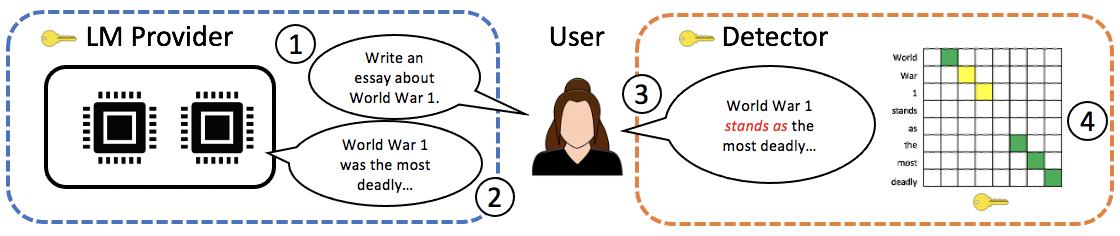
- Define a watermark protocol with a shared watermark key between the LM provider and detector.
- Introduce a generate function that maps a random key sequence to model samples while preserving the model’s distribution (distortion-free).
- Define a detect function that uses robust sequence alignment to test whether text depends on the watermark key and outputs a p-value.
- Instantiate two sampling schemes: inverse transform sampling and exponential minimum sampling.
- Provide a randomized wrapper shift_generate to avoid reusing the same watermark subsequences across queries and maintain stochasticity.
- Prove distortion-freeness of decoders and derive p-value bounds that scale with text length and watermark key length.
Experimental results
Research questions
- RQ1How can a watermark be embedded in language model outputs without distorting the output distribution?
- RQ2Can a watermark be detected robustly even after substantial text edits or paraphrasing?
- RQ3What are the theoretical limits on detectability (p-values) given watermark potential and text length?
- RQ4How do different sampling strategies (inverse transform vs exponential minimum) compare in power and robustness?
Key findings
- Watermarks are distortion-free: the generate function yields text with the same distribution as the base language model when averaged over the watermark key sequence.
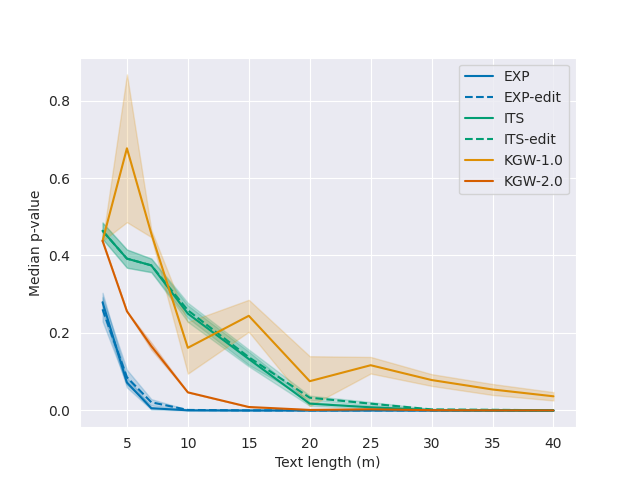
- Detection power increases exponentially with text length and decreases only linearly with the watermark key length.
- With exponential minimum sampling, detectors achieve p ≤ 0.01 detection from 35 tokens for OPT-1.3B and LLaMA-7B even after 40–50% token substitutions/edits.
- For Alpaca-7B, about 25% of responses (median length ~100 tokens) are detectable with p ≤ 0.01 and robustness to certain automated paraphrasing is weaker.
- Watermark detection remains possible under paraphrasing (translation to French/Russian and back) for the larger models, but robustness varies by model.
Read this paper
Open the full text in the Nubint reader and ask about any passage as you read.
Read this paper on NubintThis review was generated by AI from the original paper. Please check the paper before citing it.