
[Paper Review] Robust Failure Diagnosis of Microservice System through Multimodal Data
This paper proposes DiagFusion, a robust failure diagnosis approach for microservice systems that unifies multimodal data (traces, logs, metrics) using fastText embeddings and graph neural networks (GNNs) on a dependency graph. It improves root cause localization by 20.9% to 368% and failure type detection by 11.0% to 169% over existing methods, leveraging data augmentation to address class imbalance.
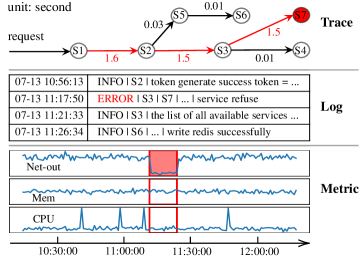
Automatic failure diagnosis is crucial for large microservice systems. Currently, most failure diagnosis methods rely solely on single-modal data (i.e., using either metrics, logs, or traces). In this study, we conduct an empirical study using real-world failure cases to show that combining these sources of data (multimodal data) leads to a more accurate diagnosis. However, effectively representing these data and addressing imbalanced failures remain challenging. To tackle these issues, we propose DiagFusion, a robust failure diagnosis approach that uses multimodal data. It leverages embedding techniques and data augmentation to represent the multimodal data of service instances, combines deployment data and traces to build a dependency graph, and uses a graph neural network to localize the root cause instance and determine the failure type. Our evaluations using real-world datasets show that DiagFusion outperforms existing methods in terms of root cause instance localization (improving by 20.9% to 368%) and failure type determination (improving by 11.0% to 169%).
Motivation & Objective
- To address the limitations of single-modal failure diagnosis in microservice systems, which often miss failure patterns due to incomplete data coverage.
- To overcome the challenge of representing heterogeneous multimodal data (traces, logs, metrics) in a unified, informative way for diagnosis.
- To mitigate the impact of imbalanced failure types in training data, which hampers model generalization and performance.
- To integrate system topology (via dependency graphs) with instance-level event representations for more accurate root cause localization.
Proposed method
- Extracts events from traces, logs, and metrics using lightweight parsing and pattern recognition.
- Applies fastText embeddings to unify event representations across different modalities into a shared vector space.
- Constructs a dependency graph using trace and deployment data to model service interactions and propagation paths.
- Employs data augmentation during training to balance rare failure types and improve model robustness.
- Integrates event embeddings with the dependency graph using a Graph Neural Network (GNN) to infer root cause instances and failure types.
- Uses end-to-end training to jointly optimize for root cause localization and failure type classification.
Experimental results
Research questions
- RQ1Can combining multimodal data (traces, logs, metrics) significantly improve failure diagnosis accuracy compared to single-modal approaches in real-world microservice systems?
- RQ2How can heterogeneous data formats (time series, text, tree-structured traces) be effectively unified into a common representation for diagnosis?
- RQ3To what extent can data augmentation mitigate performance degradation caused by imbalanced failure types in microservice failure datasets?
- RQ4How does incorporating system topology via a dependency graph enhance root cause localization compared to methods that ignore architectural relationships?
Key findings
- DiagFusion improves root cause instance localization accuracy by 20.9% to 368% compared to state-of-the-art single-modal and multimodal methods.
- Failure type determination is enhanced by 11.0% to 169% over existing approaches, demonstrating superior classification performance.
- The use of fastText embeddings enables effective cross-modal representation learning, capturing semantic and temporal patterns across logs, traces, and metrics.
- Data augmentation significantly improves model generalization on rare failure types, reducing performance drop on imbalanced datasets.
- The integration of GNNs with dependency graphs leads to more accurate failure localization by modeling failure propagation paths.
- DiagFusion achieves strong performance even when only two of the three modalities are available, demonstrating robustness and practical deployability.
Read this paper
Open the full text in the Nubint reader and ask about any passage as you read.
Read this paper on NubintThis review was generated by AI from the original paper. Please check the paper before citing it.