
[Paper Review] Robust High-Resolution Video Matting with Temporal Guidance
This paper proposes a lightweight, real-time video matting method using a recurrent architecture with temporal guidance to improve temporal coherence and robustness in high-resolution human video matting. By jointly training on matting and semantic segmentation objectives, the model achieves state-of-the-art performance—processing 4K video at 76 FPS and HD at 104 FPS—without requiring trimaps or pre-captured backgrounds.
We introduce a robust, real-time, high-resolution human video matting method that achieves new state-of-the-art performance. Our method is much lighter than previous approaches and can process 4K at 76 FPS and HD at 104 FPS on an Nvidia GTX 1080Ti GPU. Unlike most existing methods that perform video matting frame-by-frame as independent images, our method uses a recurrent architecture to exploit temporal information in videos and achieves significant improvements in temporal coherence and matting quality. Furthermore, we propose a novel training strategy that enforces our network on both matting and segmentation objectives. This significantly improves our model's robustness. Our method does not require any auxiliary inputs such as a trimap or a pre-captured background image, so it can be widely applied to existing human matting applications.
Motivation & Objective
- To develop a real-time, high-resolution video matting method that improves temporal coherence and robustness without relying on auxiliary inputs like trimaps or background images.
- To address the limitations of frame-by-frame matting methods that ignore temporal consistency and suffer from flicker and artifacts.
- To enhance model generalization by jointly training on matting and semantic segmentation objectives, reducing overfitting to synthetic data distributions.
- To enable practical deployment in real-world applications such as video conferencing and content creation by ensuring fast inference and high-quality results.
Proposed method
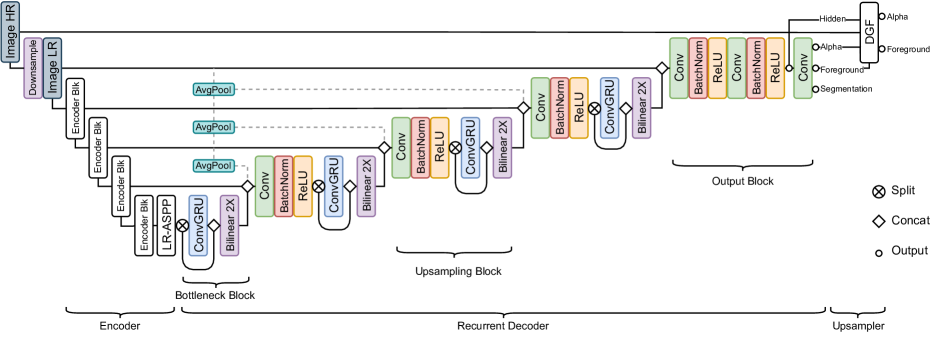
- Employs a recurrent neural network architecture that leverages hidden states to model temporal dependencies across video frames, improving temporal coherence.
- Introduces a novel training strategy that jointly optimizes for both alpha matte prediction and semantic segmentation, enhancing robustness to real-world variations.
- Uses a deep guided filter (DGF) with recurrent decoder features to refine high-resolution alpha matte predictions, preserving fine details.
- Adopts a lightweight MobileNetV3-based encoder with LR-ASPP for efficient feature extraction and high-resolution output.
- Designs a training pipeline that combines synthetic matting data with real image segmentation supervision, reducing domain shift.
- Eliminates the need for external inputs such as trimaps or pre-captured backgrounds, enabling plug-and-play deployment.
Experimental results
Research questions
- RQ1Can a recurrent architecture significantly improve temporal coherence in high-resolution video matting compared to frame-independent methods?
- RQ2Does joint training on matting and semantic segmentation objectives enhance robustness to real-world video variations and reduce overfitting to synthetic data?
- RQ3How does the proposed method perform on dynamic backgrounds and complex scenes where background reconstruction is challenging?
- RQ4To what extent does the deep guided filter (DGF) improve detail accuracy and temporal consistency compared to standard guided filters?
- RQ5Can a lightweight model achieve state-of-the-art performance while maintaining real-time inference on 4K and HD video?
Key findings
- The model achieves 76 FPS on 4K and 104 FPS on HD video using an NVIDIA GTX 1080Ti, outperforming previous methods in speed and model efficiency.
- The method achieves 61.50 mIOU on COCO validation set for human segmentation, demonstrating strong robustness on real images.
- Joint training with segmentation objective improves generalization: the model achieves 60.88 mIOU on COCO when thresholding alpha > 0.5, compared to only 38.24 mIOU when trained without segmentation supervision.
- The deep guided filter (DGF) improves Grad metric by 1.38 points and reduces dtSSD by 0.25 compared to FGF, indicating better detail accuracy and temporal consistency.
- On dynamic backgrounds, the model outperforms BGMv2 (which fails under misalignment) and MODNet, achieving lower MAD (7.50 vs. 11.23) and MSE (2.80 vs. 5.65).
- A larger model with ResNet50 backbone and expanded decoder channels achieves 71.1 FPS at 102.9 MB, with improved metrics (MAD: 5.81, Grad: 9.65), showing scalability for server-side use.

Read this paper
Open the full text in the Nubint reader and ask about any passage as you read.
Read this paper on NubintThis review was generated by AI from the original paper. Please check the paper before citing it.