
[Paper Review] Robust Privatization with Multiple Tasks and the Optimal Privacy-Utility Tradeoff
This paper proposes a robust privatization framework for data release under non-specific tasks, minimizing privacy leakage while satisfying utility constraints across multiple possible tasks. By decomposing the problem into parallel privacy funnel problems with weighted components, it derives a closed-form solution for deterministic private features and shows the optimal weighting can be found via linear programming, achieving the minimal privacy leakage with a sufficient released rate.
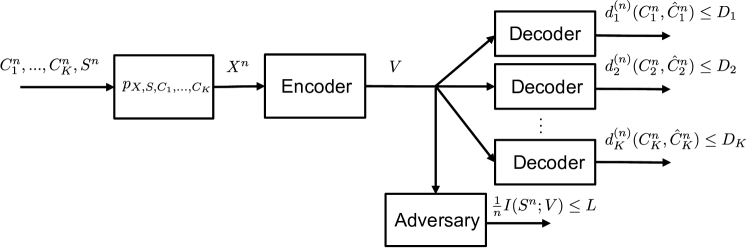
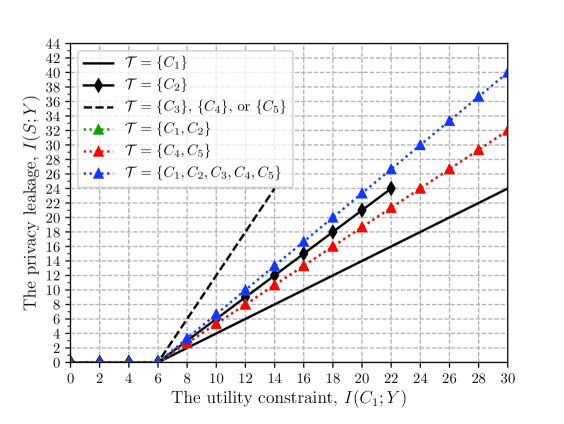
In this work, fundamental limits and optimal mechanisms of privacy-preserving data release that aims to minimize the privacy leakage under utility constraints of a set of multiple tasks are investigated. While the private feature to be protected is typically determined and known by the sanitizer, the target task is usually unknown. To address the lack of information on the specific task, utility constraints laid on a set of multiple possible tasks are considered. The mechanism protects the specific privacy feature of the to-be-released data while satisfying utility constraints of all possible tasks in the set. First, the single-letter characterization of the rate-leakage-distortion region is derived, where the utility of each task is measured by a distortion function. It turns out that the minimum privacy leakage problem with log-loss distortion constraints and the unconstrained released rate is a non-convex optimization problem. Second, focusing on the case where the raw data consists of multiple independent components, we show that the above non-convex optimization problem can be decomposed into multiple parallel privacy funnel (PF) problems with different weightings. We explicitly derive the optimal solution to each PF problem when the private feature is a component-wise deterministic function of a data vector. The solution is characterized by a leakage-free threshold: when the utility constraint is below the threshold, the minimum leakage is zero; once the required utility level is above the threshold, the privacy leakage increases linearly. Finally, we show that the optimal weighting of each privacy funnel problem can be found by solving a linear program (LP). A sufficient released rate to achieve the minimum leakage is also derived. Numerical results are shown to illustrate the robustness of our approach against the task non-specificity.
Motivation & Objective
- To address the challenge of protecting privacy when the specific downstream task using released data is unknown.
- To minimize privacy leakage under utility constraints for a set of possible tasks, ensuring robustness against task non-specificity.
- To derive fundamental limits of the privacy-utility tradeoff in an information-theoretic framework with log-loss distortion.
- To show that the optimal solution can be obtained by decomposing the problem into parallel privacy funnel problems with weighted components.
- To establish a sufficient released rate for achieving minimum privacy leakage and provide a linear programming formulation for optimal weighting.
Proposed method
- The paper formulates the privacy-utility tradeoff using log-loss distortion as the utility metric and mutual information as the privacy metric.
- It derives a single-letter characterization of the rate-leakage-distortion region for multiple utility constraints.
- Under the assumption of independent data components and deterministic private features, the problem is decomposed into parallel privacy funnel problems with distinct weightings.
- Each privacy funnel problem is solved in closed form, revealing a leakage-free threshold beyond which privacy leakage increases linearly.
- The optimal weighting for each component is determined by solving a linear program (LP), enabling efficient computation of the minimal leakage.
- A sufficient released rate for achieving the minimum leakage is derived, ensuring feasibility of the optimal solution.
Experimental results
Research questions
- RQ1What is the fundamental limit of privacy-utility tradeoff when the downstream task is unknown and multiple tasks are possible?
- RQ2How can privacy leakage be minimized under utility constraints for a set of possible tasks?
- RQ3Can the non-convex optimization problem for minimum privacy leakage be decomposed into simpler subproblems?
- RQ4What is the optimal weighting of data components in a privatization mechanism to minimize leakage under multiple utility constraints?
- RQ5What is the sufficient released rate required to achieve the optimal privacy-utility tradeoff in the robust setting?
Key findings
- The minimum privacy leakage problem with multiple utility constraints is non-convex, but under independence and deterministic private features, it decomposes into parallel privacy funnel problems.
- For each component, the privacy leakage is zero below a leakage-free threshold; above the threshold, it increases linearly with the required utility level.
- The optimal weighting for each privacy funnel component can be computed via a linear program, enabling efficient optimization.
- The sufficient released rate to achieve minimum leakage is derived and shown to be tight when parallelized privatization is used.
- Numerical results confirm the robustness of the approach against task non-specificity and demonstrate the impact of task set selection on the privacy-utility tradeoff.
- The framework extends to differential privacy, where the minimum leakage problem also decomposes into parallel single-constraint problems, though closed-form solutions remain open.
Read this paper
Open the full text in the Nubint reader and ask about any passage as you read.
Read this paper on NubintThis review was generated by AI from the original paper. Please check the paper before citing it.