
[Paper Review] Robust Tiny Object Detection in Aerial Images amidst Label Noise
The paper analyzes label noise in tiny object detection for aerial imagery and introduces DN-TOD, a robust detector with class-aware label correction and trend-guided learning to mitigate class shifts and bounding-box noise.
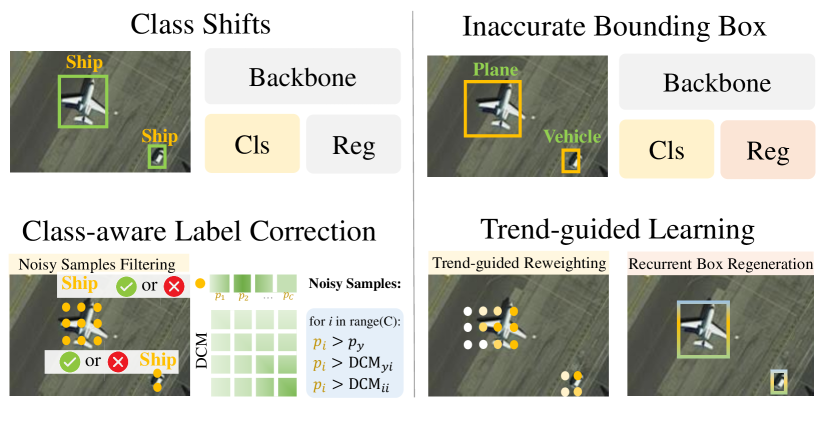
Precise detection of tiny objects in remote sensing imagery remains a significant challenge due to their limited visual information and frequent occurrence within scenes. This challenge is further exacerbated by the practical burden and inherent errors associated with manual annotation: annotating tiny objects is laborious and prone to errors (i.e., label noise). Training detectors for such objects using noisy labels often leads to suboptimal performance, with networks tending to overfit on noisy labels. In this study, we address the intricate issue of tiny object detection under noisy label supervision. We systematically investigate the impact of various types of noise on network training, revealing the vulnerability of object detectors to class shifts and inaccurate bounding boxes for tiny objects. To mitigate these challenges, we propose a DeNoising Tiny Object Detector (DN-TOD), which incorporates a Class-aware Label Correction (CLC) scheme to address class shifts and a Trend-guided Learning Strategy (TLS) to handle bounding box noise. CLC mitigates inaccurate class supervision by identifying and filtering out class-shifted positive samples, while TLS reduces noisy box-induced erroneous supervision through sample reweighting and bounding box regeneration. Additionally, Our method can be seamlessly integrated into both one-stage and two-stage object detection pipelines. Comprehensive experiments conducted on synthetic (i.e., noisy AI-TOD-v2.0 and DOTA-v2.0) and real-world (i.e., AI-TOD) noisy datasets demonstrate the robustness of DN-TOD under various types of label noise. Notably, when applied to the strong baseline RFLA, DN-TOD exhibits a noteworthy performance improvement of 4.9 points under 40% mixed noise. Datasets, codes, and models will be made publicly available.
Motivation & Objective
- Investigate how different label-noise types affect tiny object detectors in aerial imagery.
- Identify the most damaging noise types for TOD performance.
- Develop a robust detector (DN-TOD) to mitigate class-shift and bounding-box noise.
- Demonstrate DN-TOD's effectiveness across synthetic and real-world noisy datasets.
- Show that DN-TOD is compatible with both one-stage and two-stage detectors.
Proposed method
- Introduce DeNoising Tiny Object Detector (DN-TOD).
- Add Class-aware Label Correction (CLC) to address class shifts via a Dynamic Confidence Matrix (DCM) and sample filtering.
- Add Trend-guided Learning Strategy (TLS) with Trend-guided Reweighting (TLR) for classification and Recurrent Box Regeneration (RBR) for regression.
- CLC filters noisy positives by comparing class predictions against the DCM and confidence.
- TLS uses sample learning trends to reweight classification loss and regenerates box targets by fusing past predictions with GT (RBR).
- Demonstrate plug-and-play integration into FCOS (one-stage) and Faster R-CNN (two-stage) with RFLA.
Experimental results
Research questions
- RQ1How do missing labels, extra labels, class shifts, and inaccurate bounding boxes affect TOD under label noise?
- RQ2Which two noise types most significantly degrade tiny object detection performance?
- RQ3Can a denoising detector using class-aware correction and trend-guided learning improve robustness under label noise?
- RQ4How well does DN-TOD generalize to synthetic noisy datasets (AI-TOD-v2.0, DOTA-v2.0) and real-world noisy data (AI-TOD)?
Key findings
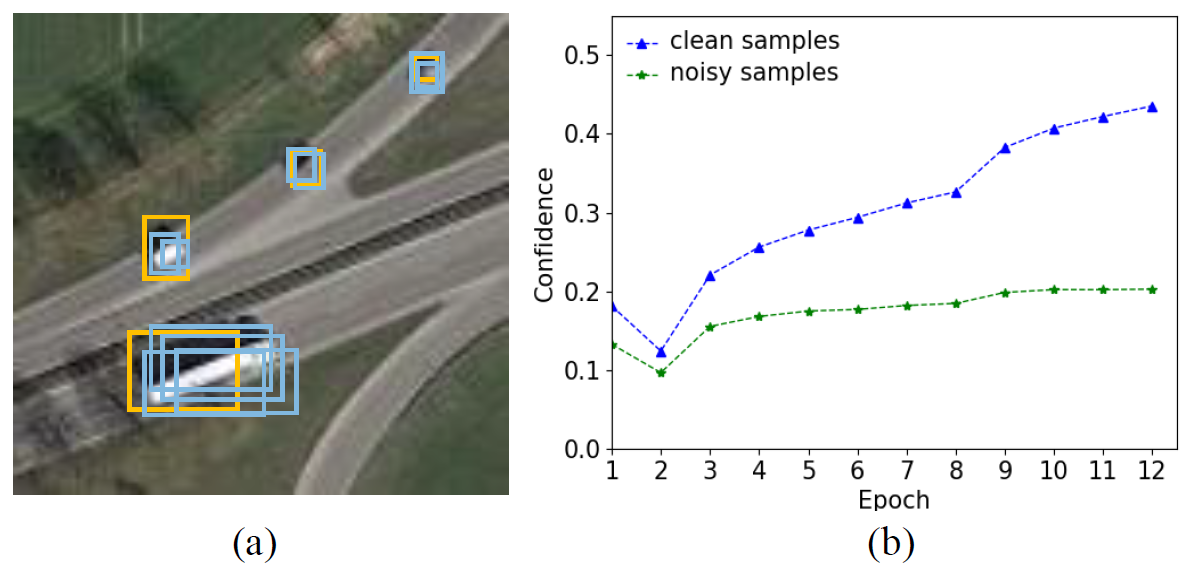
- Class shifts and inaccurate bounding boxes severely reduce TOD performance, more so than missing or extra labels.
- DN-TOD with CLC and TLS outperforms strong baselines under various noise settings on AI-TOD-v2.0, DOTA-v2.0, and AI-TOD datasets.
- DN-TOD improves the strong baseline RFLA by about 4.9 points under 40% mixed noise.
- Under box-noise experiments, TLS improves one-stage FCOS* by up to 7.2 AP under 20% noise and strengthens two-stage Faster R-CNN* as well.
- DN-TOD shows robust gains across synthetic noisy datasets and real-world noisy data, indicating practical applicability.
Read this paper
Open the full text in the Nubint reader and ask about any passage as you read.
Read this paper on NubintThis review was generated by AI from the original paper. Please check the paper before citing it.