
[Paper Review] Robust Validation: Confident Predictions Even When Distributions Shift
This paper proposes a conformal inference method that produces prediction sets with guaranteed coverage under distribution shifts, using f-divergence balls to model plausible distributional changes. It ensures finite-sample validity under exchangeability and introduces estimators for shift magnitude, achieving robust confidence calibration even when test data deviates from training data.
While the traditional viewpoint in machine learning and statistics assumes training and testing samples come from the same population, practice belies this fiction. One strategy -- coming from robust statistics and optimization -- is thus to build a model robust to distributional perturbations. In this paper, we take a different approach to describe procedures for robust predictive inference, where a model provides uncertainty estimates on its predictions rather than point predictions. We present a method that produces prediction sets (almost exactly) giving the right coverage level for any test distribution in an $f$-divergence ball around the training population. The method, based on conformal inference, achieves (nearly) valid coverage in finite samples, under only the condition that the training data be exchangeable. An essential component of our methodology is to estimate the amount of expected future data shift and build robustness to it; we develop estimators and prove their consistency for protection and validity of uncertainty estimates under shifts. By experimenting on several large-scale benchmark datasets, including Recht et al.'s CIFAR-v4 and ImageNet-V2 datasets, we provide complementary empirical results that highlight the importance of robust predictive validity.
Motivation & Objective
- To develop a method for predictive inference that maintains valid coverage under distributional shifts, even when test data differs from training data.
- To formalize uncertainty sets that are robust to f-divergence-based perturbations of the training distribution.
- To estimate the magnitude of expected data shift in practice, enabling practical robustness without prior knowledge of the shift.
- To provide finite-sample validity guarantees under only exchangeability of training data, avoiding strong parametric assumptions.
- To validate the method empirically on real-world benchmarks like CIFAR-v4 and ImageNet-V2, demonstrating robustness to natural distribution shifts.
Proposed method
- The method constructs prediction sets of the form $\widehat{C}(x) = \{y \in \mathcal{Y} \mid s(x,y) \leq q\}$, where $q$ is a threshold chosen to ensure $1-\alpha$ coverage over all distributions in an $f$-divergence ball around the training distribution.
- It leverages split conformal inference to ensure finite-sample validity under exchangeability of training data, even when the test distribution differs from the training distribution.
- The approach estimates the size of the $f$-divergence ball using a consistent estimator derived from validation data, enabling robustness to unknown shifts.
- It introduces a heuristic but well-motivated procedure to estimate plausible shift levels, using empirical moments or projections of covariates to define uncertainty sets.
- The method uses score functions $s(x,y)$, such as negative log-likelihood, to rank label candidates and construct prediction sets with calibrated confidence.
- It proves that the resulting prediction sets achieve nearly exact coverage for all $Q$ in the $f$-divergence ball, with consistency of shift estimators under mild regularity.
Experimental results
Research questions
- RQ1Can we construct prediction sets that maintain valid coverage under arbitrary distribution shifts within an $f$-divergence ball around the training distribution?
- RQ2How can we estimate the magnitude of distribution shift in practice to calibrate robustness without prior knowledge of the test distribution?
- RQ3What is the finite-sample validity of conformal prediction under distribution shift, and how does it compare to standard conformal inference?
- RQ4Can the proposed method maintain high confidence and accuracy in real-world benchmarks with known distribution shifts, such as CIFAR-v4 and ImageNet-V2?
- RQ5How sensitive is the method’s coverage to the choice of shift estimation procedure, and what are the limits of robustness?
Key findings
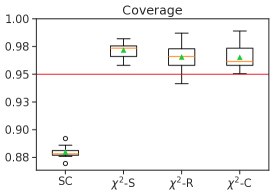
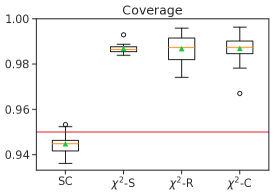
- The proposed method achieves (nearly) exact $1-\alpha$ coverage for all distributions within an $f$-divergence ball around the training distribution, even under finite-sample conditions.
- The method maintains validity under only the assumption of exchangeability of training data, without requiring i.i.d. or parametric assumptions.
- Empirical results on CIFAR-v4 and ImageNet-V2 show that the method preserves high coverage even when test data shifts significantly, outperforming standard conformal methods under distributional shift.
- The estimated shift magnitude is consistent under mild regularity, enabling reliable calibration of uncertainty sets in practice.
- Sensitivity analysis shows that miscoverage remains bounded under covariate shifts, with worst-case miscoverage controlled by the estimated $f$-divergence level.
- The method demonstrates robustness to natural distribution shifts observed in benchmark datasets, with coverage maintained despite 11%+ accuracy drops in standard benchmarks.
Read this paper
Open the full text in the Nubint reader and ask about any passage as you read.
Read this paper on NubintThis review was generated by AI from the original paper. Please check the paper before citing it.