
[Paper Review] Robustness and Directed Structures in Ecological Flow Networks
This paper investigates how realistic network structures in ecological flow networks affect robustness under random arc failure, focusing on two functionalities: coherence (via lateral connectedness) and circulation (via strong connectedness). Using theoretical percolation models on the configuration model, it finds that realistic degree distributions enhance robustness for coherence but degrade it for circulation, revealing a fundamental trade-off in network design for biological systems.
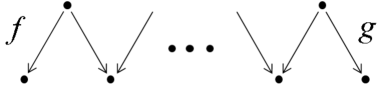
Robustness of ecological flow networks under random failure of arcs is considered with respect to two different functionalities: coherence and circulation. In our previous work, we showed that each functionality is associated with a natural path notion: lateral path for the former and directed path for the latter. Robustness of a network is measured in terms of the size of the giant laterally connected arc component and that of the giant strongly connected arc component, respectively. We study how realistic structures of ecological flow networks affect the robustness with respect to each functionality. To quantify the impact of realistic network structures, two null models are considered for a given real ecological flow network: one is random networks with the same degree distribution and the other is those with the same average degree. Robustness of the null models is calculated by theoretically solving the size of giant components for the configuration model. We show that realistic network structures have positive effect on robustness for coherence, whereas they have negative effect on robustness for circulation.
Motivation & Objective
- To understand how realistic structural features of ecological flow networks influence their robustness under random arc failure.
- To distinguish between robustness for coherence (lateral connectedness) and circulation (strong connectedness) in directed ecological networks.
- To quantify the impact of real network structures by comparing with two null models: random networks with the same degree distribution and those with the same average degree.
- To reveal whether realistic network features enhance or degrade robustness for different functional roles in ecological systems.
Proposed method
- Theoretical analysis of percolation on the configuration model for directed networks with arbitrary joint in- and out-degree distributions.
- Use of generating functions to derive the size of the giant laterally connected arc component (GLCC) and the giant strongly connected arc component (GSCC) under random arc removal.
- Application of the configuration model to compute robustness metrics for null models: one with the same degree distribution and another with the same average degree.
- Simulation-based estimation of GLCC and GSCC sizes in real ecological networks by averaging over 1000 random arc removal sequences.
- Definition of robustness complement ratios to compare real networks against null models, isolating the effect of realistic structures.
- Use of the generating function formalism to solve for the critical thresholds and component sizes in the configuration model.
Experimental results
Research questions
- RQ1How do realistic network structures affect the robustness of ecological flow networks with respect to coherence (lateral connectedness)?
- RQ2How do realistic network structures affect the robustness of ecological flow networks with respect to circulation (strong connectedness)?
- RQ3To what extent do degree distributions alone explain the observed differences in robustness between real networks and null models?
- RQ4Is there a trade-off between robustness for coherence and robustness for circulation in ecological networks?
- RQ5Can the configuration model accurately predict the robustness behavior of real ecological flow networks under random failure?
Key findings
- Realistic network structures significantly enhance robustness for coherence, as measured by the giant laterally connected component (GLCC), with robustness complement ratios indicating a strong positive effect.
- In contrast, realistic degree distributions degrade robustness for circulation, as indicated by the giant strongly connected component (GSCC), with the robustness complement ratio $ R_S $ showing negative values in most cases.
- The robustness gain for GLCC is nearly unity across all network types, as even Poissonian null models already achieve $ R_L \approx 0.5 $, suggesting that realistic structures provide a marginal but consistent improvement.
- For GSCC, the realistic degree distribution is the dominant factor in reducing robustness, with $ R_S $ values consistently below 1 across all 10 networks analyzed.
- The opposite trends in robustness for coherence and circulation reveal a fundamental trade-off: ecological networks are robust to failure for one function but fragile for another, despite identical failure mechanisms.
- The results support the 'autocatalytic view' of ecological networks, where complex, non-random structures may promote stability in certain dynamic modes while increasing vulnerability in others.
Read this paper
Open the full text in the Nubint reader and ask about any passage as you read.
Read this paper on NubintThis review was generated by AI from the original paper. Please check the paper before citing it.