
[Paper Review] RoCo: Dialectic Multi-Robot Collaboration with Large Language Models
RoCo introduces a dialectic, LLM-based framework for coordinating multi-robot teams and planning motions, evaluated on a new RoCoBench benchmark, with human-in-the-loop and zero-shot adaptation capabilities.
We propose a novel approach to multi-robot collaboration that harnesses the power of pre-trained large language models (LLMs) for both high-level communication and low-level path planning. Robots are equipped with LLMs to discuss and collectively reason task strategies. They then generate sub-task plans and task space waypoint paths, which are used by a multi-arm motion planner to accelerate trajectory planning. We also provide feedback from the environment, such as collision checking, and prompt the LLM agents to improve their plan and waypoints in-context. For evaluation, we introduce RoCoBench, a 6-task benchmark covering a wide range of multi-robot collaboration scenarios, accompanied by a text-only dataset for agent representation and reasoning. We experimentally demonstrate the effectiveness of our approach -- it achieves high success rates across all tasks in RoCoBench and adapts to variations in task semantics. Our dialog setup offers high interpretability and flexibility -- in real world experiments, we show RoCo easily incorporates human-in-the-loop, where a user can communicate and collaborate with a robot agent to complete tasks together. See project website https://project-roco.github.io for videos and code.
Motivation & Objective
- Motivate and enable zero-shot, flexible multi-robot collaboration without task-specific training.
- Leverage LLMs for high-level dialogue-based coordination and low-level motion planning.
- Provide environment feedback to improve in-context planning and validate plans before execution.
- Demonstrate adaptability to varying task semantics and human-in-the-loop collaboration.
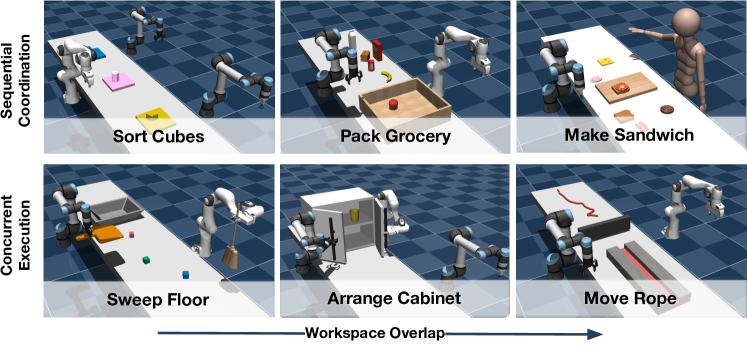
- Introduce RoCoBench to systematically evaluate multi-robot manipulation tasks.
Proposed method
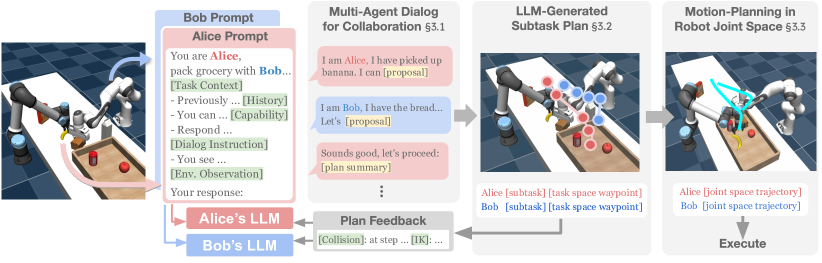
- Three-component RoCo framework: 1) multi-agent dialog via LLMs for task reasoning and coordination; 2) LLM-generated sub-task plans with environment feedback and validation; 3) LLM-informed joint-space motion planning using a centralized RRT-based planner.
- Dialogue prompts include Task Context, Round History, Agent Capability, Communication Instructions, Current Observation, and Plan Feedback to drive structured LLM reasoning.
- Sub-task plans may include optional 3D task-space waypoint paths; plans pass through a sequence of validations (Text Parsing, Task Constraints, IK feasibility, Collision, and Waypoint validity) before being executed.
- Motion planning converts validated sub-tasks to joint-space goals and uses an RRT-based planner to generate trajectories across all robot arms.
- Demonstrate 3D spatial reasoning capability of LLMs through a toy example and show reduced planner sample complexity when LLM-generated waypoints are used.
- Provide RoCoBench, a 6-task tabletop manipulation benchmark, and RoCoBench-Text for agent reasoning evaluation.
Experimental results
Research questions
- RQ1Can a dialog-based, zero-shot LLM framework coordinate multiple robot arms for diverse manipulation tasks without task-specific training?
- RQ2Does incorporating environment feedback and in-context prompts improve sub-task planning and planning efficiency in multi-robot settings?
- RQ3Do LLM-generated 3D waypoint paths reduce motion-planning sample complexity and improve planning success in high-workspace-overlap tasks?
- RQ4How well do LLM-based coordination strategies adapt to variations in task semantics and human-in-the-loop collaboration?
- RQ5What is the capability and reliability of RoCoBench as a benchmark for evaluating multi-robot collaboration with LLMs?
Key findings
- RoCo achieves high task success across RoCoBench tasks and adapts to variations in task semantics.
- Dialog-based RoCo can match or approach oracle-LMM planners on several tasks, highlighting strong zero-shot adaptation.
- LLM-proposed 3D waypoints accelerate multi-arm motion planning for placing tasks with higher collision risk.
- RoCo demonstrates robustness to object initialization, task goal changes, and varying robot capabilities in real-world tests.
- RoCoBench provides structured evaluation of task decomposition, observation sharing, and workspace overlap across tasks.
Read this paper
Open the full text in the Nubint reader and ask about any passage as you read.
Read this paper on NubintThis review was generated by AI from the original paper. Please check the paper before citing it.