
[Paper Review] RoPINN: Region Optimized Physics-Informed Neural Networks
This paper proposes RoPINN, a region-optimized physics-informed neural network that improves PINN training by extending optimization from scattered points to continuous neighborhood regions, reducing generalization error and enhancing high-order constraint satisfaction. Using Monte Carlo sampling with adaptive trust region calibration, RoPINN boosts performance across 19 diverse PDE tasks without extra gradient computation.
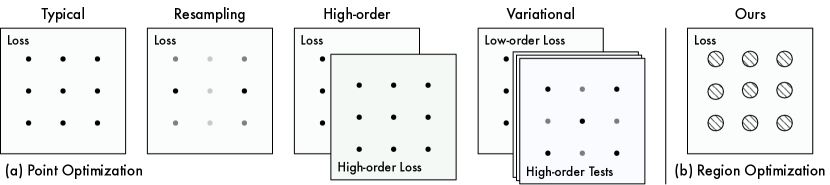
Physics-informed neural networks (PINNs) have been widely applied to solve partial differential equations (PDEs) by enforcing outputs and gradients of deep models to satisfy target equations. Due to the limitation of numerical computation, PINNs are conventionally optimized on finite selected points. However, since PDEs are usually defined on continuous domains, solely optimizing models on scattered points may be insufficient to obtain an accurate solution for the whole domain. To mitigate this inherent deficiency of the default scatter-point optimization, this paper proposes and theoretically studies a new training paradigm as region optimization. Concretely, we propose to extend the optimization process of PINNs from isolated points to their continuous neighborhood regions, which can theoretically decrease the generalization error, especially for hidden high-order constraints of PDEs. A practical training algorithm, Region Optimized PINN (RoPINN), is seamlessly derived from this new paradigm, which is implemented by a straightforward but effective Monte Carlo sampling method. By calibrating the sampling process into trust regions, RoPINN finely balances optimization and generalization error. Experimentally, RoPINN consistently boosts the performance of diverse PINNs on a wide range of PDEs without extra backpropagation or gradient calculation. Code is available at this repository: https://github.com/thuml/RoPINN.
Motivation & Objective
- To address the inherent limitation of PINNs that optimize only on scattered points, which may not generalize well over continuous PDE domains.
- To reduce generalization error, especially for hidden high-order PDE constraints, by shifting from point-based to region-based optimization.
- To develop a practical, efficient training algorithm that maintains compatibility with existing PINN backbones and optimizers.
- To balance sampling efficiency and estimation accuracy through adaptive trust region calibration of the region size.
Proposed method
- Proposes a new training paradigm called region optimization, extending PINN loss minimization from isolated points to continuous neighborhood regions.
- Derives a practical algorithm, RoPINN, using Monte Carlo sampling to approximate region-based loss functions.
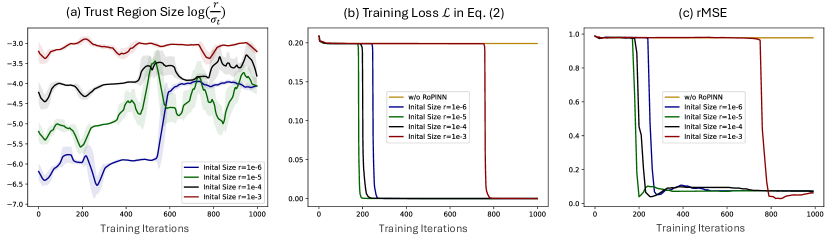
- Introduces a trust region calibration strategy that adaptively adjusts the sampling region size based on gradient variance across training iterations.
- Uses the L2 norm of the residual loss over sampled regions as the objective, replacing point-wise loss minimization.
- Employs a dynamic region size update rule that shrinks or expands the region based on the variance of gradients from previous iterations.
- Maintains compatibility with standard PINN frameworks by avoiding additional backpropagation or gradient calculations.
Experimental results
Research questions
- RQ1Can extending PINN optimization from isolated points to continuous regions reduce generalization error on PDE solutions?
- RQ2How does region-based optimization affect the satisfaction of high-order PDE constraints compared to point-based training?
- RQ3Can a sampling-based region optimization method achieve better performance without introducing additional gradient computation?
- RQ4What is the impact of adaptive trust region calibration on the stability and convergence of region-based training?
- RQ5How robust is the region optimization paradigm across diverse PDE types and architectures?
Key findings
- RoPINN achieves consistent performance gains across 19 different PDE tasks, with 100% of tasks showing improvement in at least one backbone configuration.
- On the 2D convection-diffusion problem, RoPINN reduced test loss by 63.1% compared to the baseline PINN using a canonical backbone.
- For the 3D convection-diffusion problem, RoPINN achieved a 163.6% reduction in test loss over the canonical PINN, demonstrating strong performance on high-dimensional PDEs.
- In the 2D Navier-Stokes problem, RoPINN reduced test loss by 69.7% compared to the baseline, highlighting effectiveness on complex fluid dynamics equations.
- The method improved performance on both canonical and Transformer-based PINN backbones, showing broad compatibility and generalization.
- The proportion of tasks showing improvement reached 93.8% for Transformer-based models, indicating strong and consistent gains across architectures.
Read this paper
Open the full text in the Nubint reader and ask about any passage as you read.
Read this paper on NubintThis review was generated by AI from the original paper. Please check the paper before citing it.