
[Paper Review] RTMPose: Real-Time Multi-Person Pose Estimation based on MMPose
RTMPose presents a real-time, top-down multi-person pose estimation framework built on MMPose, using SimCC-based coordinate classification, CSPNeXt backbones, and deployment-friendly optimizations to achieve high accuracy with low latency across CPU, GPU, and mobile devices.
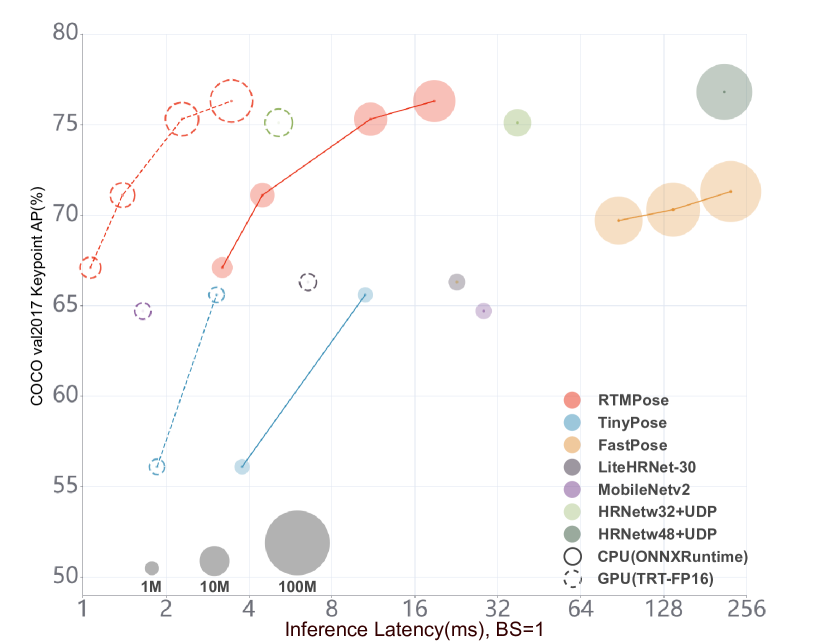
Recent studies on 2D pose estimation have achieved excellent performance on public benchmarks, yet its application in the industrial community still suffers from heavy model parameters and high latency. In order to bridge this gap, we empirically explore key factors in pose estimation including paradigm, model architecture, training strategy, and deployment, and present a high-performance real-time multi-person pose estimation framework, RTMPose, based on MMPose. Our RTMPose-m achieves 75.8% AP on COCO with 90+ FPS on an Intel i7-11700 CPU and 430+ FPS on an NVIDIA GTX 1660 Ti GPU, and RTMPose-l achieves 67.0% AP on COCO-WholeBody with 130+ FPS. To further evaluate RTMPose's capability in critical real-time applications, we also report the performance after deploying on the mobile device. Our RTMPose-s achieves 72.2% AP on COCO with 70+ FPS on a Snapdragon 865 chip, outperforming existing open-source libraries. Code and models are released at https://github.com/open-mmlab/mmpose/tree/1.x/projects/rtmpose.
Motivation & Objective
- Investigate factors affecting real-time 2D multi-person pose estimation performance (paradigm, backbone, localization, training, deployment).
- Develop a real-time pose estimation framework that balances speed and accuracy for industrial deployment.
- Demonstrate portability across CPUs, GPUs, and mobile devices using various backends and detectors.
- Provide open-source models and deployment guidance to facilitate industry adoption.
Proposed method
- Adopt a top-down pipeline using an efficient detector with a lightweight pose estimator per person.
- Use CSPNeXt backbones for a favorable speed-accuracy balance and deployment friendliness.
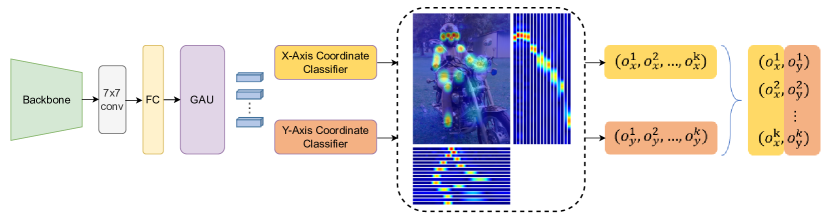
- Predict keypoints via a SimCC-based coordinate classification approach (x and y separately) with Gaussian soft labels and temperature scaling.
- Incorporate a self-attention refinement (Gated Attention Unit) to improve keypoint representations.
- Apply training strategies including UDP pre-training, EMA, flat-cosine learning rate, and two-stage strong-then-weak augmentations.
- Optimize the inference pipeline with skip-frame detection, pose NMS (OKS-based), and OneEuro smoothing; deploy across PyTorch, ONNX Runtime, TensorRT, and ncnn.
Experimental results
Research questions
- RQ1What combination of paradigm, backbone, and localization method yields the best speed-accuracy trade-off for real-time multi-person pose estimation?
- RQ2Can SimCC-based coordinate classification with targeted training and architectural choices match or exceed heatmap-based approaches in accuracy while reducing computation?
- RQ3How do deployment optimizations and platform-specific backends affect real-time performance on CPU, GPU, and mobile hardware?
Key findings
- RTMPose-m achieves 75.8% AP on COCO val with 90+ FPS on CPU and 430+ FPS on GTX 1660 Ti GPU.
- RTMPose-l achieves 74.8% AP on COCO and 76.6 GFLOPs in the reported configuration, indicating strong accuracy with moderate compute.
- RTMPose-s achieves 72.2% AP on COCO with 70+ FPS on Snapdragon 865, outperforming existing open-source mobile solutions.
- Using SimCC with CSPNeXt backbones and a GAU-based refinement yields competitive accuracy with lower computational cost than heatmap-based approaches (e.g., CT-based or transformer-heavy baselines).
- Two-stage training (pre-train on COCO with UDP, then fine-tune with strong-then-weak augmentations) and EMA improve AP by several points (demonstrated in ablations).
- Skip-frame detection and post-processing (OKS-based NMS and OneEuro filter) reduce latency and improve pose robustness across frames.
Read this paper
Open the full text in the Nubint reader and ask about any passage as you read.
Read this paper on NubintThis review was generated by AI from the original paper. Please check the paper before citing it.