
[Paper Review] Ruling out unresolved binaries in five transitional disks VLT/NACO: deep 2.12 and 1.75 μm narrow-band imaging
This study uses deep near-infrared narrow-band imaging with VLT/NACO to rule out unresolved binary companions in five transitional disks down to 0.1 arcseconds from the central stars, achieving contrast limits of 2–5 mag in the inner hole/gap region and up to 9.3 mag in outer regions. The results exclude stellar and substellar companions as the primary cause of inner cavities in most systems, favoring alternative mechanisms like planet formation or grain growth.
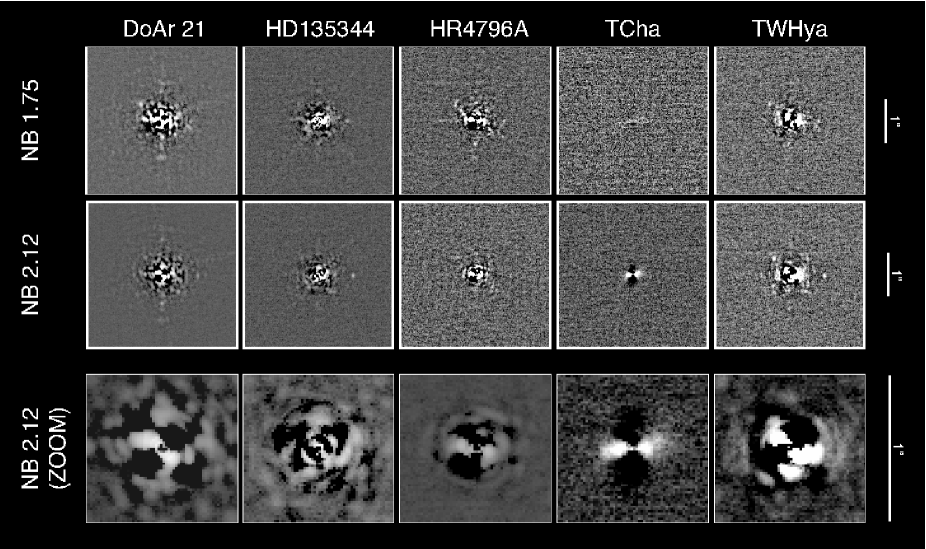
Aims. We aim at detecting the presence of companions inside the inner hole/gap region of a sample of five well known transitional disks using spatially-resolved imaging in the near-IR with the VLT/NACO/S13 camera, which probes projected distances from the primary of typically 0.1 to 7 arcsec. The sample includes the stars DoAr 21, HD 135344B (SAO 206462), HR 4796A, T Cha, and TW Hya, spanning ages of less than 1 to 10 Myr, spectral types of A0 to K7, and hole/gap outer radii of 4 to 100 AU. Methods. In order to enhance the contrast and to avoid saturation at the core of the point-spread function (PSF), we use narrow-band filters at 1.75 and 2.12 μm. The "locally optimized combination of images" (LOCI) algorithm is applied for an optimal speckle noise removal and PSF subtraction, providing an increase of 0.5-1.5 mag in contrast over the classic method. Results. With the proviso that we could have missed companions owing to unfavorable projections, the VLT/NACO observations rule out the presence of unresolved companions down to an inner radius of about 0".1 from the primary in all five transitional disks and with a detection limit of 2 to 5 mag in contrast. In the disk outer regions the detection limits typically reach 8 to 9 mag in contrast and 4.7 mag for T Cha. Hence, the NACO images resolve part of the inner hole/gap region of all disks with the exception of TW Hya, for which the inner hole is only 4 AU. The 5σ sensitivity profiles, together with a selected evolutionary model, allow to discard stellar companions within the inner hole/gap region of T Cha, and down to the substellar regime for HD 135344B and HR 4796A. DoAr 21 is the only object from the sample of five disks for which the NACO images are sensitive enough for a detection of objects less massive than \sim 13 MJup that is, potential giant planets or low-mass brown dwarfs at radii larger than \sim 76 AU (0".63).
Motivation & Objective
- To test whether unresolved binary companions could explain the inner opacity cavities observed in transitional disks.
- To investigate if tidal truncation by close binaries is a viable mechanism for clearing dust gaps in protoplanetary disks.
- To constrain the mass and orbital radius of potential companions within the inner hole/gap region of five well-studied transitional disks.
- To improve sensitivity to low-mass companions by applying advanced speckle noise reduction techniques in high-contrast imaging.
- To assess the viability of alternative mechanisms—such as planet formation, grain growth, or photoevaporation—for cavity formation when binary companions are ruled out.
Proposed method
- Acquired deep narrow-band imaging at 1.75 μm and 2.12 μm using the NACO instrument on the VLT to enhance contrast and avoid saturation at the core of the point-spread function (PSF).
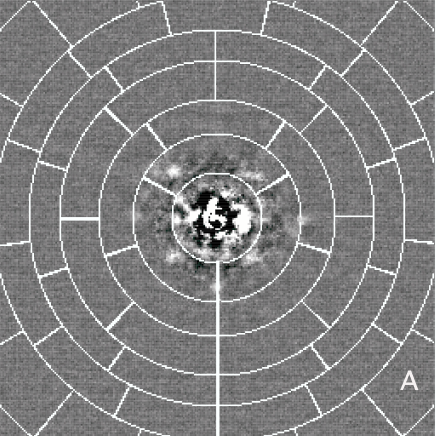
- Applied the Locally Optimized Combination of Images (LOCI) algorithm to suppress speckle noise and improve PSF subtraction, increasing contrast by 0.5–1.5 mag over conventional methods.
- Used PSF-calibrators observed under similar conditions to model and subtract the stellar PSF, enabling detection of faint companions near the primary star.
- Computed 5σ sensitivity profiles based on the observed contrast limits and combined with evolutionary models to estimate the minimum detectable mass for companions at various separations.
- Evaluated detection limits across different regions of the disks, distinguishing between inner hole/gap regions (0.1–1.5 arcsec) and outer disk regions (beyond 1 arcsec).
- Incorporated updated stellar parameters (e.g., younger age and M2.5 spectral type for TW Hya) to refine mass sensitivity estimates for substellar and planetary-mass objects.
Experimental results
Research questions
- RQ1Can unresolved binary companions explain the observed inner holes or gaps in transitional disks?
- RQ2What is the minimum mass of a companion that could be ruled out within the inner cavity of each transitional disk?
- RQ3How does the sensitivity of VLT/NACO imaging constrain the presence of stellar, brown dwarf, or planetary-mass companions in the disk regions?
- RQ4To what extent do the imaging results exclude tidal truncation by binaries as the origin of the disk cavities?
- RQ5How do updated stellar parameters (e.g., age and spectral type) affect the detectability of low-mass companions in the disk?
Key findings
- The VLT/NACO observations rule out the presence of unresolved companions within 0.1 arcseconds of the primary star in all five transitional disks, with detection limits of 2.2–4.9 mag in contrast in the inner region.
- For the outer disk regions (beyond 1 arcsecond), the detection limits reach 7.7–9.3 mag in contrast, with T Cha reaching 4.7 mag in contrast.
- The observations exclude stellar companions more massive than 0.11 M⊙ at separations beyond ~5.5 AU (0.1 arcsecond), and brown-dwarf-mass companions beyond 7 AU (0.13 arcsecond).
- Planetary-mass companions (down to ~7 M_Jup) are ruled out beyond ~13 AU (0.24 arcsecond), with sensitivity extending to 8 mag in contrast from 87 AU onward.
- For DoAr 21, the observations are sensitive to companions less massive than ~13 M_Jup at radii greater than ~76 AU (0.63 arcsecond), allowing detection of potential giant planets or low-mass brown dwarfs.
- The results support alternative mechanisms—such as giant planet formation, efficient grain growth, or photoevaporation—for cavity formation, particularly in DoAr 21 and HR 4796A, where binary companions are ruled out as the primary cause.
Read this paper
Open the full text in the Nubint reader and ask about any passage as you read.
Read this paper on NubintThis review was generated by AI from the original paper. Please check the paper before citing it.