
[论文解读] Rumor Detection with Hierarchical Representation on Bipartite Adhoc Event Trees
本文介绍 BAET,一种通过从声明帖及其回应者构建双分割临时事件树来检测谣言的模型,并使用带有作者信号和帖文信号的层次表示来提升检测效果。
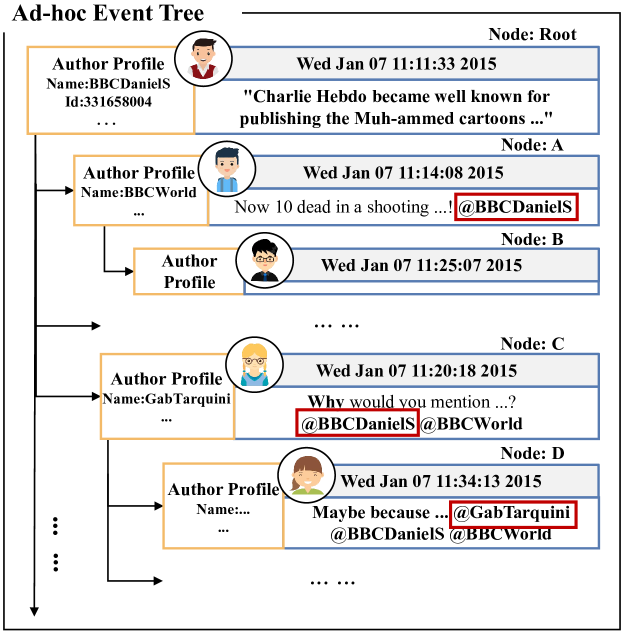
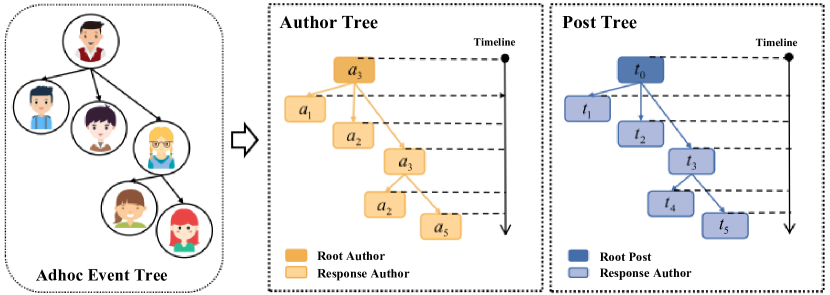
The rapid growth of social media has caused tremendous effects on information propagation, raising extreme challenges in detecting rumors. Existing rumor detection methods typically exploit the reposting propagation of a rumor candidate for detection by regarding all reposts to a rumor candidate as a temporal sequence and learning semantics representations of the repost sequence. However, extracting informative support from the topological structure of propagation and the influence of reposting authors for debunking rumors is crucial, which generally has not been well addressed by existing methods. In this paper, we organize a claim post in circulation as an adhoc event tree, extract event elements, and convert it to bipartite adhoc event trees in terms of both posts and authors, i.e., author tree and post tree. Accordingly, we propose a novel rumor detection model with hierarchical representation on the bipartite adhoc event trees called BAET. Specifically, we introduce word embedding and feature encoder for the author and post tree, respectively, and design a root-aware attention module to perform node representation. Then we adopt the tree-like RNN model to capture the structural correlations and propose a tree-aware attention module to learn tree representation for the author tree and post tree, respectively. Extensive experimental results on two public Twitter datasets demonstrate the effectiveness of BAET in exploring and exploiting the rumor propagation structure and the superior detection performance of BAET over state-of-the-art baseline methods.
研究动机与目标
- 促进将作者信息融入谣言传播建模,超越仅仅考虑帖子内容和时间。
- 提出一种双分割临时事件树表示,用于捕捉谣言级联中的帖子和作者。
- 开发一个层次化神经框架,以学习节点级和树级表示,从而实现鲁棒的谣言验证。
提出的方法
- 从围绕声明帖的临时事件中构建帖子树和作者树。
- 对帖子和作者特征进行嵌入,并采用根节点感知的注意力来学习节点表示。
- 应用树结构变体的RNN(TRvNN)以捕捉结构化传播模式。
- 使用树感知注意力对来自TRvNN输出的结构表示进行聚合。
- 将帖子树和作者树表示结合用于最终谣言分类。
实验结果
研究问题
- RQ1如何将作者信息与帖子内容有效结合,以提升谣言检测效果?
- RQ2双分割临时事件树是否能更好地捕捉传播拓扑和作者影响,以进行谣言验证?
- RQ3哪些层次化表示(节点层级和结构层级)最能区分谣言与非谣言?
- RQ4关注根节点和叶节点的注意力机制是否能提升检测性能?
主要发现
- BAET 在公共数据集 PHEME 和 RumorEval 上较当前最先进的谣言检测模型取得显著提升。
- 作者信息对谣言检测有显著贡献,超出仅帖子内容的作用。
- 节点级表示与结构级表示的结合实现了鲁棒的传播建模。
- 根节点感知注意力和树感知注意力能够有效捕捉节点内语义和节点之间传播动态。
更好的研究,从现在开始
从论文设计到论文写作,大幅缩短您的研究时间。
无需绑定信用卡
本解读由 AI 生成,并经人工编辑审核。