
[Paper Review] Run, Don't Walk: Chasing Higher FLOPS for Faster Neural Networks
The paper argues that reducing FLOPs does not guarantee lower latency due to memory bottlenecks, and introduces Partial Convolution (PConv) and FasterNet, a fast CNN family that achieves higher FLOPS and faster inference across GPUs, CPUs, and ARM devices without sacrificing accuracy.
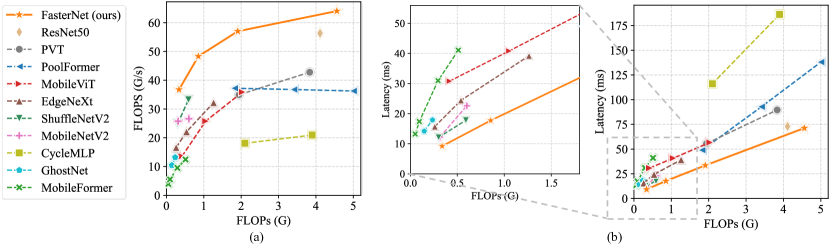
To design fast neural networks, many works have been focusing on reducing the number of floating-point operations (FLOPs). We observe that such reduction in FLOPs, however, does not necessarily lead to a similar level of reduction in latency. This mainly stems from inefficiently low floating-point operations per second (FLOPS). To achieve faster networks, we revisit popular operators and demonstrate that such low FLOPS is mainly due to frequent memory access of the operators, especially the depthwise convolution. We hence propose a novel partial convolution (PConv) that extracts spatial features more efficiently, by cutting down redundant computation and memory access simultaneously. Building upon our PConv, we further propose FasterNet, a new family of neural networks, which attains substantially higher running speed than others on a wide range of devices, without compromising on accuracy for various vision tasks. For example, on ImageNet-1k, our tiny FasterNet-T0 is $2.8 imes$, $3.3 imes$, and $2.4 imes$ faster than MobileViT-XXS on GPU, CPU, and ARM processors, respectively, while being $2.9\%$ more accurate. Our large FasterNet-L achieves impressive $83.5\%$ top-1 accuracy, on par with the emerging Swin-B, while having $36\%$ higher inference throughput on GPU, as well as saving $37\%$ compute time on CPU. Code is available at \url{https://github.com/JierunChen/FasterNet}.
Motivation & Objective
- Highlight the mismatch between FLOPs and real-world latency in existing fast networks.
- Introduce Partial Convolution (PConv) to reduce redundant computation and memory access.
- Propose FasterNet, a family of networks built on PConv that delivers higher throughput and lower latency across devices.
- Demonstrate FasterNet’s competitive accuracy on ImageNet-1k and downstream tasks like COCO object detection/segmentation.
Proposed method
- Reevaluate common CNN operators with respect to FLOPS/FPs performance, focusing on memory access bottlenecks.
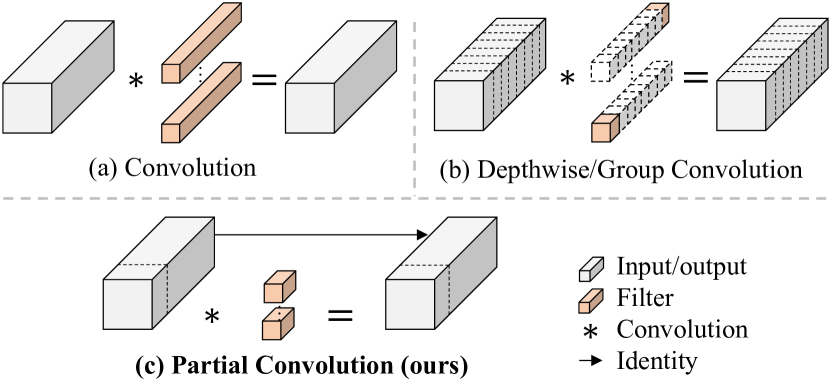
- Design Partial Convolution (PConv) that applies a regular convolution on only a subset of input channels while leaving others untouched.
- Combine PConv with a PWConv to form a T-shaped receptive field that efficiently captures spatial features.
- Assemble FasterNet blocks (PConv followed by PWConvs) into a four-stage backbone with strategic depth/width distribution for speed and accuracy.
- Use BatchNorm fusion and selective activation (GELU/ReLU) to optimize inference latency across devices.
Experimental results
Research questions
- RQ1Can higher FLOPS (FLOPS) be leveraged to achieve faster runtime (latency/throughput) on common hardware?
- RQ2Does Partial Convolution (PConv) reduce memory access and redundant computation enough to outperform depthwise/group convolutions in practice?
- RQ3Can a FasterNet backbone built on PConv deliver state-of-the-art speed-accuracy trade-offs across GPUs, CPUs, and ARM devices?
- RQ4Are FasterNet models effective for downstream tasks such as object detection and instance segmentation beyond ImageNet classification?
Key findings
- PConv achieves higher FLOPS than DWConv/GConv while reducing FLOPs compared to regular Conv, by applying convolution to only part of the input channels.
- A PConv followed by PWConv approximates regular Conv effectively, with lower memory access and competitive accuracy.
- Tiny FasterNet-T0 is 2.8x faster on GPU, 3.3x on CPU, and 2.4x on ARM than MobileViT-XXS on ImageNet-1k, with 2.9% higher accuracy.
- Large FasterNet-L reaches 83.5% top-1 accuracy on ImageNet-1k, with 36% higher GPU throughput and 37% CPU compute time savings compared to Swin-B/ConvNeXt-B baselines.
- FasterNet delivers superior accuracy-throughput and accuracy-latency trade-offs across devices and tasks (classification, detection, segmentation) compared with CNN, ViT, and MLP-based models.
- In COCO object detection/instance segmentation, FasterNet backbones yield higher AP with similar latency, e.g., FasterNet-S improves box AP and mask AP over ResNet50.
Read this paper
Open the full text in the Nubint reader and ask about any passage as you read.
Read this paper on NubintThis review was generated by AI from the original paper. Please check the paper before citing it.