
[Paper Review] Run-Off Election: Improved Provable Defense against Data Poisoning Attacks
This paper proposes Run-Off Election (ROE), a novel two-round ensemble aggregation method that improves provable defense against data poisoning by leveraging logits from all base models in a runoff election between the top two predicted classes. ROE increases the certified robustness gap, achieving up to 4% higher certified accuracy and establishing a new state-of-the-art in pointwise certified robustness—outperforming prior methods even with 32× less training computation.
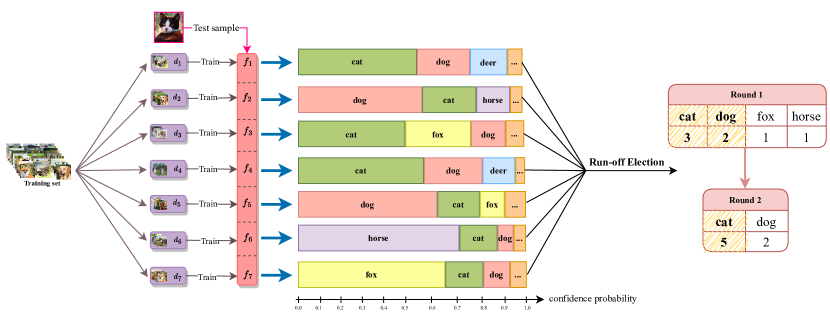
In data poisoning attacks, an adversary tries to change a model's prediction by adding, modifying, or removing samples in the training data. Recently, ensemble-based approaches for obtaining provable defenses against data poisoning have been proposed where predictions are done by taking a majority vote across multiple base models. In this work, we show that merely considering the majority vote in ensemble defenses is wasteful as it does not effectively utilize available information in the logits layers of the base models. Instead, we propose Run-Off Election (ROE), a novel aggregation method based on a two-round election across the base models: In the first round, models vote for their preferred class and then a second, Run-Off election is held between the top two classes in the first round. Based on this approach, we propose DPA+ROE and FA+ROE defense methods based on Deep Partition Aggregation (DPA) and Finite Aggregation (FA) approaches from prior work. We evaluate our methods on MNIST, CIFAR-10, and GTSRB and obtain improvements in certified accuracy by up to 3%-4%. Also, by applying ROE on a boosted version of DPA, we gain improvements around 12%-27% comparing to the current state-of-the-art, establishing a new state-of-the-art in (pointwise) certified robustness against data poisoning. In many cases, our approach outperforms the state-of-the-art, even when using 32 times less computational power.
Motivation & Objective
- Address the limitation of existing ensemble defenses that discard non-top-two class predictions, wasting valuable information from base model logits.
- Improve the robustness gap between the predicted and runner-up classes to strengthen provable certificates against data poisoning.
- Develop a generalizable aggregation framework that enhances both deterministic and stochastic ensemble methods without increasing training cost.
- Establish a new state-of-the-art in certified robustness against data poisoning attacks across MNIST, CIFAR-10, and GTSRB benchmarks.
Proposed method
- Propose a two-round election mechanism: in Round 1, each base model votes for its top-predicted class; in Round 2, only the top two classes from Round 1 compete, with models voting based on their logits layer scores.
- Use logits from all base models in the runoff round to increase the margin between the predicted class and the runner-up, enhancing robustness.
- Develop a unified certificate calculation framework for ROE, extending prior work to handle the more complex adversary behavior under the two-round voting scheme.
- Integrate ROE into existing defense frameworks: DPA+ROE and FA+ROE, based on Deep Partition Aggregation and Finite Aggregation, respectively.
- Propose a boosted variant, DPA*, inspired by an anonymous reviewer, and combine it with ROE to achieve further performance gains.
- Formalize the adversary's optimal attack strategy under ROE and derive a lower bound on the number of poisoned samples required to alter predictions.
Experimental results
Research questions
- RQ1Can a two-round voting mechanism that leverages full logits information from all base models improve the certified robustness gap in ensemble-based data poisoning defenses?
- RQ2How does ROE compare to standard majority vote aggregation in terms of robustness and computational efficiency under varying adversary budgets?
- RQ3Can ROE be generalized to work with both deterministic and stochastic ensemble methods while maintaining or improving certification guarantees?
- RQ4What is the impact of ROE on clean accuracy and certified accuracy across different datasets and model architectures?
- RQ5To what extent can ROE reduce training cost while maintaining or improving state-of-the-art certified robustness?
Key findings
- ROE improves certified accuracy by up to 4% on MNIST, CIFAR-10, and GTSRB compared to standard majority vote aggregation.
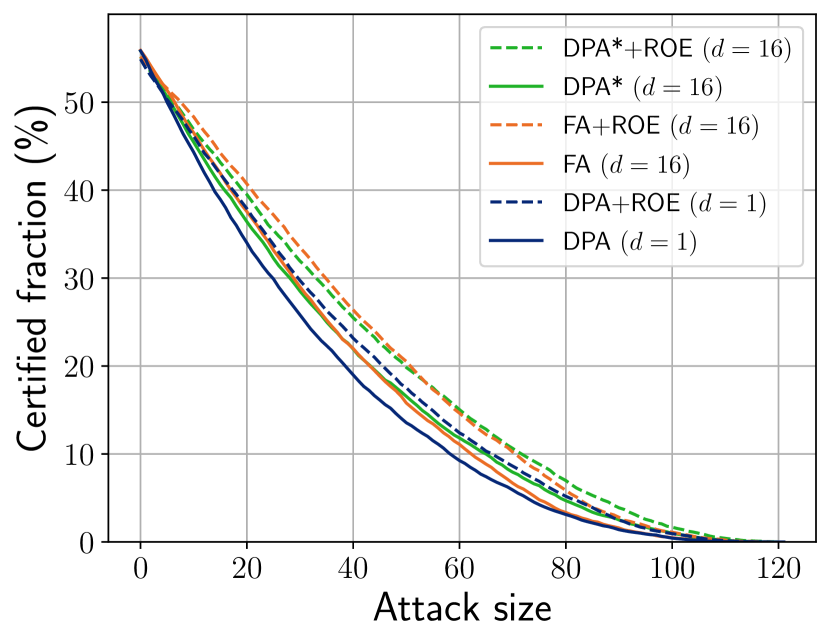
- DPA+ROE achieves a new state-of-the-art in pointwise certified robustness, outperforming prior methods even when using 32 times less training computation.
- FA+ROE and DPA*+ROE achieve 12%–27% higher certified accuracy than the current SOTA, demonstrating the effectiveness of combining ROE with enhanced base models or partitioning schemes.
- ROE maintains strong performance under high adversary budgets, with a 5% higher certified fraction on CIFAR-10 compared to FA, which degrades at large budgets.
- The method slightly reduces clean accuracy due to involving all models in prediction, but this is offset by significantly stronger robustness guarantees.
- ROE is provably more robust than majority vote: in the example case, an adversary needs at least two poisoned samples to change the prediction, compared to one under majority vote.
Read this paper
Open the full text in the Nubint reader and ask about any passage as you read.
Read this paper on NubintThis review was generated by AI from the original paper. Please check the paper before citing it.