
[Paper Review] S4Fusion: Saliency-aware Selective State Space Model for Infrared Visible Image Fusion
S4Fusion proposes a saliency-aware selective state space model for infrared-visible image fusion, introducing the Cross-Modal Spatial Awareness (CMSA) module to jointly capture global spatial and cross-modal interactions with linear complexity. By minimizing uncertainty in a pre-trained ResNet50’s decision layer, it adaptively enhances salient targets, outperforming SOTA methods in fusion quality and downstream detection tasks.
As one of the tasks in Image Fusion, Infrared and Visible Image Fusion aims to integrate complementary information captured by sensors of different modalities into a single image. The Selective State Space Model (SSSM), known for its ability to capture long-range dependencies, has demonstrated its potential in the field of computer vision. However, in image fusion, current methods underestimate the potential of SSSM in capturing the global spatial information of both modalities. This limitation prevents the simultaneous consideration of the global spatial information from both modalities during interaction, leading to a lack of comprehensive perception of salient targets. Consequently, the fusion results tend to bias towards one modality instead of adaptively preserving salient targets. To address this issue, we propose the Saliency-aware Selective State Space Fusion Model (S4Fusion). In our S4Fusion, the designed Cross-Modal Spatial Awareness Module (CMSA) can simultaneously focus on global spatial information from both modalities while facilitating their interaction, thereby comprehensively capturing complementary information. Additionally, S4Fusion leverages a pre-trained network to perceive uncertainty in the fused images. By minimizing this uncertainty, S4Fusion adaptively highlights salient targets from both images. Extensive experiments demonstrate that our approach produces high-quality images and enhances performance in downstream tasks.
Motivation & Objective
- To address the limitation in existing fusion models that fail to jointly capture global spatial and cross-modal information during interaction.
- To enhance the perception of salient targets by enabling selective, adaptive fusion based on human visual perception.
- To reduce modality bias in fusion results by leveraging uncertainty minimization in a pre-trained network’s decision layer.
- To design a one-stage fusion module that integrates global spatial and inter-modal information efficiently with linear complexity.
- To validate the method’s superiority through comprehensive ablation, qualitative, quantitative, and downstream task evaluations.
Proposed method
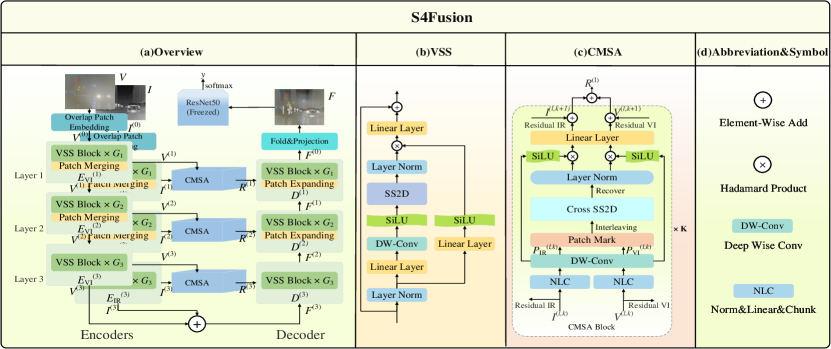
- Proposes the Cross-Modal Spatial Awareness (CMSA) module to simultaneously model intra-modality spatial features and inter-modality interactions using selective state space mechanisms.
- Introduces a perception-enhanced loss function that minimizes uncertainty in the decision layer of a pre-trained ResNet50 to guide the model toward highlighting salient structures.
- Employs a multi-scale network architecture with S4 blocks in both encoder and decoder, using a G=[1,2,1] configuration for feature refinement.
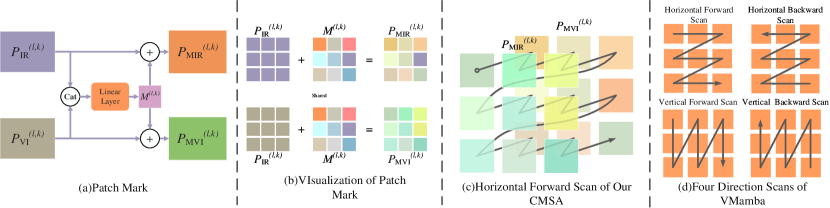
- Utilizes Patch Mark to distinguish spatial and cross-modal interactions within the Cross-SS2D attention mechanism, improving feature disentanglement.
- Applies the CMSA module in a one-stage fusion framework, enabling end-to-end learning with global context awareness.
- Leverages pre-trained features from ResNet50 as a supervisory signal to guide the fusion network toward human-like perception of salient content.
Experimental results
Research questions
- RQ1Can a fusion model effectively capture global spatial context from both infrared and visible modalities during cross-modal interaction?
- RQ2How can uncertainty in a pre-trained network’s decision layer be used to guide adaptive saliency enhancement in fused images?
- RQ3Does the proposed CMSA module outperform existing attention or fusion modules in preserving both texture and salient target information?
- RQ4To what extent does the perception-enhanced loss improve fusion quality and downstream task performance compared to handcrafted loss functions?
- RQ5How does the absence of Patch Mark or key components affect the model’s ability to retain fidelity and complementary information?
Key findings
- S4Fusion achieves state-of-the-art performance on three benchmark datasets (FLIR, TILRD, M3FD), with higher SSIM, AG, SF, and Qabf scores than all compared methods.
- The method achieves the highest mAP@50 of 82.1 on the M3FD dataset for multi-modality object detection, outperforming U2Fusion, DeFusion, and EMMA.
- Ablation studies confirm that removing the perception-enhanced loss leads to a significant drop in performance, validating its role in saliency enhancement.
- Replacing CMSA with ADD, Cross Attention, CNN, or FSSM results in degraded performance, with Cross Attention and FSSM showing particular failure in global context modeling.
- Visualization shows that CMSA improves both visible and infrared features post-processing, with clearer salient object representation and background consistency.
- The removal of Patch Mark in CMSA causes a notable decline in information retention and fusion fidelity, confirming its importance in disentangling spatial and cross-modal interactions.
Read this paper
Open the full text in the Nubint reader and ask about any passage as you read.
Read this paper on NubintThis review was generated by AI from the original paper. Please check the paper before citing it.