
[Paper Review] Safe Sequential Testing and Effect Estimation in Stratified Count Data
This paper introduces a novel method for sequential hypothesis testing and anytime-valid confidence sequences in stratified count data using e-variables, enabling valid inference under optional stopping. It extends prior work on e-values to stratified $2\times2$ tables, allowing cross-talk between strata to improve power while maintaining Type-I error control and coverage guarantees, even when risk differences are heterogeneous across subpopulations.
Sequential decision making significantly speeds up research and is more cost-effective compared to fixed-n methods. We present a method for sequential decision making for stratified count data that retains Type-I error guarantee or false discovery rate under optional stopping, using e-variables. We invert the method to construct stratified anytime-valid confidence sequences, where cross-talk between subpopulations in the data can be allowed during data collection to improve power. Finally, we combine information collected in separate subpopulations through pseudo-Bayesian averaging and switching to create effective estimates for the minimal, mean and maximal treatment effects in the subpopulations.
Motivation & Objective
- To develop sequential hypothesis tests for conditional independence in stratified $2\times2$ contingency tables that maintain Type-I error control under optional stopping.
- To construct anytime-valid confidence sequences for treatment effects in subpopulations without requiring fixed sample sizes.
- To improve statistical power by allowing cross-talk between strata during data collection, even when outcomes are interrelated.
- To enable estimation of compound effect measures—minimal, mean, and maximal—across subpopulations using pseudo-Bayesian averaging and switching strategies.
- To extend existing e-variable methods to stratified settings, generalizing prior work on $2\times2$ tables to multi-stratum designs.
Proposed method
- Uses e-variables and e-processes to ensure Type-I error control under sequential monitoring, leveraging Ville’s inequality for anytime-valid inference.
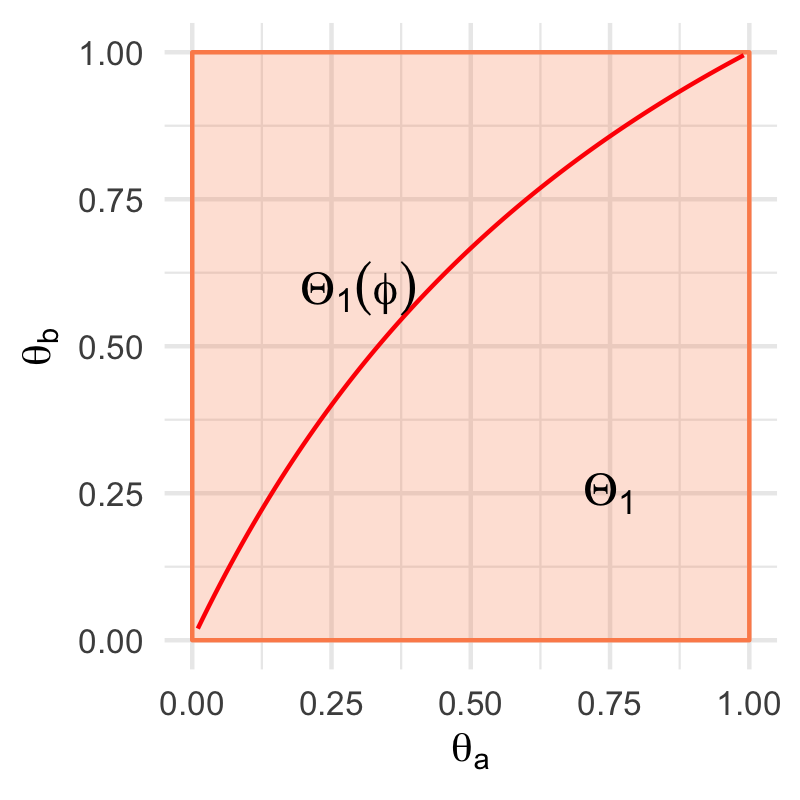
- Constructs e-variables for each stratum based on growth-rate optimal e-variables and combines them via minimization over feasible divergence vectors $\vec{\delta}$ satisfying $\sum_k \pi_k \delta_k = \delta^*$.
- Employs universal inference (Wasserman et al., 2020) to build a global e-variable $E^{*(m)}_{\delta^*} = \min_{\vec{\delta}} E^{(m)}_{[\vec{\delta}]}$ for testing the global null hypothesis.
- Develops confidence sequences by inverting the e-process, ensuring coverage of the true effect size at any stopping time.
- Introduces the concept of 'cross-talk' between strata, allowing information sharing across subpopulations to tighten confidence intervals when effects are similar.
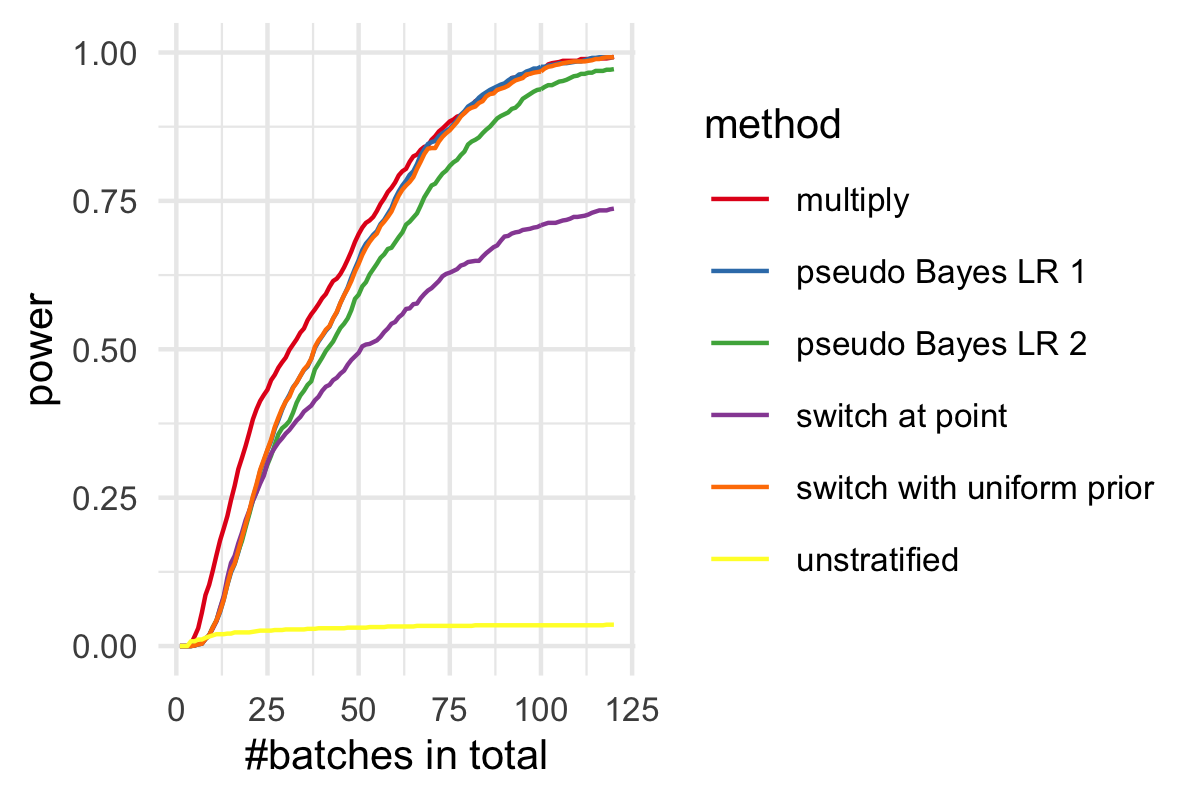
- Applies pseudo-Bayesian learning and switching strategies to estimate compound effect measures (e.g., mean, minimal, maximal effects) across strata.
Experimental results
Research questions
- RQ1Can e-variables be generalized to stratified $2\times2$ tables to enable anytime-valid testing under optional stopping?
- RQ2How can confidence sequences for stratified treatment effects be constructed while maintaining coverage under sequential monitoring?
- RQ3To what extent can cross-talk between strata improve power without compromising Type-I error control?
- RQ4Can pseudo-Bayesian averaging and switching strategies effectively estimate compound effect measures across heterogeneous subpopulations?
- RQ5How does the performance of the proposed anytime-valid confidence sequences compare to fixed-n methods like Miettinen-Nuninen intervals?
Key findings
- The proposed method achieves valid inference under optional stopping, with Type-I error controlled at level $\alpha$ regardless of stopping rule.
- Confidence sequences maintain 95% coverage at any stopping time, even when risk differences are heterogeneous across strata.
- In a homogeneous risk difference scenario, the anytime-valid confidence sequence excluded 0 significantly earlier than the fixed-n Miettinen-Nuninen interval at batch 50.
- The confidence sequence was slightly wider than the fixed-n interval in the homogeneous case, but offered the advantage of continuous monitoring and validity under model misspecification.
- Cross-talk between strata enabled narrower confidence intervals when risk differences were similar, demonstrating improved efficiency without sacrificing validity.
- The method outperforms fixed-n approaches in terms of decision speed and flexibility, while maintaining exact coverage and error control.
Read this paper
Open the full text in the Nubint reader and ask about any passage as you read.
Read this paper on NubintThis review was generated by AI from the original paper. Please check the paper before citing it.