
[Paper Review] SALSA VERDE: a machine learning attack on Learning With Errors with sparse small secrets
Salsa Verde proposes a novel machine learning attack on Learning With Errors (LWE) with sparse small secrets, using improved preprocessing and transformer-based secret recovery to break LWE instances with larger dimensions (n=512), smaller moduli (log₂q=12 for n=256), and non-binary secrets (ternary, narrow Gaussian), outperforming prior ML attacks like Salsa and Picante in speed and scope while providing a theoretical explanation for attack success.
Learning with Errors (LWE) is a hard math problem used in post-quantum cryptography. Homomorphic Encryption (HE) schemes rely on the hardness of the LWE problem for their security, and two LWE-based cryptosystems were recently standardized by NIST for digital signatures and key exchange (KEM). Thus, it is critical to continue assessing the security of LWE and specific parameter choices. For example, HE uses secrets with small entries, and the HE community has considered standardizing small sparse secrets to improve efficiency and functionality. However, prior work, SALSA and PICANTE, showed that ML attacks can recover sparse binary secrets. Building on these, we propose VERDE, an improved ML attack that can recover sparse binary, ternary, and narrow Gaussian secrets. Using improved preprocessing and secret recovery techniques, VERDE can attack LWE with larger dimensions ($n=512$) and smaller moduli ($\log_2 q=12$ for $n=256$), using less time and power. We propose novel architectures for scaling. Finally, we develop a theory that explains the success of ML LWE attacks.
Motivation & Objective
- To develop a more scalable and effective machine learning attack on Learning With Errors (LWE) with sparse small secrets, extending beyond binary secrets.
- To reduce the computational cost of preprocessing for large-dimensional LWE instances, overcoming limitations of prior lattice-reduction-based methods.
- To enable successful recovery of ternary and narrow Gaussian secrets, not just binary secrets, broadening the scope of ML-based LWE cryptanalysis.
- To provide a theoretical framework explaining the success of ML attacks on LWE, particularly the role of data distribution and modular arithmetic performance.
- To assess the security implications of using small, sparse secrets in post-quantum cryptosystems like those standardized by NIST.
Proposed method
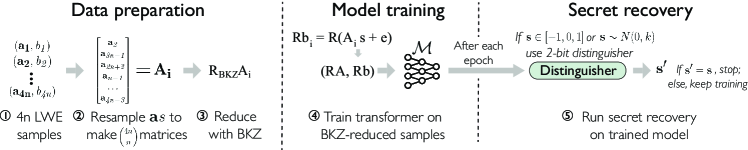
- Introduces a novel preprocessing pipeline that concentrates the distribution of LWE vectors around a center without relying on BKZ lattice reduction, reducing computational cost.
- Employs a transformer-based model trained on preprocessed LWE samples to predict the noisy inner product b from vector a, enabling secret recovery via query-based inference.
- Applies a 'NoMod' percentage metric to quantify how well the model handles modular arithmetic, identifying a key bottleneck in attacks on small moduli.
- Uses Hamming reduction and secret recovery techniques to efficiently recover sparse secrets from model predictions, even with low model accuracy.
- Develops new model architectures and scaling strategies to improve performance on higher-dimensional LWE problems (n=512).
- Proposes a theoretical scaling law linking attack success to data distribution, modulus size, and secret sparsity, explaining observed performance trends.
Experimental results
Research questions
- RQ1Can machine learning attacks on LWE be extended beyond sparse binary secrets to include ternary and narrow Gaussian secrets?
- RQ2How can preprocessing be redesigned to scale efficiently to high-dimensional LWE instances without relying on expensive lattice reduction algorithms?
- RQ3Why do current ML models struggle with small moduli in LWE, and what metrics can explain this failure?
- RQ4What theoretical principles govern the success of ML-based LWE attacks, and how can they guide future improvements?
- RQ5To what extent do ML-based attacks on LWE pose a threat to real-world post-quantum cryptosystems using small, sparse secrets?
Key findings
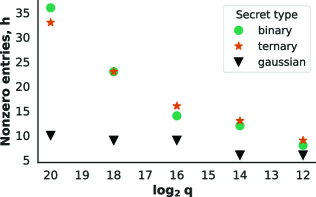
- Salsa Verde successfully recovers sparse ternary and narrow Gaussian secrets, extending the scope of ML-based LWE attacks beyond binary secrets.
- The attack achieves higher performance than prior methods, breaking LWE instances with n=512 and log₂q=12, which were previously infeasible with existing ML approaches.
- Verde reduces the number of required LWE samples for attack success compared to Picante, improving efficiency and scalability.
- The model outperforms the unique shortest vector problem (uSVP) attack in time, though it requires more computational resources, indicating a trade-off between time and compute.
- The NoMod percentage metric identifies poor modular arithmetic performance as a key limitation in attacks on small moduli, suggesting a need for better model design in this area.
- The theoretical analysis reveals that data concentration and distribution quality are critical to attack success, providing a foundation for future targeted improvements.
Read this paper
Open the full text in the Nubint reader and ask about any passage as you read.
Read this paper on NubintThis review was generated by AI from the original paper. Please check the paper before citing it.