
[Paper Review] SAM on Medical Images: A Comprehensive Study on Three Prompt Modes
The paper evaluates Segment Anything Model (SAM) on medical images using three prompt modes (auto, box, point) across 12 public datasets, finding that box prompts yield the best zero-shot performance, while jitter in box size and the number of prompt points significantly influence results.
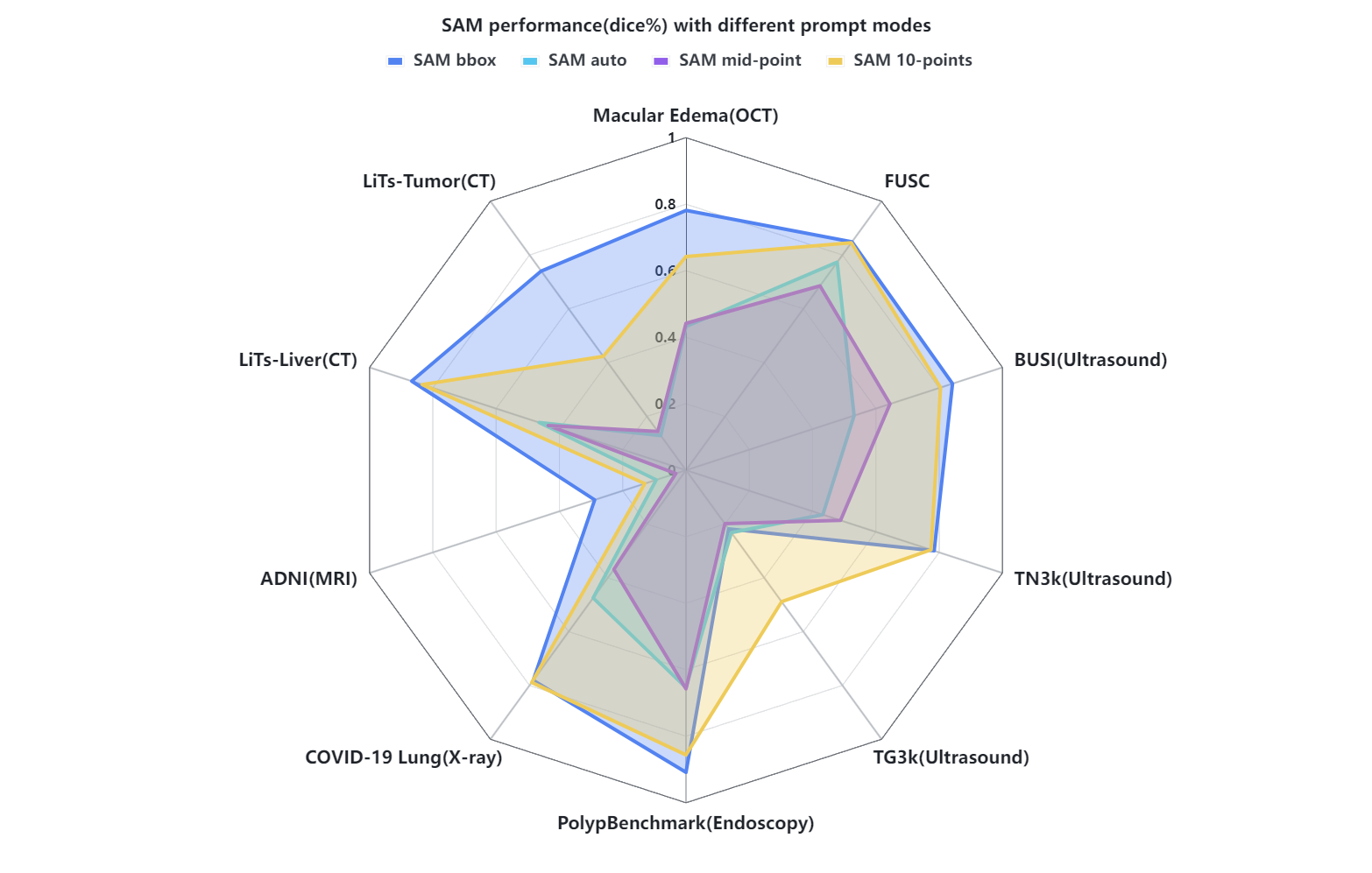
The Segment Anything Model (SAM) made an eye-catching debut recently and inspired many researchers to explore its potential and limitation in terms of zero-shot generalization capability. As the first promptable foundation model for segmentation tasks, it was trained on a large dataset with an unprecedented number of images and annotations. This large-scale dataset and its promptable nature endow the model with strong zero-shot generalization. Although the SAM has shown competitive performance on several datasets, we still want to investigate its zero-shot generalization on medical images. As we know, the acquisition of medical image annotation usually requires a lot of effort from professional practitioners. Therefore, if there exists a foundation model that can give high-quality mask prediction simply based on a few point prompts, this model will undoubtedly become the game changer for medical image analysis. To evaluate whether SAM has the potential to become the foundation model for medical image segmentation tasks, we collected more than 12 public medical image datasets that cover various organs and modalities. We also explore what kind of prompt can lead to the best zero-shot performance with different modalities. Furthermore, we find that a pattern shows that the perturbation of the box size will significantly change the prediction accuracy. Finally, Extensive experiments show that the predicted mask quality varied a lot among different datasets. And providing proper prompts, such as bounding boxes, to the SAM will significantly increase its performance.
Motivation & Objective
- Assess SAM's zero-shot generalization to medical image segmentation using three prompt modes (auto, box, point).
- Identify which prompt mode delivers the best performance across diverse medical imaging modalities.
- Analyze how prompt design (box size, jitter, and point count) affects segmentation accuracy.
- Explore variability of SAM performance across different datasets and modalities to guide future medical foundation model development.
Proposed method
- Assemble 12 public medical imaging datasets spanning CT, X-ray, MRI, Endoscopy, Ultrasound, and OCT.
- Evaluate SAM in three prompt modes: auto-prompt, box-prompt, and point-prompt.
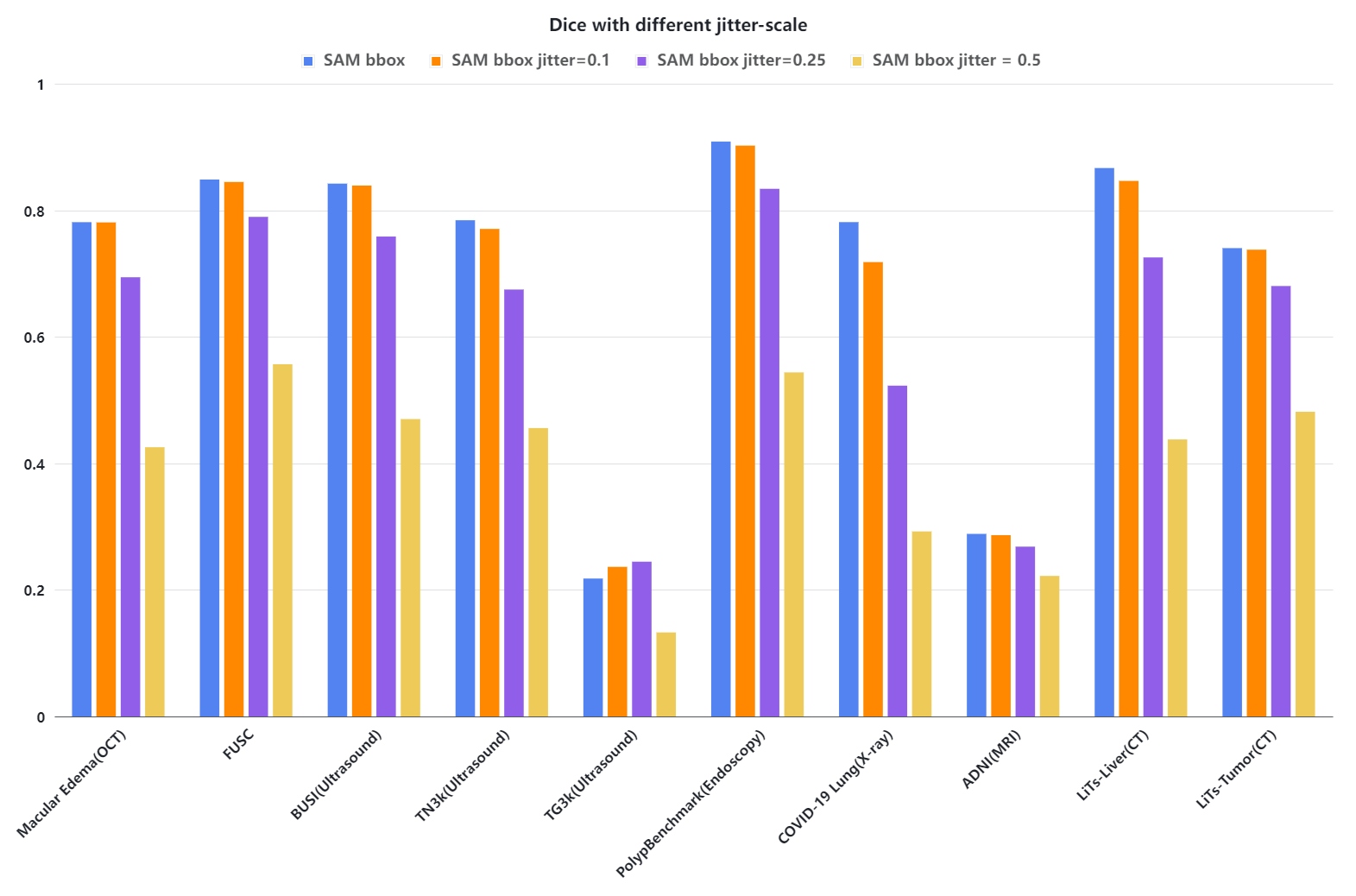
- For box-prompt, input ground-truth-based bounding boxes with varying jitter scales to study robustness.
- For point-prompt, test single, 3-point, and 10-point prompts to observe how prompt density affects zero-shot performance.
- Compare SAM zero-shot results with state-of-the-art supervised methods on the same datasets.
- Analyze how jitter and prompt configuration influence dice scores and segmentation quality.
Experimental results
Research questions
- RQ1Which SAM prompt mode yields the highest zero-shot dice score across diverse medical imaging datasets?
- RQ2How do prompt design choices (box jitter, point quantity) affect SAM’s segmentation accuracy in medical images?
- RQ3What is the variability of SAM’s zero-shot performance across modalities and datasets compared to supervised methods?
Key findings
- Box-prompt mode with zero jitter generally provides the best average dice across evaluated medical datasets.
- Increasing jitter on box prompts degrades segmentation accuracy, indicating sensitivity to box size and localization."
Read this paper
Open the full text in the Nubint reader and ask about any passage as you read.
Read this paper on NubintThis review was generated by AI from the original paper. Please check the paper before citing it.