
[Paper Review] Sampling random graphs with specified degree sequences
This paper proposes a convergence detection method and sampling gap estimation algorithm for Markov chain Monte Carlo (MCMC) sampling in the configuration model for random graphs with specified degree sequences. By using degree assortativity to estimate effective independence between MCMC states and applying the Dickey-Fuller Generalized Least Squares (DFGLS) test, the method enables accurate and efficient convergence detection across all eight configuration model graph spaces, with empirical scaling rules allowing automated gap selection without re-running the estimation algorithm.
The configuration model is a standard tool for uniformly generating random graphs with a specified degree sequence, and is often used as a null model to evaluate how much of an observed network's structure can be explained by its degree structure alone. A Markov chain Monte Carlo (MCMC) algorithm, based on a degree-preserving double-edge swap, provides an asymptotic solution to sample from the configuration model. However, accurately and efficiently detecting this Markov chain's convergence on its stationary distribution remains an unsolved problem. Here, we provide a solution to detect convergence and sample from the configuration model. We develop an algorithm, based on the assortativity of the sampled graphs, for estimating the gap between effectively independent MCMC states, and a computationally efficient gap-estimation heuristic derived from analyzing a corpus of 509 empirical networks. We provide a convergence detection method based on the Dickey-Fuller Generalized Least Squares test, which we show is more accurate and efficient than three alternative Markov chain convergence tests.
Motivation & Objective
- To address the lack of reliable convergence detection in MCMC sampling for the configuration model, which is critical for generating valid null models in network science.
- To develop a computationally efficient method for estimating the sampling gap that ensures effectively uncorrelated MCMC states in degree-preserving Markov chains.
- To provide a practical, automated solution for selecting appropriate sampling gaps across diverse empirical networks without re-running gap estimation for each network.
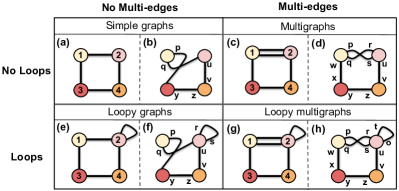
- To validate the method’s accuracy and efficiency across all eight configuration model graph spaces, including those forbidding self-loops and multi-edges.
- To establish empirical scaling rules linking sampling gap estimates to network size (number of edges), enabling heuristic-based gap selection.
Proposed method
- The method uses degree assortativity as a scalar summary of network structure to estimate the effective sampling gap between uncorrelated MCMC states.
- It applies the Dickey-Fuller Generalized Least Squares (DFGLS) test to detect stationarity in the MCMC chain, outperforming three alternative convergence tests in accuracy and efficiency.
- A gap-estimation algorithm (Algorithm 1) computes the minimum number of steps required between samples to achieve statistical independence, based on autocorrelation in assortativity values.
- The authors analyze 509 empirical and semi-synthetic networks to identify scaling patterns of estimated sampling gaps with respect to the number of edges, leading to heuristic decision rules.
- The method is validated across all eight configuration model variants, including simple graphs, by confirming convergence detection accuracy and mixing time scaling.
- The approach is designed to be computationally efficient and applicable to real-world networks, with fallback options for low-variance degree sequences where assortativity is ineffective.
Experimental results
Research questions
- RQ1Can the Dickey-Fuller Generalized Least Squares (DFGLS) test be used to accurately and efficiently detect convergence in MCMC sampling of the configuration model across all eight graph spaces?
- RQ2What is the relationship between the number of edges in a network and the effective sampling gap required for uncorrelated MCMC states?
- RQ3Can empirical scaling patterns of sampling gaps be used to derive heuristic rules that eliminate the need to recompute gaps for each network?
- RQ4How does the choice of network statistic (e.g., assortativity vs. clustering coefficient) affect the reliability of convergence detection in low-variance degree networks?
- RQ5Is the mixing time of the double-edge swap MCMC chain in all eight configuration model spaces asymptotically Θ(m), where m is the number of edges?
Key findings
- The Dickey-Fuller Generalized Least Squares (DFGLS) test outperforms three alternative convergence tests in both accuracy and computational efficiency for detecting MCMC convergence in all eight configuration model graph spaces.
- The estimated sampling gap scales empirically with the number of edges m, and this scaling behavior is consistent across different graph spaces, enabling the development of heuristic rules for gap selection.
- The authors identify and validate a set of decision rules based on network size that allow researchers to automatically select an appropriate sampling gap without running the gap estimation algorithm.
- The study supports the conjecture that the mixing time of the double-edge swap MCMC chain is Θ(m) across all eight configuration model variants, indicating linear dependence on the number of edges.
- For networks with very low degree variance (e.g., k-regular graphs), degree assortativity is ineffective as a convergence summary statistic, and alternative metrics like clustering coefficient are recommended despite higher computational cost.
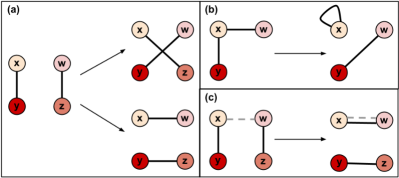
- The method is robust across diverse empirical networks and remains effective even when the target graph space excludes self-loops and multi-edges, provided the correct MCMC transition rules are applied.
Read this paper
Open the full text in the Nubint reader and ask about any passage as you read.
Read this paper on NubintThis review was generated by AI from the original paper. Please check the paper before citing it.