
[Paper Review] SAMScore: A Content Structural Similarity Metric for Image Translation Evaluation
SAMScore is a novel image translation evaluation metric that leverages the Segment Anything Model (SAM) to measure semantic structural similarity between source and translated images. By computing spatial cosine similarity on SAM-encoded embeddings, it outperforms existing metrics across 19 diverse image translation tasks, demonstrating superior robustness and faithfulness assessment in preserving high-level semantic structures.
Image translation has wide applications, such as style transfer and modality conversion, usually aiming to generate images having both high degrees of realism and faithfulness. These problems remain difficult, especially when it is important to preserve content structures. Traditional image-level similarity metrics are of limited use, since the content structures of an image are high-level, and not strongly governed by pixel-wise faithfulness to an original image. To fill this gap, we introduce SAMScore, a generic content structural similarity metric for evaluating the faithfulness of image translation models. SAMScore is based on the recent high-performance Segment Anything Model (SAM), which allows content similarity comparisons with standout accuracy. We applied SAMScore on 19 image translation tasks, and found that it is able to outperform all other competitive metrics on all tasks. We envision that SAMScore will prove to be a valuable tool that will help to drive the vibrant field of image translation, by allowing for more precise evaluations of new and evolving translation models. The code is available at https://github.com/Kent0n-Li/SAMScore.
Motivation & Objective
- To address the lack of a general-purpose metric for evaluating semantic structural faithfulness in image translation.
- To overcome limitations of traditional metrics like L2, PSNR, SSIM, and LPIPS, which fail to capture high-level semantic content.
- To mitigate the domain gap and labeling dependency issues inherent in FCNScore by using a zero-shot segmentation model.
- To develop a universal, robust, and scalable evaluation metric applicable across diverse image translation tasks.
- To enable more precise benchmarking of image translation models by focusing on semantic structure preservation.
Proposed method
- Utilizes the pre-trained Segment Anything Model (SAM) to encode semantic embeddings from both source and translated images.
- Computes spatial cosine similarity between corresponding embedding features across the two images to generate a similarity score.
- Applies zero-shot segmentation capability of SAM without requiring fine-tuning or annotated labels.
- Aggregates similarity scores across the spatial feature map to produce a single SAMScore value.
- Standardizes scores to [0,1] for consistent comparison across diverse image translation tasks.
- Validates performance across 19 diverse image translation tasks, including style transfer, modality translation, and domain adaptation.
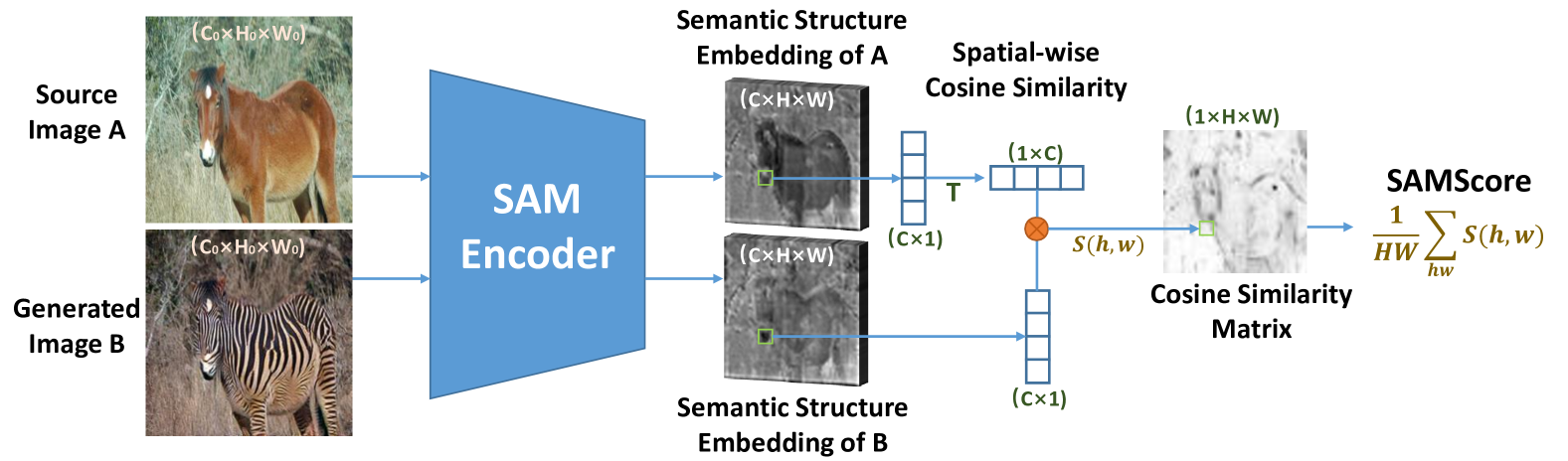
Experimental results
Research questions
- RQ1Can a zero-shot, segmentation-based metric outperform traditional pixel-level and perceptual metrics in evaluating semantic faithfulness in image translation?
- RQ2How robust is SAMScore to image corruptions such as Gaussian noise and affine deformations compared to FCNScore?
- RQ3Does SAMScore maintain high performance across diverse image translation tasks with varying domain gaps?
- RQ4Can SAMScore effectively distinguish between faithful and unfaithful translations based on semantic structure rather than pixel-level similarity?
- RQ5How does SAMScore compare to state-of-the-art metrics like LPIPS and FCNScore in capturing structural fidelity?
Key findings
- SAMScore outperformed all competing metrics—including L2, PSNR, SSIM, LPIPS, and FCNScore—on all 19 image translation tasks.
- In the cityscapes (label to photo) task, SAMScore achieved a score of 0.7624, significantly outperforming FCNScore’s 0.5055 in per-pixel accuracy.
- SAMScore remained stable under Gaussian noise corruption, increasing from 0.7624 to 0.7574 at 250 noise level, while FCNScore dropped from 0.5055 to 0.4402.
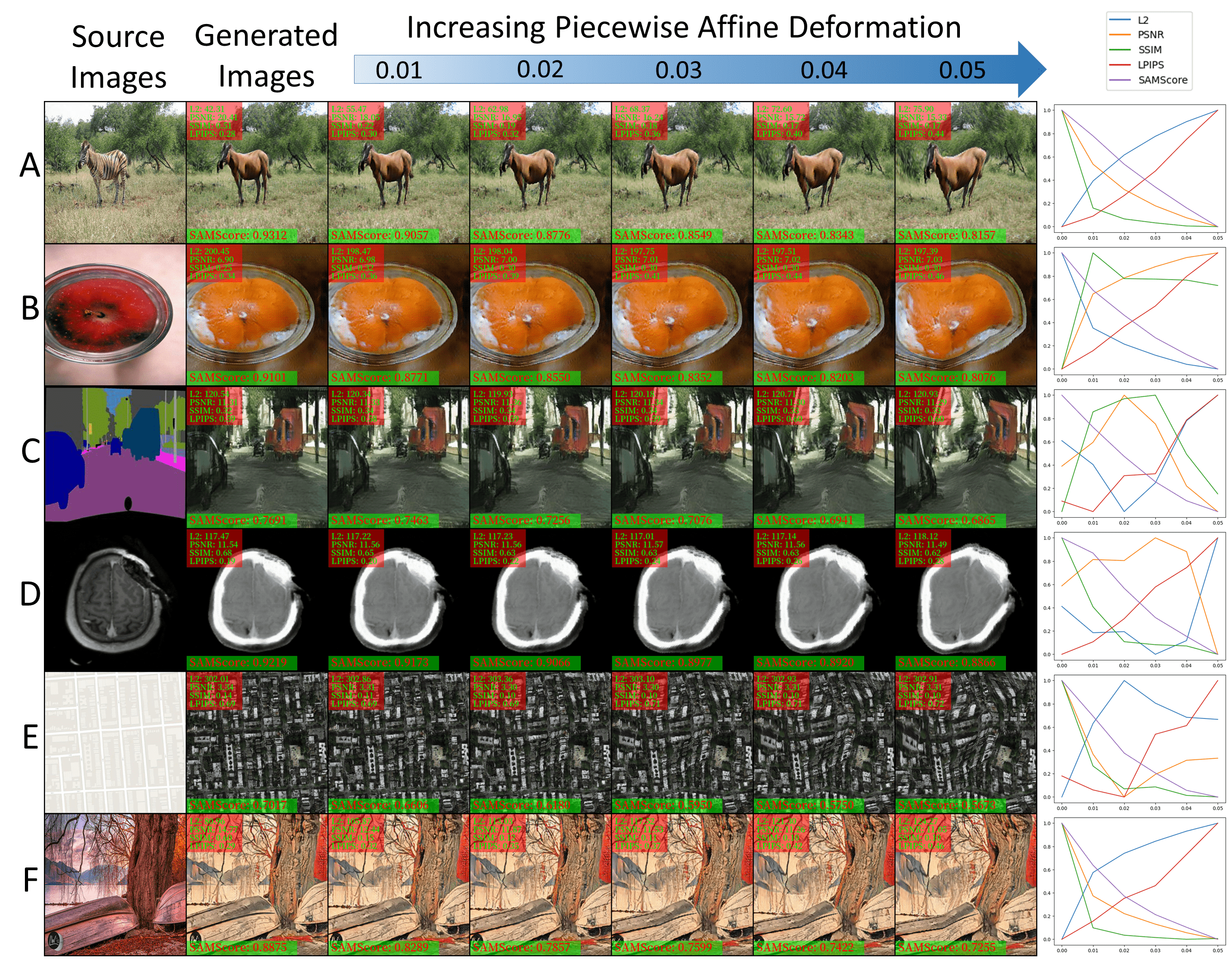
- Under piecewise affine deformation, SAMScore decreased gradually from 0.7624 to 0.7091, showing consistent sensitivity to structural distortion.
- In the head (MR to CT) translation task, SAMScore achieved 0.8861, outperforming LPIPS and FCNScore, which showed lower faithfulness scores.
- SAMScore demonstrated superior robustness in the photo-to-Monet and photo-to-Vangogh tasks, maintaining high scores (0.9054 and 0.8510 respectively) even under structural perturbations.
Read this paper
Open the full text in the Nubint reader and ask about any passage as you read.
Read this paper on NubintThis review was generated by AI from the original paper. Please check the paper before citing it.