
[Paper Review] SaulLM-7B: A pioneering Large Language Model for Law
SaulLM-7B is a 7B legal-domain LLM built on Mistral-7B, trained on 30B legal tokens, with an instruction-tuned variant SaulLM-7B-Instruct, released under MIT.
In this paper, we introduce SaulLM-7B, a large language model (LLM) tailored for the legal domain. With 7 billion parameters, SaulLM-7B is the first LLM designed explicitly for legal text comprehension and generation. Leveraging the Mistral 7B architecture as its foundation, SaulLM-7B is trained on an English legal corpus of over 30 billion tokens. SaulLM-7B exhibits state-of-the-art proficiency in understanding and processing legal documents. Additionally, we present a novel instructional fine-tuning method that leverages legal datasets to further enhance SaulLM-7B's performance in legal tasks. SaulLM-7B is released under the MIT License.
Motivation & Objective
- Develop a public, open-source LLM specialized for legal text understanding and generation.
- Pretrain on a large, diverse English legal corpus to capture legal language nuances.
- Enhance performance with instruction fine-tuning including legal-specific prompts.
- Provide open licensing and evaluation tools to catalyze research and adoption in the legal domain.
Proposed method
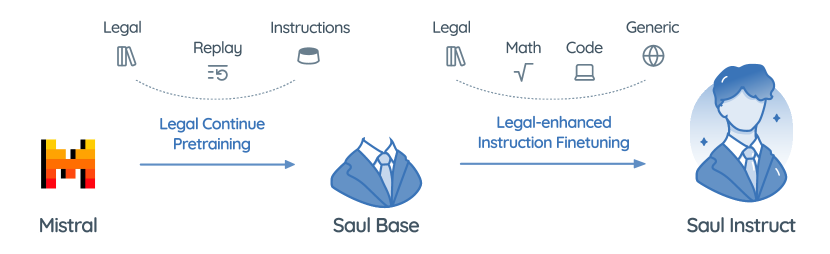
- Base model: Mistral-7B used as the foundation for SaulLM-7B.
- Continued pretraining on a curated 30B-token English legal corpus from diverse jurisdictions.
- Data cleaning and deduplication to produce high-quality legal text for pretraining.
- Instruction fine-tuning using a mix of generic and legal instruction data to create SaulLM-7B-Instruct.
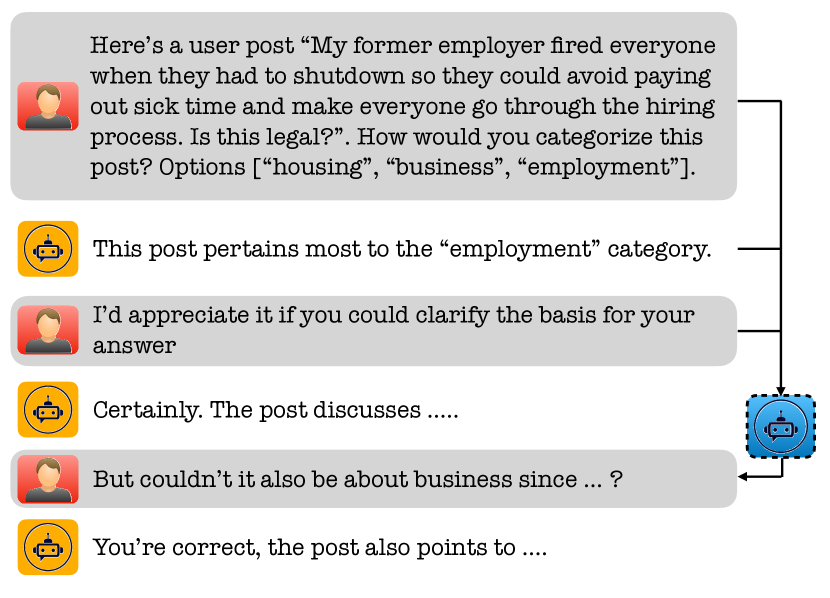
- Synthetic construction of legal instruction conversations to enhance task-focused abilities.
- Evaluation protocol including LegalBench-Instruct and Legal-MMLU, with perplexity analysis on legal document types.
Experimental results
Research questions
- RQ1Does continued pretraining on a large legal corpus improve legal task performance over generic models?
- RQ2Does adding legal instruction fine-tuning (SaulLM-7B-Instruct) yield state-of-the-art results on legal benchmarks?
- RQ3How does SaulLM-7B-Instruct compare to open-source 7B/13B models on LegalBench-Instruct and Legal-MMLU tasks?
- RQ4What is the impact of base-model choice and instruction data composition on legal reasoning and deduction tasks?
Key findings
- SaulLM-7B achieves strong performance as a standalone model, approaching or matching some 7B baselines on legal benchmarks.
- SaulLM-7B-Instruct establishes a new state-of-the-art on LegalBench-Instruct with an average score of 0.61, an 11% relative improvement over the best open-source instruct model (Mistral-7B-Instruct-v0.1).
- LegalBench-Instruct results show SaulLM-7B-Instruct outperforms non-legal instruction-tuned models across core legal abilities (issue spotting, rule recall, interpretation, understanding).
- On Legal-MMLU, SaulLM-7B-Instruct shows superior performance over non-legal instruction-tuned models across three tasks with a 3–4 point gap to the best 7B open-source competitor.
- Perplexity analysis: SaulLM-7B-Instruct achieves a median perplexity of 8.69, reducing perplexity by 5.5% vs Mistral-7B and by 9.20% vs Llama2-7B (9.74 median).
- The combination of continued legal pretraining and legal instruction tuning yields substantial gains, while DPO-aligned models underperform compared to instruction-tuned counterparts in this legal context.
Read this paper
Open the full text in the Nubint reader and ask about any passage as you read.
Read this paper on NubintThis review was generated by AI from the original paper. Please check the paper before citing it.