
[Paper Review] SBMLtoODEjax: Efficient Simulation and Optimization of Biological Network Models in JAX
SBMLtoODEjax is a lightweight library that converts SBML models to end-to-end Python models written in JAX, enabling fast, parallel simulations and gradient-based optimization within ML pipelines.
Advances in bioengineering and biomedicine demand a deep understanding of the dynamic behavior of biological systems, ranging from protein pathways to complex cellular processes. Biological networks like gene regulatory networks and protein pathways are key drivers of embryogenesis and physiological processes. Comprehending their diverse behaviors is essential for tackling diseases, including cancer, as well as for engineering novel biological constructs. Despite the availability of extensive mathematical models represented in Systems Biology Markup Language (SBML), researchers face significant challenges in exploring the full spectrum of behaviors and optimizing interventions to efficiently shape those behaviors. Existing tools designed for simulation of biological network models are not tailored to facilitate interventions on network dynamics nor to facilitate automated discovery. Leveraging recent developments in machine learning (ML), this paper introduces SBMLtoODEjax, a lightweight library designed to seamlessly integrate SBML models with ML-supported pipelines, powered by JAX. SBMLtoODEjax facilitates the reuse and customization of SBML-based models, harnessing JAX's capabilities for efficient parallel simulations and optimization, with the aim to accelerate research in biological network analysis.
Motivation & Objective
- Enable seamless reuse of SBML models in Python/ML pipelines.
- Leverage JAX for efficient parallel simulation of ODE models.
- Provide differentiable, gradient-enabled optimization of model parameters and interventions.
- Maintain simplicity and extensibility comparable to SBMLtoODEpy while adding JAX acceleration.
Proposed method
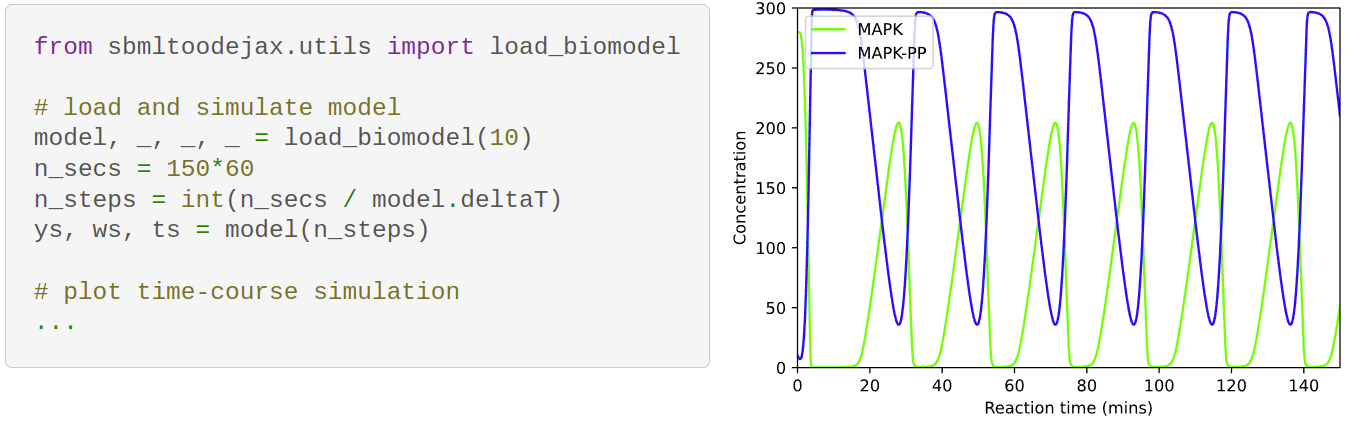
- Automatically parse SBML and convert to Python models implemented in JAX.
- Use JAX transformations (jit, vmap, grad) to accelerate simulations and enable parallelization.
- Extend SBMLtoODEpy conventions to fit a JAX-friendly functional programming style and Equinox PyTree integration.
- Allow integration with Optax for gradient-based optimization of parameters and interventions.
- Demonstrate parallel rollout vectorization and gradient-based optimization within ML pipelines.
Experimental results
Research questions
- RQ1Can SBML-based ODE models be efficiently simulated and optimized inside the JAX ecosystem?
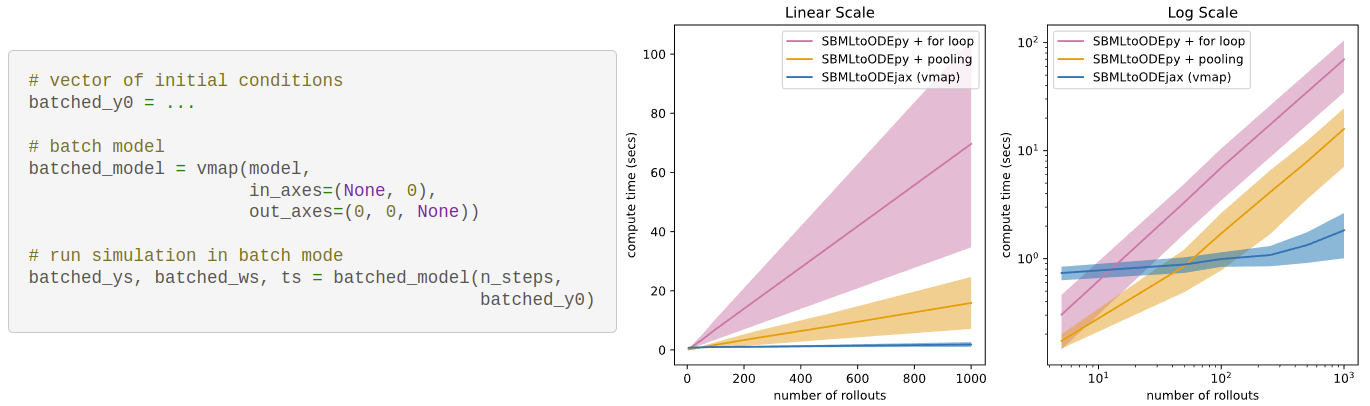
- RQ2Do JAX transformations enable scalable parallel simulations of SBML-derived models?
- RQ3What are the practical benefits and limitations of differentiating through SBML model rollouts?
- RQ4How does SBMLtoODEjax integrate with ML tooling like Optax for optimization tasks?
Key findings
- SBMLtoODEjax enables parallelized ODE simulations with minimal code, leveraging jit, vmap, and grad.
- Generated models are compatible with JAX tooling and can be batched for large-scale experiments.
- Integration with Optax supports gradient-based optimization of kinetic parameters and external interventions.
- The approach facilitates gradient-based discovery and optimization of biological network behaviors within ML workflows.
- Benchmarking shows speed advantages over SBMLtoODEpy for multiple rollouts in their notebooks.
Read this paper
Open the full text in the Nubint reader and ask about any passage as you read.
Read this paper on NubintThis review was generated by AI from the original paper. Please check the paper before citing it.