
[Paper Review] Scalable Vision Transformers with Hierarchical Pooling
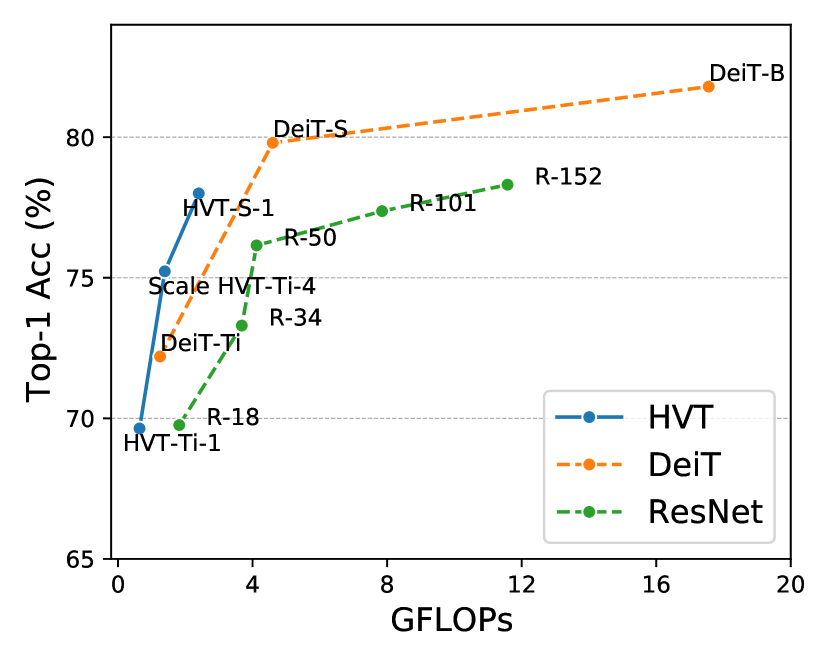
This paper proposes Hierarchical Visual Transformers (HVT), a scalable vision transformer architecture that progressively downsamples visual tokens via hierarchical pooling to reduce sequence length and computational cost. By replacing the class token with average pooling over patch tokens, HVT achieves improved performance—outperforming DeiT by 3.03% top-1 accuracy on ImageNet with comparable FLOPs—while enabling efficient scaling of depth, width, resolution, and patch size without increased computation.
The recently proposed Visual image Transformers (ViT) with pure attention have achieved promising performance on image recognition tasks, such as image classification. However, the routine of the current ViT model is to maintain a full-length patch sequence during inference, which is redundant and lacks hierarchical representation. To this end, we propose a Hierarchical Visual Transformer (HVT) which progressively pools visual tokens to shrink the sequence length and hence reduces the computational cost, analogous to the feature maps downsampling in Convolutional Neural Networks (CNNs). It brings a great benefit that we can increase the model capacity by scaling dimensions of depth/width/resolution/patch size without introducing extra computational complexity due to the reduced sequence length. Moreover, we empirically find that the average pooled visual tokens contain more discriminative information than the single class token. To demonstrate the improved scalability of our HVT, we conduct extensive experiments on the image classification task. With comparable FLOPs, our HVT outperforms the competitive baselines on ImageNet and CIFAR-100 datasets. Code is available at https://github.com/MonashAI/HVT
Motivation & Objective
- Address the high computational cost and lack of hierarchical representation in standard Vision Transformers (ViT), which maintain full-length patch sequences throughout inference.
- Improve model scalability by reducing sequence length through progressive pooling, enabling efficient scaling of model depth, width, resolution, and patch size.
- Demonstrate that average-pooled visual tokens contain more discriminative information than the single learnable class token, making it unnecessary to rely on the latter for classification.
- Achieve state-of-the-art performance on image classification benchmarks by re-allocating saved FLOPs to increase model capacity without increasing computational cost.
Proposed method
- Introduce a hierarchical pooling mechanism that downsamples the sequence length across multiple stages, analogous to spatial downsampling in CNNs.
- Partition ViT blocks into stages and apply average or max pooling after each stage to progressively reduce sequence length and computational load.
- Replace the learnable class token with global average pooling over all patch tokens to generate the final prediction vector.
- Design the architecture to allow independent scaling of depth, width, input resolution, and patch size, leveraging saved FLOPs for improved capacity.
- Use a 2D pooling variant in select experiments to explore spatial downsampling with reduced patch size, requiring careful head and block scheduling.
- Train models with varying numbers of attention heads, input resolutions, and patch sizes to evaluate scalability and performance trade-offs.
Experimental results
Research questions
- RQ1Can hierarchical pooling in Vision Transformers reduce sequence length and computational cost while maintaining or improving accuracy?
- RQ2Does replacing the class token with average pooling over patch tokens lead to better classification performance than using a dedicated class token?
- RQ3To what extent can model capacity be scaled (in depth, width, resolution, patch size) with comparable FLOPs using hierarchical pooling?
- RQ4How does the performance of HVT compare to strong baselines like DeiT under similar FLOP constraints on ImageNet and CIFAR-100?
- RQ5What is the impact of 2D pooling on model performance, and can it enable further improvements with proper architectural adjustments?
Key findings
- With comparable FLOPs (1.25 vs. 1.39 GFLOPs), HVT-Ti-4 achieves 3.03% higher top-1 accuracy than DeiT-Ti on ImageNet.
- On CIFAR-100, HVT-S-4 with a patch size of 8 achieves 77.29% top-1 accuracy, a 9.14% gain over the 32-patch variant.
- Increasing input resolution from 160 to 384 improves top-1 accuracy from 73.84% to 76.31%, demonstrating the benefit of high-resolution representations.
- HVT-S-4 with 16 attention heads achieves 75.43% top-1 accuracy, outperforming the 3-head variant by 6.79 percentage points.
- HVT-S-2 with 2D pooling achieves 77.58% top-1 accuracy on CIFAR-100, outperforming DeiT-S (71.99%) with nearly identical FLOPs.
- The average-pooled visual tokens consistently yield better performance than the class token, indicating their richer discriminative capacity.

Read this paper
Open the full text in the Nubint reader and ask about any passage as you read.
Read this paper on NubintThis review was generated by AI from the original paper. Please check the paper before citing it.