
[Paper Review] Scale-Aware Modulation Meet Transformer
Introduces Scale-Aware Modulation Transformer (SMT) that hybridizes convolutional modulation with Vision Transformers via Scale-Aware Modulation (SAM), MHMC, and SAA, plus an Evolutionary Hybrid Network to capture local-to-global dependencies.
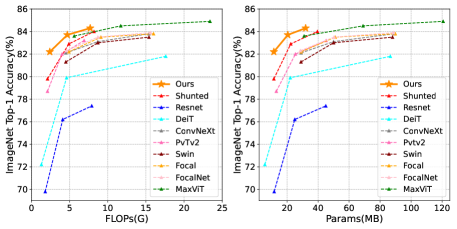
This paper presents a new vision Transformer, Scale-Aware Modulation Transformer (SMT), that can handle various downstream tasks efficiently by combining the convolutional network and vision Transformer. The proposed Scale-Aware Modulation (SAM) in the SMT includes two primary novel designs. Firstly, we introduce the Multi-Head Mixed Convolution (MHMC) module, which can capture multi-scale features and expand the receptive field. Secondly, we propose the Scale-Aware Aggregation (SAA) module, which is lightweight but effective, enabling information fusion across different heads. By leveraging these two modules, convolutional modulation is further enhanced. Furthermore, in contrast to prior works that utilized modulations throughout all stages to build an attention-free network, we propose an Evolutionary Hybrid Network (EHN), which can effectively simulate the shift from capturing local to global dependencies as the network becomes deeper, resulting in superior performance. Extensive experiments demonstrate that SMT significantly outperforms existing state-of-the-art models across a wide range of visual tasks. Specifically, SMT with 11.5M / 2.4GFLOPs and 32M / 7.7GFLOPs can achieve 82.2% and 84.3% top-1 accuracy on ImageNet-1K, respectively. After pretrained on ImageNet-22K in 224^2 resolution, it attains 87.1% and 88.1% top-1 accuracy when finetuned with resolution 224^2 and 384^2, respectively. For object detection with Mask R-CNN, the SMT base trained with 1x and 3x schedule outperforms the Swin Transformer counterpart by 4.2 and 1.3 mAP on COCO, respectively. For semantic segmentation with UPerNet, the SMT base test at single- and multi-scale surpasses Swin by 2.0 and 1.1 mIoU respectively on the ADE20K.
Motivation & Objective
- Motivate a hybrid CNN-Transformer design that balances local feature modeling and global context.
- Develop Scale-Aware Modulation (SAM) with Multi-Head Mixed Convolution (MHMC) and Scale-Aware Aggregation (SAA).
- Propose Evolutionary Hybrid Network (EHN) to simulate transitions from local to global dependency capture as depth increases.
- Demonstrate SMT’s superiority on ImageNet, COCO, and ADE20K with efficient parameter and compute budgets.
Proposed method
- Propose Scale-Aware Modulation (SAM) to replace or augment traditional attention in early stages.
- Implement Multi-Head Mixed Convolution (MHMC) to capture multi-scale features with channel-wise heads.
- Introduce Scale-Aware Aggregation (SAA) to fuse multi-scale features with lightweight cross-head interaction.
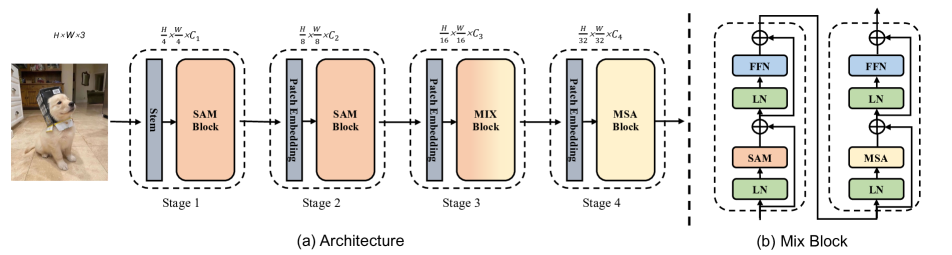
- Adopt Evolutionary Hybrid Network (EHN) by placing SAM in top stages and MSA in deeper stages with two hybrid stacking strategies.
- Use a Mix Block design combining SAM and MSA blocks to model local-to-global transitions.
- Evaluate SMT on ImageNet-1K/22K, COCO, and ADE20K with ablations on MHMC heads, aggregation, and stacking.
Experimental results
Research questions
- RQ1Can Scale-Aware Modulation (SAM) with MHMC and SAA outperform pure attention or pure convolutional blocks across classification, detection, and segmentation tasks?
- RQ2Does an Evolutionary Hybrid Network (EHN) that transitions from SAM-dominated early stages to MSA-dominated later stages yield better efficiency-accuracy trade-offs?
- RQ3How does the number of MHMC heads and the aggregation strategy affect performance and throughput?
- RQ4What stacking strategy best models the local-to-global dependency shift in SMT?
Key findings
- SMT achieves 82.2% top-1 on ImageNet-1K with SMT-T and 84.3% with SMT-B, outperforming several state-of-the-art baselines at similar parameter counts and FLOPs.
- Pretraining on ImageNet-22K and finetuning at 224^2 and 384^2 yields 87.1% and 88.1% top-1 respectively.
- On COCO with Mask R-CNN, SMT base surpasses Swin by 4.2 AP for 1x and 1.3 AP for 3x schedules.
- On ADE20K with UPerNet, SMT base improves mIoU by 2.0 (single-scale) and 1.1 (multi-scale) over Swin.
- Ablations show 4 MHMC heads yield peak ImageNet accuracy and that Scale-Aware Aggregation (SAA) provides a 1.6% gain over baselines.
- Two hybrid-stacking strategies were evaluated; the strategy with sequential SAM and MSA blocks (and leaving MSA in last stages) performed best.
Read this paper
Open the full text in the Nubint reader and ask about any passage as you read.
Read this paper on NubintThis review was generated by AI from the original paper. Please check the paper before citing it.