
[Paper Review] Scale-awareness in an eddy energy constrained mesoscale eddy parameterization
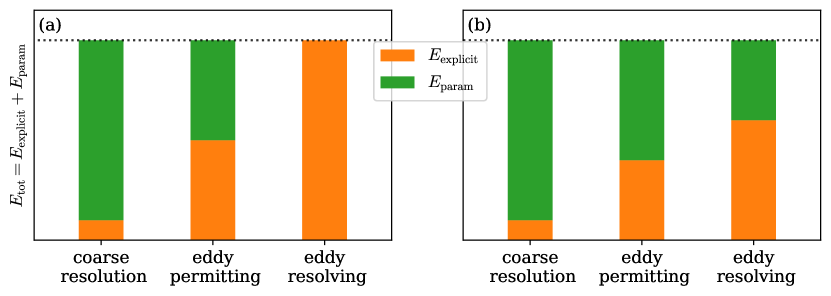
This paper proposes a splitting procedure to enable scale-awareness in the GEOMETRIC mesoscale eddy parameterization by isolating the large-scale background field for parameterized eddy fluxes, allowing explicit and parameterized eddies to coexist. The method maintains approximate constancy of total eddy energy across resolutions, improving model mean state representation without degrading explicit eddy dynamics.
There is an increasing interest in mesoscale eddy parameterizations that are scale-aware, normally interpreted to mean that a parameterization does not require re-tuning of parameters as the model resolution changes. Here we examine whether Gent--McWilliams (GM) based version of GEOMETRIC, a mesoscale eddy parameterization that is constrained by a parameterized eddy energy budget, is scale-aware in its energetics. It is generally known that GM-based schemes severely damp out explicit eddies, so the parameterized component would be expected to dominate across resolutions, and we might expect a negative answer to the question of energetic scale-awareness. A consideration of why GM-based schemes damp out explicit eddies leads a suggestion for what we term a splitting procedure: a definition of a `large-scale' field is sought, and the eddy-induced velocity from the GM-scheme is computed from and acts only on the large-scale field, allowing explicit and parameterized components to co-exist. Within the context of an idealized re-entrant channel model of the Southern Ocean, evidence is provided that the GM-based version of GEOMETRIC is scale-aware in the energetics as long as we employ a splitting procedure. The splitting procedure also leads to an improved representation of mean states without detrimental effects on the variability.
Motivation & Objective
- To investigate whether the GM-based GEOMETRIC eddy parameterization exhibits energetic scale-awareness, defined as constancy of total eddy energy across model resolutions.
- To address the challenge that traditional GM-based schemes overly damp explicit eddies, undermining their utility in eddy-permitting models.
- To develop and test a splitting procedure that separates large-scale and eddy components, enabling coexistence of explicit and parameterized eddies.
- To evaluate whether the proposed method improves model mean state representation without degrading the simulation of explicit eddy motions.
Proposed method
- A filtering procedure based on the equation $(1 - L^2 abla_H^2)^M heta_L^n = heta^n$ is used to decompose the temperature field into large-scale and eddy components, with $M=2$ and $L$ as the filter length-scale.
- The Richardson iteration method is applied to solve the filtering equation iteratively, with convergence ensured via a preconditioned scheme using an acceleration parameter $\gamma$.
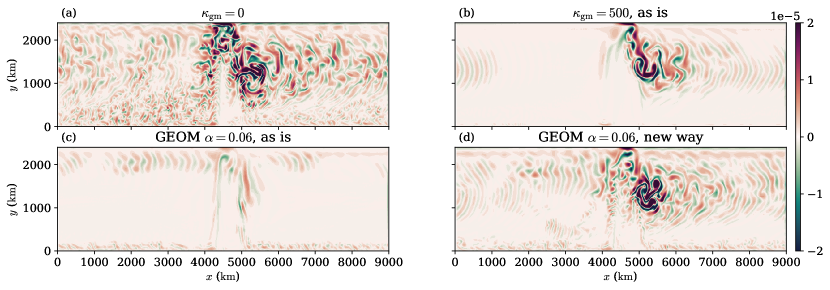
- The eddy-induced velocity in the GEOMETRIC scheme is computed only from the large-scale field, preventing damping of explicitly resolved eddies.
- The parameterized eddy fluxes are applied exclusively to the large-scale component, while explicit eddies evolve independently in the model.
- The method is implemented in an idealized Southern Ocean re-entrant channel model using the NEMO framework, with model configurations tested at varying resolutions.
- Convergence is monitored using the supremum norm $\|\Theta^{k+1} - \Theta^k\|_\infty < \epsilon$, with $\epsilon = 0.001\,^\circ\text{C}$, ensuring numerical stability and accuracy.
Experimental results
Research questions
- RQ1Does the GM-based GEOMETRIC parameterization exhibit energetic scale-awareness when applied in a multi-resolution framework?
- RQ2Can a splitting procedure prevent the damping of explicitly resolved eddies while preserving the energetics of the parameterization?
- RQ3How does the coexistence of explicit and parameterized eddies affect the representation of the ocean mean state in eddy-permitting models?
- RQ4What is the computational cost of implementing the filtering and splitting procedure in a standard ocean model like NEMO?
Key findings
- The GEOMETRIC parameterization with the splitting procedure maintains approximate constancy of total eddy energy across different model resolutions, demonstrating energetic scale-awareness.
- Explicit eddies are preserved in the model due to the restriction of parameterized fluxes to the large-scale field, avoiding the strong damping typical of standard GM schemes.
- The splitting procedure leads to an improved representation of the mean ocean state, including more realistic circumpolar transport and reduced biases in the Southern Ocean.
- The method introduces minimal computational overhead, with an estimated increase in run time of no more than 5% compared to standard configurations.
- The filtering procedure converges reliably within 500 iterations using the preconditioned Richardson iteration, with convergence tolerance $\epsilon = 0.001\,^\circ\text{C}$.
- The results suggest that the splitting-based GEOMETRIC scheme is a viable candidate for use in multi-resolution climate modeling hierarchies, particularly in eddy-permitting configurations.
Read this paper
Open the full text in the Nubint reader and ask about any passage as you read.
Read this paper on NubintThis review was generated by AI from the original paper. Please check the paper before citing it.