
[Paper Review] Scaling End-to-End Models for Large-Scale Multilingual ASR
This paper proposes scaling end-to-end multilingual ASR models up to 10 billion parameters using GShard to overcome performance degradation in high-resource languages caused by data imbalance and model capacity constraints. By increasing model size, the authors achieve state-of-the-art performance across all 15 languages, outperforming monolingual baselines on high-resource languages and enabling efficient continual adaptation to new languages and domains with minimal additional training.
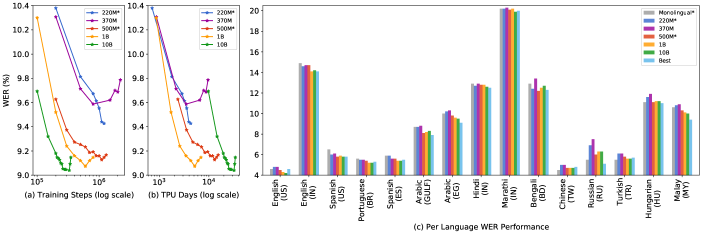
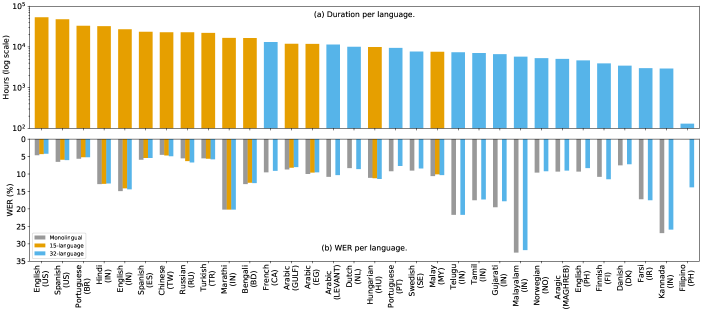
Building ASR models across many languages is a challenging multi-task learning problem due to large variations and heavily unbalanced data. Existing work has shown positive transfer from high resource to low resource languages. However, degradations on high resource languages are commonly observed due to interference from the heterogeneous multilingual data and reduction in per-language capacity. We conduct a capacity study on a 15-language task, with the amount of data per language varying from 7.6K to 53.5K hours. We adopt GShard [1] to efficiently scale up to 10B parameters. Empirically, we find that (1) scaling the number of model parameters is an effective way to solve the capacity bottleneck - our 500M-param model already outperforms monolingual baselines and scaling it to 1B and 10B brought further quality gains; (2) larger models are not only more data efficient, but also more efficient in terms of training cost as measured in TPU days - the 1B-param model reaches the same accuracy at 34% of training time as the 500M-param model; (3) given a fixed capacity budget, adding depth works better than width and large encoders do better than large decoders; (4) with continuous training, they can be adapted to new languages and domains.
Motivation & Objective
- Address performance degradation in high-resource languages within large-scale multilingual ASR due to model capacity bottlenecks and data imbalance.
- Investigate the impact of increasing model capacity on multilingual ASR performance across languages with highly varying data sizes (7.6K to 53.5K hours).
- Determine the most effective scaling strategy—depth vs. width, encoder vs. decoder capacity—for improving multilingual ASR performance under fixed capacity budgets.
- Explore the feasibility of continual training to extend multilingual models to new languages and domains without catastrophic forgetting.
- Demonstrate that larger models are more sample- and training cost-efficient, reducing TPU days required to reach target accuracy.
Proposed method
- Employ the GShard mixture-of-experts (MoE) technique to efficiently scale the model up to 10 billion parameters while maintaining training efficiency.
- Train a single multilingual end-to-end ASR model using an attention-based encoder-decoder architecture with Conformer encoders and Transformer-based decoders.
- Conduct ablation studies comparing width vs. depth scaling, and encoder vs. decoder capacity allocation under fixed parameter budgets.
- Use continuous training to adapt the pre-trained multilingual model to new languages and domains, such as read speech from the Multilingual Librispeech dataset.
- Measure performance using word error rate (WER) across 15 languages and evaluate efficiency via TPU days and training steps to reach target accuracy.
- Apply knowledge distillation and transfer learning by initializing new models from the pre-trained multilingual model to improve convergence and performance.
Experimental results
Research questions
- RQ1Can scaling model capacity to 10B parameters eliminate performance degradation in high-resource languages within a multilingual ASR setup?
- RQ2How does increasing model depth versus width affect recognition performance under a fixed parameter budget?
- RQ3Does a larger model improve sample efficiency and reduce training cost (measured in TPU days) for multilingual ASR?
- RQ4Can a pre-trained multilingual model be effectively fine-tuned for new languages and domains through continual training without performance drop on existing languages?
- RQ5To what extent does pre-training on diverse languages and domains transfer knowledge to unseen languages and speech styles?
Key findings
- Scaling the model from 500M to 10B parameters consistently reduces WER across all 15 languages, with the 1B-param model outperforming monolingual baselines on high-resource languages.
- The 1B-param model achieves an average WER of 11.57%, surpassing the 11.87% WER of 32 monolingual 142M-param models, including on Filipino (PH), which failed to train with a monolingual setup.
- The 1B-param model reaches the same accuracy as the 500M-param model in 34% of the training time, demonstrating higher training efficiency in terms of TPU days.
- Larger models are more sample-efficient, requiring fewer optimization steps to converge, and exhibit better generalization across languages and domains.
- Continuous training enables the model to adapt to new languages (e.g., 5 unseen languages in Multilingual Librispeech) and new domains (e.g., long-form read speech), achieving a 12% relative WER reduction compared to random initialization.
- Fine-tuning the 1B-param multilingual model on the Multilingual Librispeech dataset reduces average WER to 7.9%, representing a 10% relative improvement and fixing performance regression on English.
Read this paper
Open the full text in the Nubint reader and ask about any passage as you read.
Read this paper on NubintThis review was generated by AI from the original paper. Please check the paper before citing it.