
[Paper Review] ScenarioNet: Open-Source Platform for Large-Scale Traffic Scenario Simulation and Modeling
ScenarioNet aggregates real-world driving data from multiple datasets into a unified, open-source platform for large-scale traffic scenario simulation and modeling, enabling data-driven scenario generation, cross-dataset RL/IL training, multi-agent learning, and AD stack testing in MetaDrive.
Large-scale driving datasets such as Waymo Open Dataset and nuScenes substantially accelerate autonomous driving research, especially for perception tasks such as 3D detection and trajectory forecasting. Since the driving logs in these datasets contain HD maps and detailed object annotations which accurately reflect the real-world complexity of traffic behaviors, we can harvest a massive number of complex traffic scenarios and recreate their digital twins in simulation. Compared to the hand-crafted scenarios often used in existing simulators, data-driven scenarios collected from the real world can facilitate many research opportunities in machine learning and autonomous driving. In this work, we present ScenarioNet, an open-source platform for large-scale traffic scenario modeling and simulation. ScenarioNet defines a unified scenario description format and collects a large-scale repository of real-world traffic scenarios from the heterogeneous data in various driving datasets including Waymo, nuScenes, Lyft L5, and nuPlan datasets. These scenarios can be further replayed and interacted with in multiple views from Bird-Eye-View layout to realistic 3D rendering in MetaDrive simulator. This provides a benchmark for evaluating the safety of autonomous driving stacks in simulation before their real-world deployment. We further demonstrate the strengths of ScenarioNet on large-scale scenario generation, imitation learning, and reinforcement learning in both single-agent and multi-agent settings. Code, demo videos, and website are available at https://metadriverse.github.io/scenarionet.
Motivation & Objective
- Provide a unified format to convert heterogeneous driving data into scalable traffic scenarios.
- Aggregate real-world scenarios from multiple datasets to enable cross-dataset training and evaluation.
- Enable large-scale scenario generation, imitation learning, and reinforcement learning in single-agent and multi-agent settings.
- Support simulation-based testing of autonomous driving stacks through ROS bridge integration.
Proposed method
- Define a unified nested dictionary scenario description with four top-level keys.
- Convert scenarios from Waymo, nuScenes, nuPlan, L5, Argoverse, and procedurally generated data into the unified format.
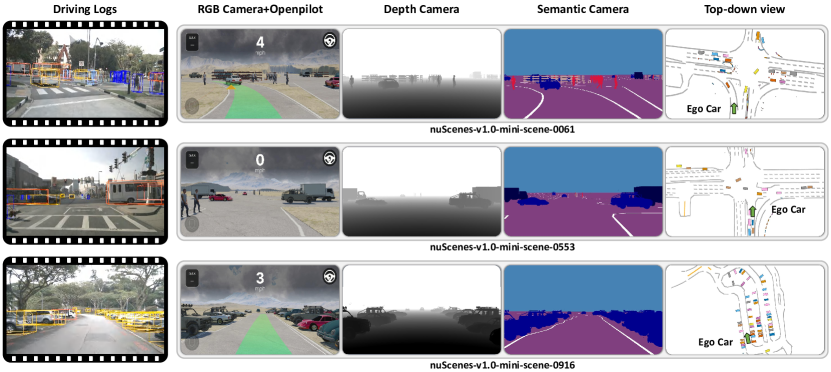
- Replay scenarios in the MetaDrive simulator with 2D BEV and 3D rendering, plus sensor simulation.
- Provide dataset management operations (conversion, sanity check, merging, filtering, splitting, sampling) that are copy-free and parallelized.
- Offer tools to add new datasets via converters and scale up conversion with multi-processing.
- Describe system architecture with data layer, system layer, and application layer connected by data conversion and simulation flows.
Experimental results
Research questions
- RQ1Can real-world driving datasets be unified into a scalable, interoperable scenario database for simulation?
- RQ2Does cross-dataset training improve policy learning compared to single-dataset training in imitation and reinforcement learning?
- RQ3Can ScenarioNet support effective multi-agent learning and AD stack testing using its unified scenarios?
- RQ4What is the impact of aggregating synthetic and real-world scenarios on policy generalization and sim-to-real transfer?
Key findings
- A unified scenario description enables replay and interaction in MetaDrive across multiple datasets (Waymo, nuScenes, L5, nuPlan, Argoverse).
- Cross-dataset curriculum RL experiments show real-world data improves success rates over synthetic-only data when evaluated on real-world test sets.
- Combining synthetic and real-world scenarios yields higher policy performance and better generalization to curved trajectories in nuPlan-test."
- MARL/IL experiments demonstrate that using ground-truth trajectories for reward, termination, and evaluation enables effective learning in multi-agent settings.
- Openpilot can operate in ScenarioNet-reconstructed real-world scenarios, illustrating practical testing of end-to-end AD stacks.
- Table 2 and Table 3 summarize dataset statistics and multi-agent learning results respectively, illustrating dataset track length, vehicle counts, and RL/IL performance.

Read this paper
Open the full text in the Nubint reader and ask about any passage as you read.
Read this paper on NubintThis review was generated by AI from the original paper. Please check the paper before citing it.