
[Paper Review] SceneFormer: Indoor Scene Generation with Transformers
SceneFormer proposes a transformer-based autoregressive model for indoor scene generation that predicts object categories, 3D locations, orientations, and sizes from room layouts or text descriptions, leveraging self-attention to implicitly learn object relations without manual relation annotations. It achieves faster inference (1.48s per scene) and higher user preference (53.9–56.7%) than state-of-the-art methods like FastSynth, while maintaining high realism and accuracy in text-conditioned generation.
We address the task of indoor scene generation by generating a sequence of objects, along with their locations and orientations conditioned on a room layout. Large-scale indoor scene datasets allow us to extract patterns from user-designed indoor scenes, and generate new scenes based on these patterns. Existing methods rely on the 2D or 3D appearance of these scenes in addition to object positions, and make assumptions about the possible relations between objects. In contrast, we do not use any appearance information, and implicitly learn object relations using the self-attention mechanism of transformers. We show that our model design leads to faster scene generation with similar or improved levels of realism compared to previous methods. Our method is also flexible, as it can be conditioned not only on the room layout but also on text descriptions of the room, using only the cross-attention mechanism of transformers. Our user study shows that our generated scenes are preferred to the state-of-the-art FastSynth scenes 53.9% and 56.7% of the time for bedroom and living room scenes, respectively. At the same time, we generate a scene in 1.48 seconds on average, 20% faster than FastSynth.
Motivation & Objective
- To generate diverse and realistic 3D indoor scenes without relying on visual appearance or manually annotated object relations.
- To model indoor scene generation as a sequence generation task using transformers, treating each object's properties as tokens in a sequence.
- To enable flexible conditioning on both room layouts and natural language descriptions using cross-attention mechanisms.
- To improve inference speed while maintaining or enhancing scene realism compared to existing autoregressive scene generation methods.
- To implicitly learn spatial and relational patterns between objects through self-attention, avoiding the need for predefined relation heuristics or annotations.
Proposed method
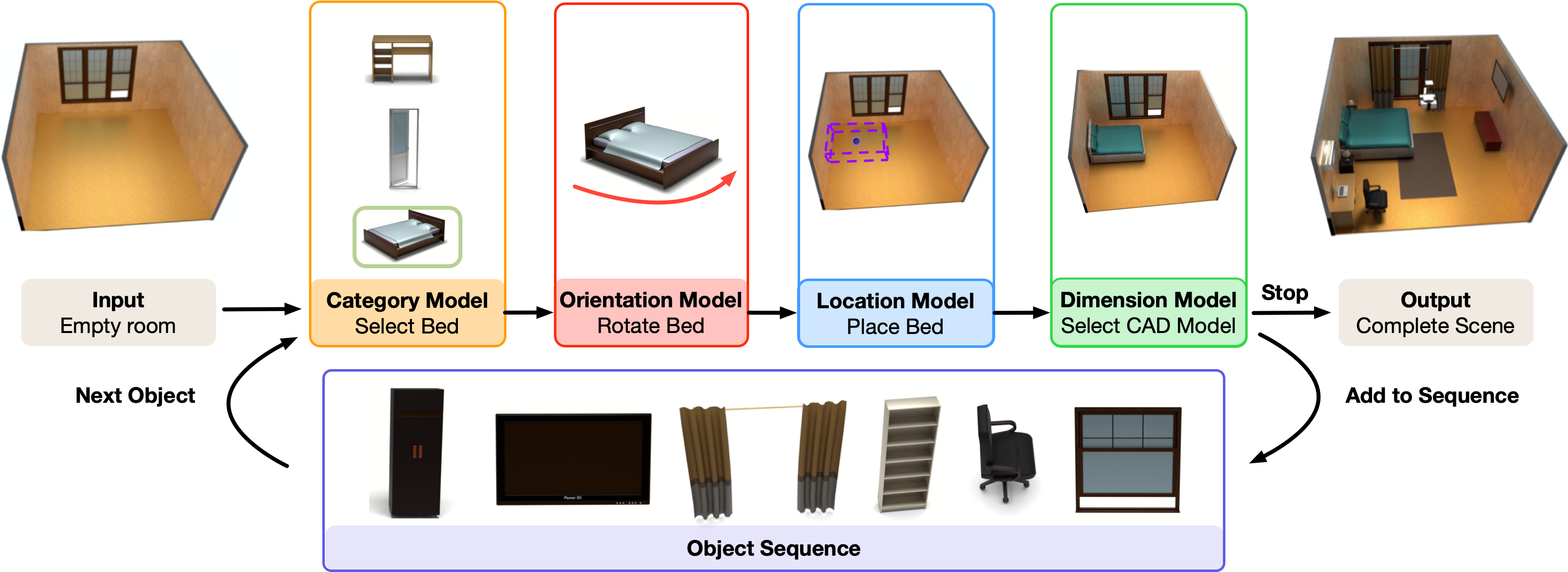
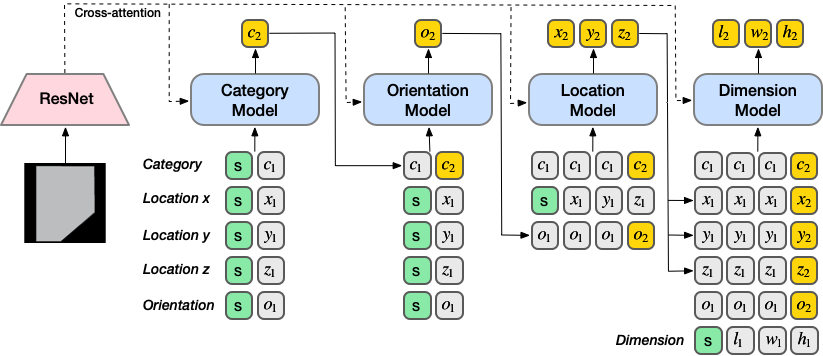
- Represent each indoor scene as a sequence of object property tokens: class, 3D position (discretized), orientation, and size.
- Use a transformer decoder with autoregressive generation to predict the next object's properties conditioned on previously generated objects.
- Leverage self-attention mechanisms to implicitly learn complex spatial and relational dependencies between objects without explicit relation supervision.
- Condition the generation process on room layouts via positional encoding of door/window locations and room boundaries.
- Condition on text descriptions using cross-attention between the text encoder (e.g., BERT, ELMo) and the transformer decoder.
- Discretize 3D coordinates into a voxel-like grid to enable differentiable and efficient prediction of object positions.
Experimental results
Research questions
- RQ1Can a transformer-based sequence model generate realistic 3D indoor scenes without using visual appearance or predefined object relations?
- RQ2How well can self-attention in transformers implicitly learn spatial and relational patterns between objects in a scene?
- RQ3To what extent does conditioning on text descriptions improve the accuracy of object category and spatial relation generation compared to baselines?
- RQ4Can layout- and text-conditioned scene generation be achieved with high inference speed and user preference?
- RQ5How does the model's performance vary across different scene types (e.g., bedroom vs. living room) and conditioning modalities?
Key findings
- SceneFormer generates scenes in 1.48 seconds on average, which is 20% faster than FastSynth and an order of magnitude faster than PlanIT and DeepSynth.
- In user preference studies, SceneFormer-generated scenes were preferred over FastSynth in 53.9% of comparisons for bedroom scenes and 56.7% for living room scenes.
- For text-conditioned generation, the BERT-encoder variant achieved 84.83% category accuracy and 46.42% relation accuracy in bedroom scenes, significantly outperforming the GT baseline (10.67% relation accuracy).
- The multiple transformer model setting improved next token prediction accuracy to 51.5%, a 14.5-point gain over the single transformer baseline, demonstrating the benefit of ensemble modeling.
- The model achieved 76.59% and 84.83% category accuracy using ELMo and BERT embeddings, respectively, showing strong alignment with input text descriptions.
- Perceptual evaluation showed a realism score of 4.61±1.84 and a text-match score of 4.38±1.73, indicating that generated scenes are both realistic and semantically aligned with text prompts.
Read this paper
Open the full text in the Nubint reader and ask about any passage as you read.
Read this paper on NubintThis review was generated by AI from the original paper. Please check the paper before citing it.