
[Paper Review] SceneScape: Text-Driven Consistent Scene Generation
SceneScape generates long-term, 3D-consistent videos from text prompts and camera trajectories by combining a pre-trained text-to-image diffusion model with monocular depth priors and online test-time optimization to build a unified 3D scene mesh. It operates zero-shot without domain-specific training and progressively updates a mesh to ensure geometric consistency.
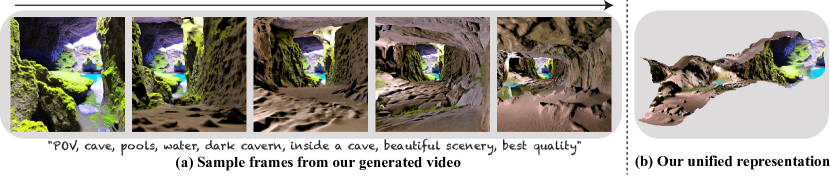
We present a method for text-driven perpetual view generation -- synthesizing long-term videos of various scenes solely, given an input text prompt describing the scene and camera poses. We introduce a novel framework that generates such videos in an online fashion by combining the generative power of a pre-trained text-to-image model with the geometric priors learned by a pre-trained monocular depth prediction model. To tackle the pivotal challenge of achieving 3D consistency, i.e., synthesizing videos that depict geometrically-plausible scenes, we deploy an online test-time training to encourage the predicted depth map of the current frame to be geometrically consistent with the synthesized scene. The depth maps are used to construct a unified mesh representation of the scene, which is progressively constructed along the video generation process. In contrast to previous works, which are applicable only to limited domains, our method generates diverse scenes, such as walkthroughs in spaceships, caves, or ice castles.
Motivation & Objective
- Motivate text-driven perpetual view generation that can produce long videos of diverse scenes from free-form text prompts and a given camera trajectory.
- Eliminate the need for large-scale domain-specific training by leveraging pre-trained image diffusion and depth models in a zero-shot framework.
- Achieve 3D-consistent generation by building and refining a unified 3D mesh of the scene during video synthesis.
- Provide a scalable framework that handles parallax, occlusion, and content continuation across frames.
Proposed method
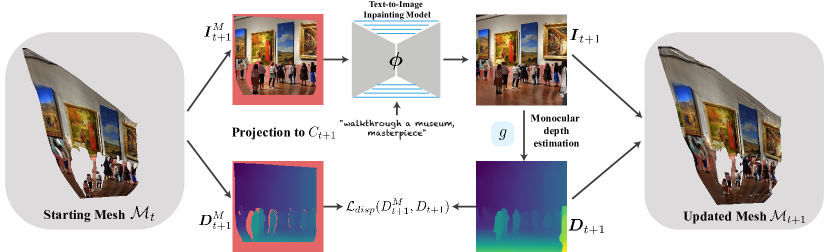
- Use a pre-trained text-to-image diffusion model to synthesize newly revealed content as the camera moves.
- Estimate geometry with a monocular depth predictor and enforce depth consistency through test-time finetuning (L_disp).
- Maintain a progressively updated unified triangle mesh M that represents the scene and is expanded with new content (unproj and merge).
- Perform test-time decoder finetuning of the inpainting model to preserve known content and prior content (L_dec).
- Render frames by projecting the mesh to the next view and inpainting border/occluded areas to avoid artifacts.
- Handle geometric artifacts by removing stretched triangles and inpainting border regions during rendering.
Experimental results
Research questions
- RQ1Can a text prompt plus a camera trajectory yield long-term, diverse, and 3D-consistent walkthrough videos without task-specific training?
- RQ2How can monocular depth priors and a unified mesh representation be used to enforce geometry consistency across frames in a zero-shot setting?
- RQ3What is the impact of depth finetuning and decoder finetuning on 3D consistency and visual quality?
- RQ4How does SceneScape perform relative to baselines in terms of 3D consistency, visual quality, and prompt adherence?
Key findings
- SceneScape produces high-quality, geometrically plausible walkthrough videos across diverse indoor scenes.
- Ablation shows depth finetuning and decoder finetuning significantly improve depth consistency and temporal coherence.
- Replacing the mesh with 2D warping degrades 3D reconstruction and metrics, highlighting the importance of the unified mesh.
- Compared to baselines, SceneScape outperforms in 3D-consistency metrics and user-perceived visual quality in AMT studies.
- CLIP-based prompt adherence is maintained at a competitive level while achieving strong 3D consistency.
Read this paper
Open the full text in the Nubint reader and ask about any passage as you read.
Read this paper on NubintThis review was generated by AI from the original paper. Please check the paper before citing it.