
[Paper Review] Schema-learning and rebinding as mechanisms of in-context learning and emergence
The paper shows that in-context learning (ICL) can be achieved with clone-structured causal graphs (CSCGs) and explains ICL mechanisms via schema learning, template circuits, retrieval, and rebinding, arguing for parallels with transformers.
In-context learning (ICL) is one of the most powerful and most unexpected capabilities to emerge in recent transformer-based large language models (LLMs). Yet the mechanisms that underlie it are poorly understood. In this paper, we demonstrate that comparable ICL capabilities can be acquired by an alternative sequence prediction learning method using clone-structured causal graphs (CSCGs). Moreover, a key property of CSCGs is that, unlike transformer-based LLMs, they are {\em interpretable}, which considerably simplifies the task of explaining how ICL works. Specifically, we show that it uses a combination of (a) learning template (schema) circuits for pattern completion, (b) retrieving relevant templates in a context-sensitive manner, and (c) rebinding of novel tokens to appropriate slots in the templates. We go on to marshall evidence for the hypothesis that similar mechanisms underlie ICL in LLMs. For example, we find that, with CSCGs as with LLMs, different capabilities emerge at different levels of overparameterization, suggesting that overparameterization helps in learning more complex template (schema) circuits. By showing how ICL can be achieved with small models and datasets, we open up a path to novel architectures, and take a vital step towards a more general understanding of the mechanics behind this important capability.
Motivation & Objective
- Explain how ICL can arise in a non-transformer sequence model (CSCGs) and how its mechanisms relate to transformers.
- Demonstrate learning of templates (schemas) and rebinding as core ICL processes.
- Show that overparameterization, schema formation, and context retrieval drive ICL and emergence across datasets.
Proposed method
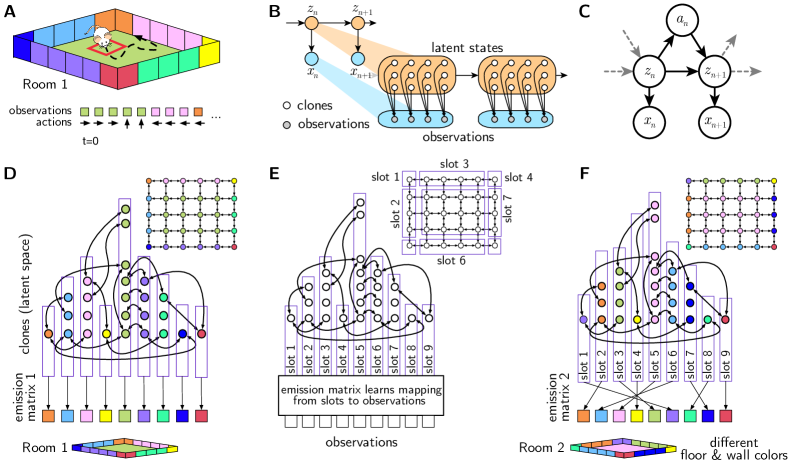
- Introduce clone-structured causal graphs (CSCGs) and their emission and transition structures.
- Define and implement rebinding to map existing schemas to new observations.
- Propose a fast rebinding algorithm that updates only the emission matrix based on prediction surprise.
- Demonstrate MAP inference and EM-based updates to retrieve and bind schemas for task completion.
- Relate CSCG mechanisms to ICL in transformers and discuss implications for architecture design.
Experimental results
Research questions
- RQ1Can CSCGs achieve ICL comparable to LLMs on standard ICL benchmarks?
- RQ2How do template circuits (schemas) and rebinding contribute to context-dependent generalization?
- RQ3What is the role of overparameterization in learning and emergent ICL capabilities?
- RQ4How can rebinding enable rapid transfer of learned algorithms to novel tokens and prompts?
- RQ5Do CSCG mechanisms generalize to tasks typically associated with transformer ICL, such as zero-shot learning and instruction-based retrieval?
Key findings
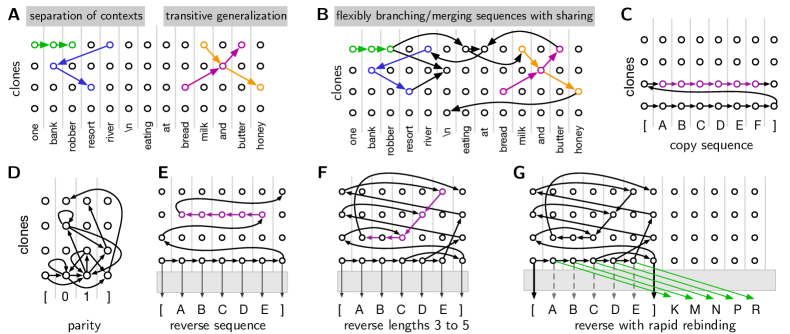
- CSCGs can reproduce ICL-like behavior with context-dependent latent representations and transitive generalization.
- Learning templates (schemas) and context-sensitive retrieval enable effective prompt completion and task execution.
- Rebinding of novel tokens to learned slots allows applying the same templates to entirely new inputs.
- Overparameterization enhances the separation of latent concepts and improves ICL performance across tasks.
- Experiments on GINC, LIALT, and a dax-style test support the proposed mechanism and show emergence linked to model capacity and data patterns.
Read this paper
Open the full text in the Nubint reader and ask about any passage as you read.
Read this paper on NubintThis review was generated by AI from the original paper. Please check the paper before citing it.