
[Paper Review] SciEval: A Multi-Level Large Language Model Evaluation Benchmark for Scientific Research
SciEval is a comprehensive, multi-level benchmark for evaluating scientific reasoning in large language models (LLMs), integrating objective and subjective questions across chemistry, physics, and biology. It introduces dynamic data generation to prevent data leakage and evaluates LLMs across four dimensions—basic knowledge, knowledge application, scientific calculation, and research ability—revealing that GPT-4 leads but significant gaps remain, especially in dynamic and experimental reasoning tasks.
Recently, there has been growing interest in using Large Language Models (LLMs) for scientific research. Numerous benchmarks have been proposed to evaluate the ability of LLMs for scientific research. However, current benchmarks are mostly based on pre-collected objective questions. This design suffers from data leakage problem and lacks the evaluation of subjective Q/A ability. In this paper, we propose SciEval, a comprehensive and multi-disciplinary evaluation benchmark to address these issues. Based on Bloom's taxonomy, SciEval covers four dimensions to systematically evaluate scientific research ability. In particular, we design a "dynamic" subset based on scientific principles to prevent evaluation from potential data leakage. Both objective and subjective questions are included in SciEval. These characteristics make SciEval a more effective benchmark for scientific research ability evaluation of LLMs. Comprehensive experiments on most advanced LLMs show that, although GPT-4 achieves SOTA performance compared to other LLMs, there is still substantial room for improvement, especially for dynamic questions. The codes and data are publicly available on https://github.com/OpenDFM/SciEval.
Motivation & Objective
- To address the limitations of existing benchmarks that rely solely on static, objective questions and suffer from data leakage.
- To develop a comprehensive evaluation framework that captures the full spectrum of scientific reasoning abilities in LLMs.
- To incorporate both objective and subjective questions, including experimental design and result analysis, to assess higher-order scientific thinking.
- To mitigate data leakage risks through dynamic data generation based on scientific principles.
- To provide a standardized, multi-disciplinary benchmark for evaluating state-of-the-art LLMs in real-world scientific research scenarios.
Proposed method
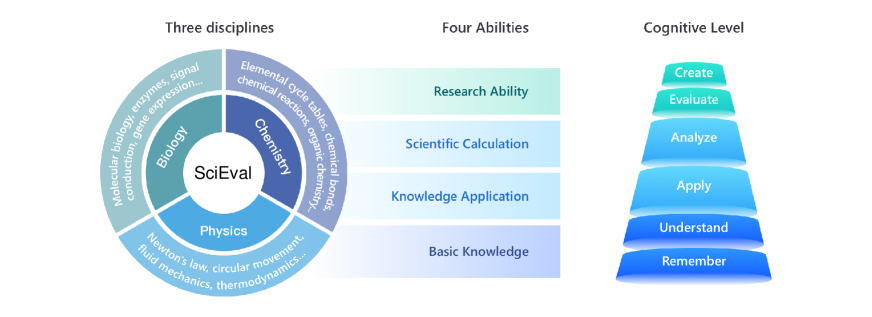
- SciEval is structured around Bloom’s taxonomy, evaluating LLMs across four cognitive dimensions: basic knowledge, knowledge application, scientific calculation, and research ability.
- The benchmark includes 15,901 questions across chemistry, physics, and biology, with 18,000 total questions including dynamic and static subsets.
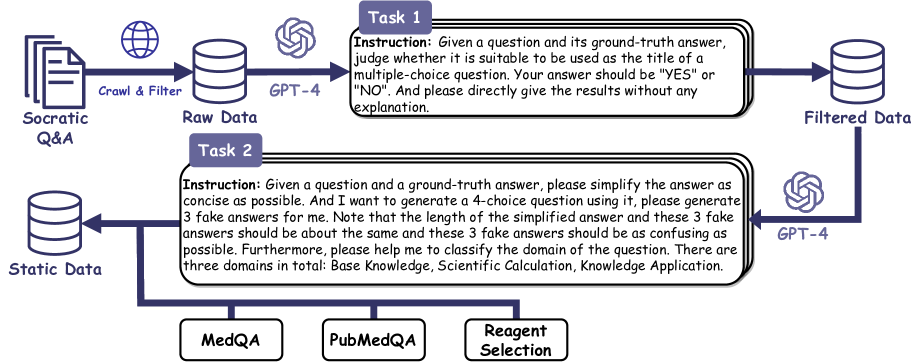
- Dynamic data is generated in real-time using scientific principles to prevent memorization and ensure evaluation fairness.
- The dataset includes a specialized 'Experimental Data' subset with 12 real scientific experiments, involving subjective reasoning on experimental design and result interpretation.
- Evaluation is conducted in three settings: answer-only, chain-of-thought (CoT), and few-shot (3-shot), enabling performance comparison across reasoning strategies.
- Performance is measured using accuracy, BLEU scores, and mean squared error (for calculation tasks), with results analyzed per domain and setting.
Experimental results
Research questions
- RQ1How do state-of-the-art LLMs perform on a multi-level, multi-disciplinary scientific benchmark that includes both objective and subjective questions?
- RQ2To what extent do LLMs exhibit data leakage when evaluated on static, pre-collected scientific questions?
- RQ3How do different reasoning strategies—answer-only, chain-of-thought, and few-shot—impact LLM performance on scientific reasoning tasks?
- RQ4How well do LLMs generalize to dynamic, principle-based scientific questions that prevent memorization?
- RQ5What are the specific weaknesses of LLMs in scientific calculation and experimental result analysis, particularly in physics and chemistry?
Key findings
- GPT-4 achieves state-of-the-art performance across all subsets, with the highest average accuracy and BLEU scores, especially in the 3-shot setting where it reaches 51.01% accuracy on Dynamic Data.
- Despite strong performance, GPT-4 frequently uses incorrect formulas in physics problems under CoT settings, indicating reasoning flaws despite high accuracy.
- Most LLMs, including GPT-3.5-turbo and Claude-v1.3, achieve less than 60% accuracy on Static Data, highlighting substantial room for improvement.
- In the physics subset, all models perform near-random on Dynamic Data, with accuracy below 25% for most, indicating poor generalization to novel physical problems.
- Models like Galactica-30B outperform others in scientific calculation tasks, particularly in chemistry, suggesting benefits from domain-specific pretraining.
- All models struggle significantly with experimental result analysis in the Experimental Data subset, despite decent performance on experimental design and principles.
Read this paper
Open the full text in the Nubint reader and ask about any passage as you read.
Read this paper on NubintThis review was generated by AI from the original paper. Please check the paper before citing it.