
[Paper Review] Score-based Diffusion Models in Function Space
This paper introduces Denoising Diffusion Operators (DDOs), a mathematically rigorous framework for training score-based diffusion models directly in function space, enabling generative modeling of continuous functional data. By formulating the forward process with a Gaussian process and the reverse process via function-valued Langevin dynamics, DDOs achieve resolution-invariant generation with fixed computational cost, validated on Navier-Stokes solutions, InSAR data, and MNIST-SDF with high-fidelity sampling.
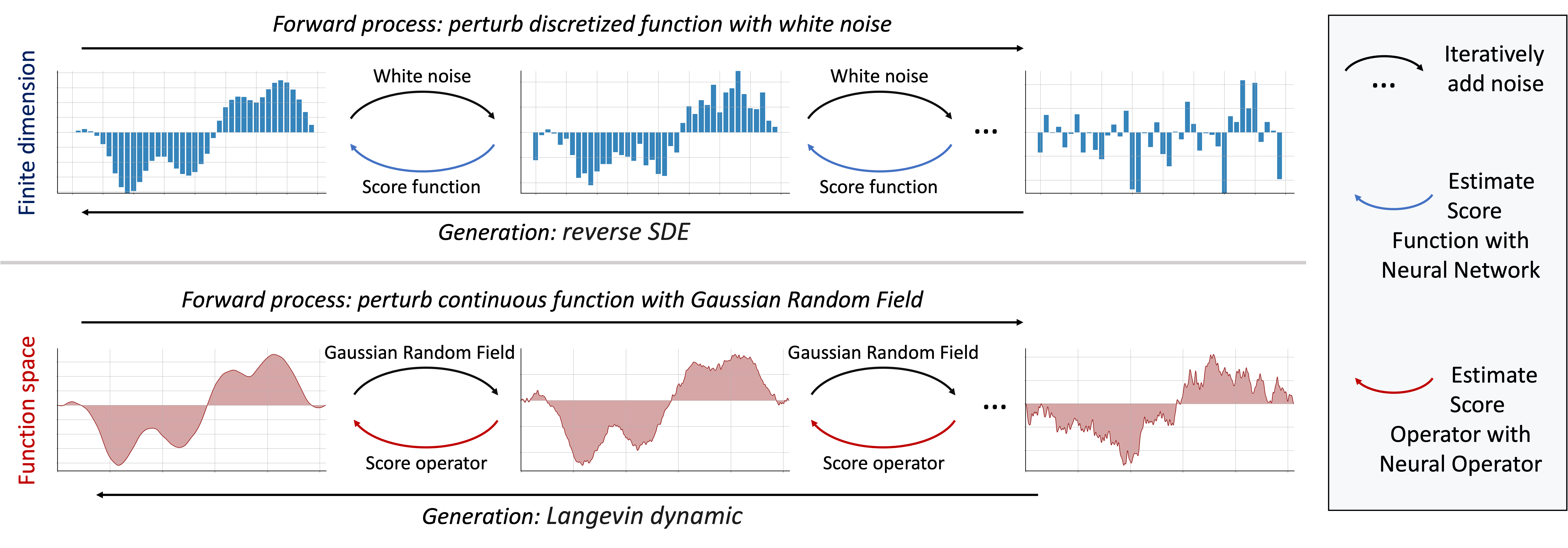
Diffusion models have recently emerged as a powerful framework for generative modeling. They consist of a forward process that perturbs input data with Gaussian white noise and a reverse process that learns a score function to generate samples by denoising. Despite their tremendous success, they are mostly formulated on finite-dimensional spaces, e.g., Euclidean, limiting their applications to many domains where the data has a functional form, such as in scientific computing and 3D geometric data analysis. This work introduces a mathematically rigorous framework called Denoising Diffusion Operators (DDOs) for training diffusion models in function space. In DDOs, the forward process perturbs input functions gradually using a Gaussian process. The generative process is formulated by a function-valued annealed Langevin dynamic. Our approach requires an appropriate notion of the score for the perturbed data distribution, which we obtain by generalizing denoising score matching to function spaces that can be infinite-dimensional. We show that the corresponding discretized algorithm generates accurate samples at a fixed cost independent of the data resolution. We theoretically and numerically verify the applicability of our approach on a set of function-valued problems, including generating solutions to the Navier-Stokes equation viewed as the push-forward distribution of forcings from a Gaussian Random Field (GRF), as well as volcano InSAR and MNIST-SDF.
Motivation & Objective
- To address the limitation of existing diffusion models that operate only on finite-dimensional spaces, restricting their use in functional data domains such as PDE solutions and 3D geometric data.
- To develop a theoretically sound framework for score-based diffusion models in infinite-dimensional function spaces, avoiding discretization-dependent or latent-space-based approximations.
- To enable efficient, resolution-invariant sampling by introducing structured noise and a novel function-space score matching approach.
Proposed method
- Formulates a forward diffusion process that perturbs input functions using a Gaussian process, replacing white noise with structured, spatially correlated noise to ensure stability across resolutions.
- Defines the reverse generative process as a function-valued Langevin dynamic, enabling iterative denoising in function space.
- Generalizes denoising score matching to infinite-dimensional Hilbert spaces, deriving a loss function that avoids singular measures and enables stable training.
- Employs spectral convolutions and Fourier-space normalization in a modified UNet architecture to build a neural operator that respects resolution invariance.
- Uses a convolutional construction of Gaussian measures via Fourier transforms to efficiently sample from the forward process on lattice-structured data.
- Applies a cosine noise schedule and sine blurring schedule to stabilize training and improve sample quality in function-space diffusion.
Experimental results
Research questions
- RQ1Can score-based diffusion models be rigorously extended to infinite-dimensional function spaces without relying on finite-dimensional discretizations or latent space mappings?
- RQ2How can a stable and resolution-invariant score matching objective be derived for probability measures on function spaces?
- RQ3What noise structure enables efficient learning in function space without increasing model capacity with resolution?
- RQ4How does the proposed method compare to existing approaches in terms of sample quality and generalization across different functional data types?
- RQ5Can the framework generate high-fidelity samples of complex functional data such as PDE solutions and signed distance functions?
Key findings
- The proposed DDO framework achieves resolution-invariant generation, with inference cost independent of data resolution, enabling scalable sampling on continuous functions.
- The method generates high-fidelity samples of Navier-Stokes solutions from Gaussian random field forcings, demonstrating accurate recovery of complex fluid dynamics.
- On the volcano InSAR dataset, DDOs produce realistic interferograms with fine spatial details, outperforming discretization-dependent baselines.
- For MNIST-SDF, the model generates sharp, diverse, and structurally accurate signed distance function representations of handwritten digits.
- The use of structured noise (via convolutional Gaussian measures) enables stable training and avoids the infinite loss issues seen in prior infinite-dimensional diffusion models.
- The spectral convolution and Fourier-space normalization in the UNet-based architecture ensure resolution invariance and improve generalization across different input grids.

Read this paper
Open the full text in the Nubint reader and ask about any passage as you read.
Read this paper on NubintThis review was generated by AI from the original paper. Please check the paper before citing it.