
[Paper Review] SDD-FIQA: Unsupervised Face Image Quality Assessment with Similarity Distribution Distance
SDD-FIQA proposes an unsupervised face image quality assessment method that leverages the Wasserstein distance between intra-class and inter-class similarity distributions as quality pseudo-labels, enabling accurate, label-free quality prediction. It outperforms state-of-the-art methods across multiple benchmarks and recognition models, demonstrating superior accuracy and generalization.
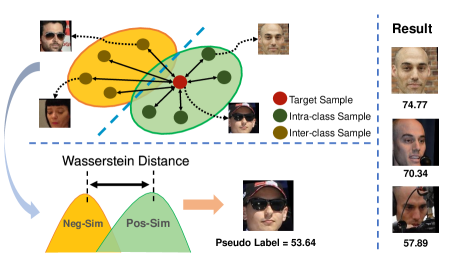
In recent years, Face Image Quality Assessment (FIQA) has become an indispensable part of the face recognition system to guarantee the stability and reliability of recognition performance in an unconstrained scenario. For this purpose, the FIQA method should consider both the intrinsic property and the recognizability of the face image. Most previous works aim to estimate the sample-wise embedding uncertainty or pair-wise similarity as the quality score, which only considers the information from partial intra-class. However, these methods ignore the valuable information from the inter-class, which is for estimating to the recognizability of face image. In this work, we argue that a high-quality face image should be similar to its intra-class samples and dissimilar to its inter-class samples. Thus, we propose a novel unsupervised FIQA method that incorporates Similarity Distribution Distance for Face Image Quality Assessment (SDD-FIQA). Our method generates quality pseudo-labels by calculating the Wasserstein Distance (WD) between the intra-class similarity distributions and inter-class similarity distributions. With these quality pseudo-labels, we are capable of training a regression network for quality prediction. Extensive experiments on benchmark datasets demonstrate that the proposed SDD-FIQA surpasses the state-of-the-arts by an impressive margin. Meanwhile, our method shows good generalization across different recognition systems.
Motivation & Objective
- Address the limitation of existing FIQA methods that focus only on intra-class similarity or embedding uncertainty, ignoring inter-class similarity critical for recognizability.
- Develop a label-free FIQA framework that directly links quality assessment to recognition performance by modeling both intra-class and inter-class similarity distributions.
- Improve generalization across diverse recognition models by evaluating the method on multiple models during training and testing.
- Establish a new paradigm for FIQA as a recognizability estimation problem, grounded in similarity distribution distance.
Proposed method
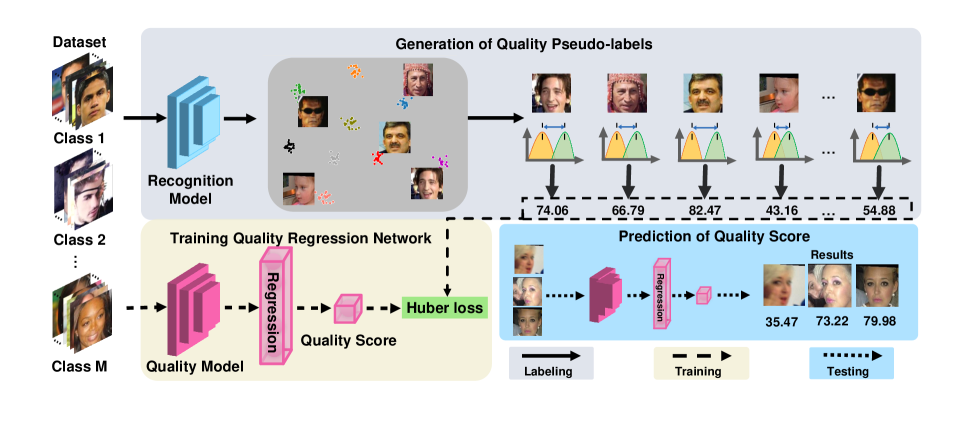
- Collect intra-class similarity (Pos-Sim) and inter-class similarity (Neg-Sim) distributions for each face image using a pre-trained recognition model.
- Compute the Wasserstein Distance (WD) between the Pos-Sim and Neg-Sim distributions as a quality pseudo-label, reflecting the separation between intra- and inter-class similarities.
- Train a regression network using Huber loss to predict quality scores from the pseudo-labels, enabling end-to-end learning without human-annotated quality labels.
- Optimize the method’s efficiency by introducing an O(n) implementation of the similarity distribution distance, reducing time complexity from O(n²).
- Use a fixed number of top-k nearest neighbors (K=12) and m similarity pairs (m=24) to balance accuracy and computational cost.
- Apply the framework across multiple recognition models (e.g., ResNet101-MSIM, ResNet101-CASIA) to evaluate generalization.
Experimental results
Research questions
- RQ1Can modeling both intra-class and inter-class similarity distributions improve face image quality assessment beyond methods relying only on intra-class information?
- RQ2How effective is the Wasserstein distance between similarity distributions as a proxy for face image quality in an unsupervised setting?
- RQ3Does the proposed method generalize well across different face recognition models and datasets?
- RQ4What is the impact of hyperparameters K (number of neighbors) and m (number of similarity pairs) on the method’s performance?
- RQ5How does the inclusion of inter-class similarity information compare to using only intra-class or only inter-class information in quality labeling?
Key findings
- SDD-FIQA achieves state-of-the-art performance on LFW, Adience, and IJB-C datasets, with an average AUC of 0.6898 at FMR=1e-2, surpassing previous methods including PCNet (0.6369).
- On the IJB-C dataset, SDD-FIQA achieves an AUC of 0.6768 at FMR=1e-2, outperforming the second-best method PCNet (0.6537).
- The method shows strong generalization: when tested with ResNet101-CASIA as the deployed model, it achieves 0.5790 AUC on Adience and 0.6768 on IJB-C, significantly outperforming learning-based baselines.
- Ablation studies confirm that using both intra-class and inter-class similarity distributions yields the best performance, with Pos-Only outperforming Neg-Only, and the full SDD-FIQA method achieving the highest AUC.
- Parametric studies show that AUC stabilizes and converges at K=12 and m=24, indicating robustness to hyperparameter choices within this range.
- The O(n) implementation of SDD reduces computational complexity from O(n²), enabling efficient deployment on large-scale datasets.
Read this paper
Open the full text in the Nubint reader and ask about any passage as you read.
Read this paper on NubintThis review was generated by AI from the original paper. Please check the paper before citing it.